Foreword by Ian Thompson, Editor
3D Printed Houses is a reality, it’s more than an experiment now, it’s a viable building system for innovative and forward thinking developers who want to embrace new construction technologies and more efficient practices. The world of 3D printing has expanded beyond just small trinkets and prototypes to now include entire houses. This innovative technology has the potential to be a mainstream construction method globally, offering faster and less resource demanding building practices. However, as with any building system there are both pros and cons to 3D printing houses.
One of the biggest advantages of 3D printing houses is the speed at which they can be built on flat sites. Traditional construction methods often take several months or even years to complete, while a 3D printer can construct a house’s envelope in a matter of days – as Matt’s video shows. This can significantly reduce the time and labour requirements associated with building homes, making it a potentially more affordable option for both builders and buyers if employed properly.
Another sales incentive is the ability to create unique and complex designs. 3D printers can produce intricate shapes and patterns that would be difficult and very expensive to achieve with traditional construction methods. This allows for more creative and personalized designs, giving homeowners the opportunity to customize their homes to their exact specifications. But please consider my advice that simple design is better, it’s cheaper, and utilizes space better for the homeowner.
In addition to the speed, reduced disruption, and design flexibility, 3D printing houses also offer environmental benefits. The technology uses less material waste which is a good sustainability consideration, but the retrofitting of services like electricity and plumbing is not as easy or as quick as timber construction.
3D printing companies are also experimenting with materials other than concrete which might present some promising opportunities for recycled material usage.
There are also some drawbacks to 3D printing houses. One of the biggest challenges at the moment is building a house with more than one or two levels, which may require further structural reinforcement depending on the design, which may defeat the speed and efficiency of 3D Printing.
Also, a company I met recently in New Zealand has invested heavily in a 3D Printing machine, but they are restricted to printing wall panels on site and then lifting into position which adds time, effort and cost. This I believe is because the council consents teams are not educated in 3D printing technology and want the printer to be considered a panel producer, not a building system. I may have misunderstood the usage restriction but that is what I recall from the conversation with the 3D printing company owner.
Despite these concerns, the future market for 3D printing houses looks promising in many countries. As the technology continues to improve and become more widely adopted, it has the potential to significantly disrupt the construction industry and offer a more sustainable and affordable option for home construction. Like everything, the more companies investing in the technology the faster the market will grow. But in my opinion designers need to design to the 3D printers strengths and not get carried away with curves and convoluted shapes.
Over to Matt Risinger’s post:
3D Printed Houses Entering Mass Production – 2023 Update
Introduction
Discover the future of home construction with 3D printed houses. These innovative dwellings feature load-bearing concrete walls, precision design, and a range of customizable floor plans. With durability, energy efficiency, and easy upgradeability at the forefront, these homes combine cutting-edge technology with traditional building practices. Experience spacious interiors, polished concrete floors, and smart design details that simplify installation for tradespeople. From the sloped exterior walls to the top plates and hollow cores, every element is thoughtfully engineered for long-lasting strength and aesthetic appeal. Step into the world of 3D printed houses and witness the convergence of innovation and practicality in home construction.
Video Transcript:
Check this out, y’all! This is super cool. Not only that, this house that I’m in is one of 99 other houses in a hundred-home community being printed here by ICON. This is a Lennar community in Georgetown, Texas, just north of Austin, Texas, where I live. Super cool! We’re gonna get into all the nerdy details today’s build show from this ICON Community. Let’s get going.
Alright, guys! Connor, Senior PM with ICON. Dude, this is a mind-blower. As a guy who’s been in construction his whole career but has done nothing but wood framing, this house behind me, the fact that it was printed, is crazy. And not only that, you’re printing the whole community. There are like seven printers on-site, right? Seven total. That’s right, more to come. So we’re bringing out as many as we can. Holy cow, this is the first one that you printed, though, and it is the furthest along in construction. That’s right. Why don’t we walk these guys through the kind of process and actually what it looks like?
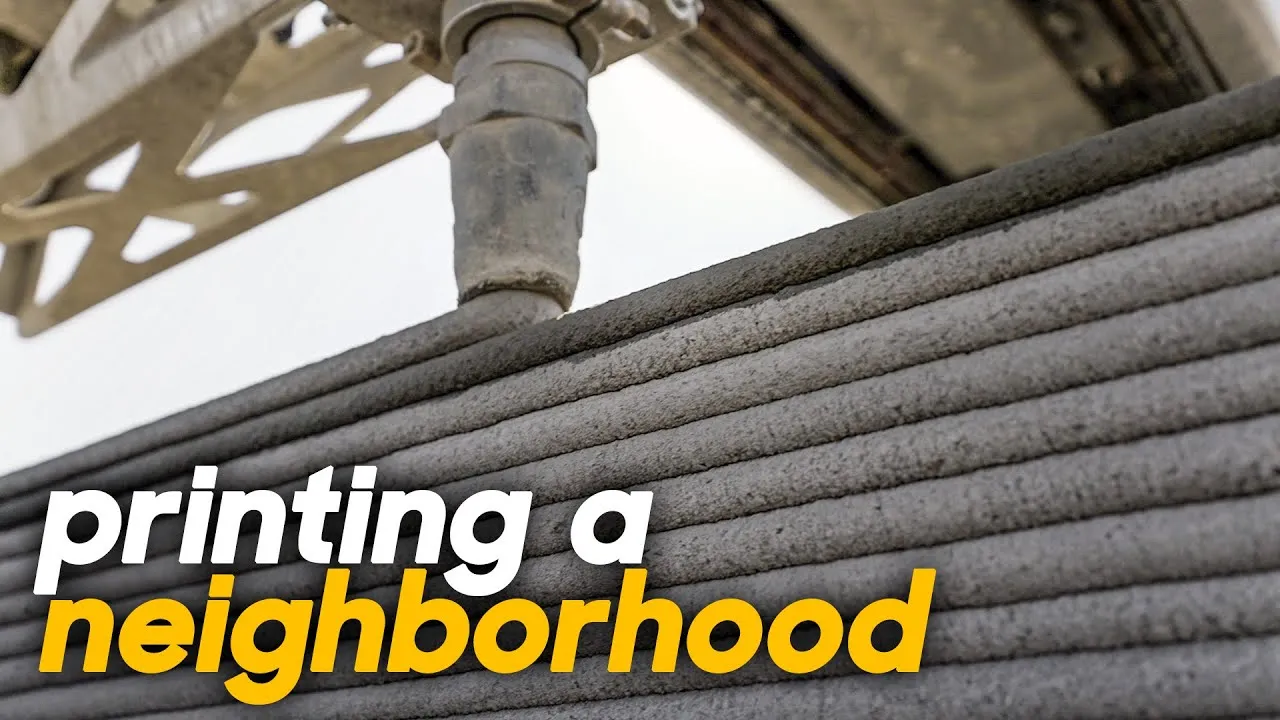
So first off, all these houses are single-story houses, right? Yep, so all these walls are load-bearing. No interior partitions, everything’s concrete. Everything’s concrete. Interior exterior walls are exterior walls are a little different than our interior. So we have three beads on our exterior walls and two on our interior. Got it. We also start at the slab and print on a slope around the perimeter of the slab, so this helps us with water egress. That’s smart. So you’ve got, like, a dry stone ledge, yeah, like a brick ledge, but we’re sloping it. That lets us print on it easier. I love it. That makes a lot of sense. So water were to migrate in there somehow, that’s right. It’s going to hit a backstop, plus it’s got some slope to migrate out. Yep, it hits the slope. We actually don’t have weeps, we don’t need them. Okay, but if water would migrate out in the very unlikely event that water got in our wall, sure, it would migrate out. And then garages are printed as well. And then am I seeing a steel header across there? It is a steel header, yep. It’s bearing the load. It’s a steel plate, it’s got a fin on top of it, and it bears the load of the beads above it, so it spans this whole opening. That’s wild. Yep, and then these walls on the outside, nothing’s going on top of these, right? Like, this is the finished concrete. We’re painting them. You’re going to paint them? Okay, I’m gonna paint them. No other finish, though? We want to show off the beads. Clients like them, we like them, so we’ll paint them so we can do different colors and things like that and add a little more moisture protection. But that’s really it.
And then where you’ve got punched openings, you know, you’ve got a front door here, it looks like you’ve put a pressure buck in, just like you would with an ICF house.
Continue Reading
That’s right, with a four-concrete wall, yeah. So the initiative right now is to get our wall system to a place that our trade partners are used to building around, right? So when you slap in your window, your exterior door, even your roof trusses, they’re really not doing anything different. And so the magic of printing with additive manufacturing is that we can design these jams however they need to be designed. So we’ve designed them to accept this buck so that the door will sit exactly in the plane that we want it to sit.
Got it. And this looks like just a regular 2×4 wall, basically, made out of pressure-treated. Did you put some special caulking or foam in to seal it here?
That’s it. And then I love how, what I’ve seen in the past, as you guys don’t do necessarily caulking on the outside for prettiness. I mean, one of the cool things about this wall is that it’s not perfect, right? That there are some imperfections.
And then when you walk in, the first thing I’m noticing is I don’t remember seeing these in past projects. You’ve got, like, a piece of U-shaped metal that’s almost acting like a little header for the electrical.
That’s right, that’s right. It’s what we call an electrical sleeve. So this is the first project we’re using it on. I like that it is designed to hold the weight. So as we print, cut out the gap for the opening, install this sleeve, it’s got little tabs in it to hold it in place, and then the electricians can come and install their metal rough-in box that they’ll attach MC to the back of.
MC cable, that’s right, which is a shielded cable, that’s right. And then they’re off to the races. And you’ll notice, I’ll speak to the benefits of the wall system. These are all pre-located, right? So your electrician isn’t spending a day with a tape measure and a pencil figuring out. They’re all done. All he knows is there’s an electrical right here, and then there’s probably a double-gang switch, and we’re good. Slap it in.
Now, how do they get the wires in there? Are these top plates open or are they closed or what’s going on with that?
Yeah, because our walls are so precision-made, our top plate needs to replicate that. For a couple of reasons. Number one, our top plates are acting as a reveal, so you’ll actually see a gap between the ceiling and our walls. We’ll paint it, but we want the ceiling, the architect, the Arc Ingles group wants that ceiling, and it is big design, and they want it to float over the walls. We want that top plate to replicate our wall. Now, the other reason is for what you’re speaking to. So we need the top plate on to install the trusses, so it’s bearing the weight of those trusses. And we need the metal roof on for the insulation. And so we’ve created this piece of blocking on the outside. There’s a gap that you can get into our wall, install all the MEP rough-in, the insulation, add the blocking, and then liquid flash it, and you’re good to go.
Gotcha. So these walls then haven’t been insulated yet. They’ll get insulated after the fact.
They have not, right? Because we’re looking at open air, and so we want to protect our insulation from the elements.
Got it. Okay. And it’s cool to see just a little bit of wood framing.
Yeah, so will there be some drywall on the inside of this house or not really?
The ceiling will be the only drywall.
Okay. Nowhere else, right? So even here, it’ll be your door trim. Just like the exterior, and what we do like, it’s minor details.
Yeah, I’m sorry. Yeah, that’s just a tiny little I’m lying to you. They’re excited.
Yeah, there’s drywall above the headers. We were playing with the material actually. We were looking at like MDF or other things, but we did land on a smooth coat of drama.
Yeah, don’t forget this is a production builder community. The house that I saw that you guys did at the home store was like one of the finest custom homes I’ve ever seen.
Yep, and yet it was 3D printed. And this is a little bit of the opposite in some respects. I mean, this is meant to be an affordable, everyman house.
Yeah, an affordable everyman house, but yet the durability, the strength, I mean, I feel like it’s through the roof on this house.
Yeah, it will be standing here for, you know, we hope over 100 years, many hundreds of years potentially.
Yeah, winds or tornadoes or all that stuff.
Yeah, that’s the hope.
Yeah, that’s pretty awesome.
Interesting to see the windows on this house being installed with a sill and then going up, so there’s really no header on, well, I guess that’s not true. You have an LVL header, so to speak, right? Because that LVL is bearing the weight of, for instance, in this bathroom, of those trusses.
Yeah, and really, the LVL is not there to bear the weight of the trusses, it’s actually because we have overhangs on the roof and front and back, and so it’s actually helping to stabilize the roof system.
I do like the overhangs, by the way. What are they on this house, three or four feet?
Maybe seven feet on the front, two feet on the sides, seven feet. That’s a big overhang.
Yeah, that’s nice. So it’s going to keep the walls dry, to begin with, it will. Good solar protection, right?
Yeah, but yeah, we take the windows up to the roofline. This is kind of that positive interplay between technology and traditional building, right? Because we don’t want to print over openings as much as possible. It kind of slows us down, but what that brings is a great design aesthetic, right? More sunlight, you get better views.
Um, yep, I like that. In all hundred homes, same floor plan in here or what? What’s the scoop?
Eight different floor plans, three variations each.
Okay, each are flipped, so that’s, you do the math, 48 different variations. So this is not just press print and it’s the same output every time.
Right now, to the printer, it doesn’t matter, it doesn’t matter, right? It’s the same thing. And so this is the magic of 3D printing, right? You get a lot of variation for no really extra effort, but it’s not besides the design on the front end.
Yeah, but once it’s input into the printer, it can roll. That’s pretty wild. And you guys call this Lava Creek. This is your proprietary Secret Sauce that you’re printing out. I love that you even use it for the island on this house. Is that what’s going on here? There’s a countertop going in.
Yeah, getting into Millwork. Yeah, we’re not just doing walls. We have a planter out front, we have kitchen islands, and so, really always looking at what we can replace in the home, right?
That’s pretty cool. What’s going on with the rest of the openings in the kitchen here? You’ve got this recess with a couple of Smurf tubes, yeah, and then maybe a recess behind the, what’s going on there?
Yeah, that’ll be the fridge. Yeah, we have a couple of openings in the wall. We call these our MEP openings, okay?
Right, so this is how we’re dropping in things like gas and plumbing and connecting them to the appliances or vanities or whatever it is that’s in the rest of the home.
Got it. Yeah, so the electrician or the low volt guy will just run a wire in there to the island, that’s right, or run a gas line, a flexible gas line, whatever. Well, a big initiative this project was getting all MEP in the walls, right? So in the past, we’ve played with electrical, but we’ve also often done wet walls in bathrooms and things like that, right? We didn’t want to do that anymore. And so to achieve that, you need to give plumbers and electricians somewhere to connect their lines. And so that’s what this is, and it’s going to be hidden, so you can kind of give them ample room. Again, really all about making the experience good, not just for the end user or the customer, right? But also our trade partners that are building out, yeah. So we want them to have room, we want these things to be pre-located, we want this to be easy, not harder, right?
Yeah, so smart. These are… I have to tell you, though, as I’m in the kitchen here, I have to think, what is the cabinet guy going to think who comes in here and he’s never seen this before and goes, “You want me to scribe my cabinet filler to that?”
Yeah, yeah, I’ll tell them, good news, you don’t describe, just put a flat piece in and go again.
That’s right, and we know what he’s going to think. We have invited them along the way, so they’ve been a part of the design process, a lot of feedback loops there, and so they’ll drop it in, and because this is a horizontal surface, it’ll actually be easy to talk to.
Right, the vertical surfaces are a little tougher, a little harder, but not on the horizontal, no, not until they stop, that’s right. Put in the countertop, caulk around, oh, they got a big deal.
Yeah, and there’s no backsplash tile needed in this case, right? That is your bag natural backsplash, however, they’re gonna have to use some Tapcon screws or whatever, whatever the no-name brand concrete, that’s right, that’s right.
Yeah, yeah, we will be using some concrete anchor screws, um, a couple approaches there. You can use the screw straight into the concrete, or you can use the anchor approach, yeah.
Um, yeah, and think from a cabinet perspective, from the cabinet guy’s perspective, they’re used to kind of wider tolerances. They have to come in and feel, measure, field measure often. In our application, the precision is really tight, right? So there’s a lot more fidelity around knowing what you need to build. So this can allow them to get way ahead in their supply chain, yeah, that makes a lot of sense. Real positive.
So, trust roof with some overhangs. I’d be worried about uplift. How do we make sure this roof doesn’t blow off, you know? If this roof was just sitting on there and the wind blows, it’s got a lot to pull it off. There’s got to be some kind of hold downs or something there. What do you guys do?
Yeah, I’ll even take you from the slab, okay, so once we start printing, we anchor in dowels, number five rebar dowels into our slab. 5/8 rebar, that’s beefy.
It’s beefy, it’s big. We print all the way up, and as we print, we print these what we call cores in our wall, so these vertical columns, okay?
I saw that, it’s like a U-shape. It’s a U-shape, right. And the beauty of that is just like we only use whatever material that we need, we also design no more or no less than we need. So those are precision plates in the wall, right around doors and windows, and spaced perfectly.
We print all the way, we drop the rest of the number five and thread that in with a coupler. Take all thread out of the top of the wall, slap on the top plate, tighten that down, roll the trusses, and then attach the soffit. So there’s 5/8 steel that’s running from the foundation all the way up top.
So I mean, that tells me that you guys could probably just beef those up if you were in an earthquake zone, and you could print these in California or somewhere on the West Coast too.
And we have, we’ve printed in earthquake zones in Central America, we’ve printed on the coast where there are high winds, we’ve printed in West Texas, right? We’ve printed all over, and so awesome. Our structural engineering consultants, like, do design to that, so yeah, it’s not theoretical. We know you’ve done it, yeah, that’s pretty cool.
Yeah, I see, I see a stone sill, like I’ve seen in the past from you guys. Are you guys putting these into to cover everything up and make complete that kind of concrete house look?
Yeah, it’s our finished sill product. That’s actually also made with Lava Creek.
Is it really? We built it, so it’s really gonna match. Yeah, that’s right. It’s a versatile material, yeah, it’s pretty awesome. Made some custom forms that we fill, and this house lives a lot larger than I would have expected for a Lennar project.
Yeah, our printers can print over 10 feet tall. So, where are we walking into now?
This is the primary suite, okay? So here’s your primary bedroom, primary closet.
I would just notice this is polished concrete too. It is polished, okay, so we’re just power wash off the dirt from construction, and you got a finished floor, that’s right.
We pre-polished, right? We wanted that polish to run under the wall. You can imagine if you wait till after you print, right? You’re gonna get these like weird finishes. Yeah, this looks great.
Yeah, and then bathroom over here, probably master bath, that’s right, primary back in the corner, yep, check it out.
Okay, so this time, now we’re not going to express, like I’ve seen in your house zero house, you guys just had concrete walls and in the shower, air, this recess is probably for your plumbing pipes, yep, so you can see the way it’s fully insulated behind, right?
Yeah, that’s right. And we, uh, you can see one of these MEP openings. This one’s just really tall, okay, right, so it allows you to drop your plumbing, not only for your shower head but for your valves, put your backer on, tile it, and you’re done.
That’s it. And we’re excited about this detail. It’s actually going to turn a 90, um, and we’re going to score it into our beads, so there’s a nice interplay there.
Oh, that’s pretty smart, so just take a concrete saw or a diamond blade, yeah, score it in, and then your tiles slip right in, yeah, yeah, yeah, yeah, that’ll look nice. I like that.
I’m excited about that. Yeah, and, uh, just a good builder detail, good job Lennar putting a recess in for the shower, that’s it. So if the pan ever leaks, there’s nothing to go wrong, it wouldn’t matter if the pan ever leaks, that’s right. I like that.
And then you get a recess for the tub, we do, we’ve got a little toilet room here, and we’ve got a little spot for a mirror and a vanity in here in the corner. Yep, this is really cool, man.
Yeah, all ceilings too, what are these, 10 feet? This is nice for mid-scale kind of residential, right? It’s a good height. We’re excited about it. This is really nice.
And that’s the reaction, right? Often is like, man, this feels so much bigger than the square footage shows. Yeah, you know, the other thing that really strikes me as we’ve been walking, this house would be super easy to upgrade, you know, 20, 30 years from now.
You want to come in here and remodel, you could really remodel that kitchen in one day. There’s no drywall to demo, the cabinets are wall-to-wall. You need to pull the electrical out because there’s some new standard or some new wire in 30 years from now, no big deal, right?
These windows, if you don’t like these windows someday, you want to upgrade to triple glaze or some custom window, boom, pop those out and put a new one in. You just have a little trim to take care of. There’s no stucco repair, there’s no brick to chip out. This house is super easy to upgrade.
And if you had a flood, you know, minus maybe some wood cabinets, there’s nothing to do. I doubt there’s any base molding going in, right? No base. And if these doors were wood doors with wood trim, hopefully they will be Lennar, you know, even if the flood waters came up to here, once they recessed, if this is solid wood in here, no big deal.
Yep, it’ll be just fine. And check this out, you’ve got concrete screws and every once in a while I see a shim in here, and boom, there’s your opening.
Yeah, that’s super easy. Slap it in, install the interior door, good to go. Yep, that’s really cool.
Yeah, Connor, what a cool house, man. I’d love to show you the other side of the top plate. Let’s go do it.
Yeah, it’s right here. Um, so we talked about how we’re installing the top plate, so you can see that this guy is CNC cut, labeled with the floor plan. Holy cow, check that out.
So that’s concrete contact rated. Um, this looks like one of my favorite materials. I know you guys don’t like to talk brands, but yeah, this looks like one of my show sponsors’ materials right here.
Yeah, you probably know it. Comment below if you know what this is. It is OSB subfloor. That’s awesome, rated for contact with concrete. And so we’re flipping the script a bit and put it on the top of the wall. That’s pretty awesome.
Yeah, so that’ll finish out. And did I see that there are some curves on there too in places?
Yeah, so like the wall where that wall ends, you’ve got a curved top on there.
That’s right, that’s pretty legit. The beauty of CNC machines, right? So talked about insulation. Then these walls are hollow, right? Because you actually have a three-ply wall. So then what happens in the hollow core?
Yep, in the hollow section of the wall, there is open-cell moisture-resistant foam. It’s a type of product they often use in CMU block if needed, right? It’s the kind that you pour in and it expands, shaving cream. It looks and smells like shaving cream.
Yeah, yeah, yeah, and then how about the roof line?
Yeah, I’m assuming it’ll be some type of open-cell or closed-cell cellulose in the roof. That’s Lennar’s. I don’t want to speak too much of that.
Yeah, yeah, but I would go ahead and close-cell or open-cell foam that, and you could have all your ductwork in the conditioned space as well.
Yeah, close-cell would be my preference, but not everybody can afford that, and you can get away with open-cell in this climate zone.
Yeah, and then back door too, same deal. You’ve got just a steel lintel there, and then you drop in the wood. Yep, this is so cool.
Yeah, this will be a big sliding glass door. And so you have your drop for your door to sit on, and we’ve poured around the wood bucks.
Could I see one of the printers going? Would that be something you’d allow me to film and leave you guys nicely, please? Pretty please?
Absolutely, let’s go see it, guys.
ER: What did they have to do to get this slab ready for you guys here?
Slab’s ready to go, yeah, and it’s in here. It’s normal construction tolerances, and Lennar has been great partners in delivering slabs within those tolerances.
So, meaning it doesn’t need to be absolutely perfect for you guys?
No, it can absolutely accept some tolerance variation there, gotcha. And they’ve done that very politically correct for the builders in the audience. They know that it’s not perfect, but it’s… it needs to be good within tolerance, right?
Within a tolerant spec, um… the new detail on this slab is a slope, right? Um, so this is just like kind of a standard brick lug that you, a builder may be used to. It’s the same concept, slightly different execution. We shift our homes around as a block, as a unit, right? And so to give us the ability to do that, we’ve built a slope so that we can shift. If you have just a ledge and you need to shift one direction, you’re going to fall off, and that’s going to cause… that inside wall could be anywhere along here, and it wouldn’t really matter, that’s right.
That’s right, but the outside wall… the point is, if water were to migrate through there somehow, it’s going to hit this and it’s got a, you know, quarter inch to a foot or so to slide on out, yeah, that’s really smart. It’s your belt and suspenders and I love wearing abilities, yarn and all that, yeah, you know, it gets down to the bottom, gets it out.
We also have a polish on it, you can see that, looks great. So, they polish it obviously, it makes sense to do it when there’s nothing in the way, whereas in the walls are up, it’d be a real pain to come and polish it. So, the polisher, in fact, I saw a guy over here when we were coming in, polishing, just has one big wide open slab, knocks it out probably in a couple hours, yeah, leaning into some efficiencies there, right?
It has some not-going-to-benefits too, like the slab is going to be the finished floor, so it gets under the wall also, it protects during construction, and then when you’re done, you do a quick touch-up polish and you’re good to go, yeah, it makes sense.
Let’s go see one of the burners, let’s do it.
ER, this is a huge privilege for me to be on the site while you guys are printing. Talk me through the details like the rail system I’m seeing here. I’m assuming this has to be pretty close to dead level, right?
Yeah, it does. And this is our current iteration of the rails that our printer works on. So, this floats outside of the slab, so we want to kind of free the slab up from the knee to support the system.
Okay, that makes sense. Yeah, and because of that, we go through some kind of stabilization efforts and then we align them with the laser to make sure that they are dead leveled, dead straight, dead real well.
Yep, and then the printer just rides in the rail system. And then I’ve seen different versions of this. This is a three-bead. Thank you. I think I’ve seen two in the past. Will you talk me through what’s happening here?
Yeah, we’re constantly playing with that, right? We can kind of design horses for horses. We can customize depending on the situation that we’re in. So, our standard typical wall system on an exterior wall is a three-bead wall system.
Okay, so you have a structural interior wall that’s a double-watt. That’s this guy, the double-watt, two-wise, two courses, just like in masonry, right? And then our veneer bead, that’s a single-watt on the outside of the home.
Okay, um, we reinforce that with number two rebar that lays along the bead. Um, on the interior and exterior, so those are all custom bent to match the shape of our wall.
What’s this happening here and here because I’m seeing the curve in the wall?
So, this is our typical core. So, we call this the core, it’s a vertical column. This is what we’ll print, install the number five dowel. We’ll print all the way up, drop the number five down.
So, if I looked in that hole there’d be a number five. It’s epoxied into the slab there, better be sticking up, and it’s threaded. So then, when it’s all done, I saw in that other one across the way, there’s a number five rebar that’s threaded, sticking up.
That’s right, and that’s gonna basically tie down the roof so it’s plenty windy today. Yeah, when that wind comes from the Georgetown, West Wind, it’s not gonna blow that roof off because it’s tied all the way back down. That’s right, that’s right. We’re sandwiching the walls with that.
And then, do you solid grout these later, or is that happening during the process?
Later. So, we make it all the way to the top, we drop our reinforcement in, and then actually Vulcan fills the cores as well. So, we use lava Creek to fill.
The grotto, Vulcan’s the name of your printer side, sorry, alright. Yeah, and how many printers do you have going on this site?
We have seven out here. Holy cow, that’s awesome. Yep, that’s just the start, we’re getting more. And then we’ll have future projects. And are you guys printing, like, on 24-hour shifts or what’s happening?
I wish. We’re still navigating relationships with municipalities, and yeah, we have neighbors, and we want to be respectful. Just during the day hours, but we’re maximizing our day hours, printing seven days a week out here.
But I bet it would be better for you guys, I suspect, in terms of productivity, to actually run all the time. Because once this machine gets going, you probably want it to maximize its efficiency.
Yeah, it’s not like the robot’s getting tired. The human does, but we can rotate the humans out, right? So think of it like a plane, right? Lift-off and landing is the hardest part. Once you’re flying, you want to kind of stay flying. We want to keep our printers flying.
Yeah, your fuel efficiency is best actually when you’re flying, not when you’re taking off. That’s right, or when you’re on the highway in your car, right? So we want to get rolling and then we want to keep rolling, right? We perform soft cleans as we go, but that’s the ideal state. And there are places we can do that, just not here.
The other thing that’s funny about construction is, you know, on most job sites, if we were building walls, there’d be nail guns and radios and saws. You’re… I don’t hear a sound from that printer, which is what, 10 feet behind me?
Yeah, I mean, I would suspect that besides some lights, that actually this process would be really quiet. And if you could get a municipality to go, “Oh, okay, no big deal at midnight,” they have a couple of job lights, and other than that, there’s not much noise.
Yeah, it really… it’s less about the mechanics. I’ve… I’ve actually written a decibel report for this job site myself. I took readings at different distances away from the slab, and we get to ambient noise levels pretty quick.
Yeah, so, so not loud at all. The line is… minus the wind today, sorry, guys. Yeah, yeah, you can hear us, okay. Yeah, so, so very… the technology is ready to work 24/7, yeah, we just need to convince folks to let us do it.
Talk to me about timelines. This house… uh, looks like I can probably tell that the first couple layers here have been printed. It’s noon time or so today, yeah. How long does it take to print one of these houses, and these aren’t small houses, by the way?
Yeah, averaging about 2,000 square feet. Um, before I answer the time question, it’s really important for me to address what we’re replacing, right? Because you have to kind of run that apples-to-apples comparison.
Sure, so we’re replacing the framing, of course, but also the exterior sheathing, the exterior veneer, the interior drywall. There’s no stucco crew here, no stucco, drywall, that’s right. So it’s all that.
So now that I’ve oriented your mind, that’s a big deal, we started around a three to four-week timeline on those. Our first few were trending down towards a two to three-week timeframe, something like that, for that wall system delivery. So you not only save on the time, but the coordination for the GC, right? They’re not having to call. That’s pretty awesome.
And if you could go 24 hours a day, I suspect that a house that’s 2,000 square feet like this could get printed in a couple of days, really?
Yeah, that’s the hope. If you’re going from Foundation to trade partners in the house too, that’s it. That’s it, right? It’s crazy. It’s framer, the tradespeople could all start right after that.
Yeah, that’s the hope. We can gain not just double the time, but a lot more time because you’re leaning into the efficiencies. So let’s embrace technology and let it do its job, right? So that’s the long-term goal.
So I got a random question. I suspect you get this question all the time. How do you hang a picture on these walls?
Oh man, I’ve never gotten that question, shockingly, no. Here’s what I like to say, Matt. You have a stud everywhere. It’s great. It’s 100% sheet. It’s like a plywood house, that’s it, man.
Yeah, so you can hang it wherever you want. Wherever you want, there’s not a single crappy drywall anchor anywhere that’s gonna pull out on this.
No, no, hang your TV wherever you want. It’s beautiful.
Yeah, so it’s very easy. Use a concrete screw if you want to move the picture rail. Is what I would say. Hey guys, you guys did a super slick picture rail on your… Yeah, your house I toured, that was the one house.
Yeah, house zero. Pretty awesome.
Yeah, picture rail, hang it. Yep.
So then, while this thing’s going, um, it looks to me like you just have one or two people here on site to tend to the robot, is that right?
Yeah, that’s it right now. Alright, we have a crew size of four people.
Okay.
Um, so one running Vulcan, one running Magma, which is our material delivery system. It’s what mixes the lava cream.
Okay, a QC tech that’s ensuring everything is per spec.
Yeah.
And then a site lead that’s running the site. Um, by the end of this year, we’ll be down to two or three, and then eventually we want to get down to one per site, and then less than one per site is amazing.
What about, uh, what about cracking? Like in the last house we were at, I saw maybe one floor crack, and that was it. And that was a post, these are post-tension slabs, uh, by Lenar, which is well regarded by production builders as a good slab to be more crack-resistant. Not crack-free, alright, but less cracks typically. But you don’t have post-tension here, and I haven’t seen any cracks really in any of your projects. Is that, and you probably, maybe I’m getting into too much proprietary here, but there’s probably some super plasticizers used in the concrete mix which help with that, and maybe there’s even some fiberglass, uh, rebar, not fiberglass rebar, fiberglass, what am I trying to say, embedment? I know you can’t see anything, there’s something going on here because these houses don’t have any cracks, including the one that Connor and I were just at. And I’ve seen houses now that are two or three or four years old at the Community First Village where I built some wood-frame houses, and y’all built some concrete houses. You all have some Secret Sauce going on here, you’ve perfected it.
I’m not at liberty talking about the, yeah, but what I will say is, as you know, you have a lot of smart engineers here.
Well, we have many people that are much smarter than I am that are scientists and have their doctorates and are designing this stuff. But also, concrete, like the way that cracking happens is how it cures, right?
Sure.
So there’s a lot of focus on that, both with our mixture, how we treat it after we print it, the kind of environments that we’re printing in, and so we pay a lot of attention to that, right? Like how we mix it, the time of day, how that mix responds to the time of day, right? And so we want to mix it so that when we lay that bead down, it cures appropriately and so it’s strong and it’s resistant to cracking. That’s the hope.
And now the way we do that, I mean your QC is incredible, it’s pretty wild. Appreciate that.
We’ve worked hard. Anything I missed on this particular foundation? It’s interesting to see. This is a whole different floor plan. The last house we were just at, isn’t it?
Yeah, one of eight. This is one of eight floor plans, a completely different one.
Yeah, so we have, we have, you know, three different elevations per and they all flip, so you get up to 48 pretty quick. But, um, yeah, no, you can see our reinforcements kind of staged and ready to go. Our site lead is misting the walls to make sure they kind of cure slowly over time. That’s pretty cool.
Um, I suspect that people will be touring this neighborhood in 50 years and saying, this is one of the first full neighborhoods of concrete 3D printed houses that Icon did.
That’s right. And now they’re in every state of the union and or a hundred countries around the world, building a hundred thousand houses a day. Who knows what will happen someday? They’re naming my dream match. I really, really appreciated.
I know that you guys have somewhere on-site a very iconic personality, the founder, the guy that always wears the cowboy hat, Jason. Is somewhere over here, so I’m gonna go see if I can find Jason.
I bet you’ll find him around. Appreciate your help, man. Thanks for the tour. Absolutely.
“Guys, Jason, the CEO! Jason, last time I saw you was at the House Zero, which was super sick. But here, you don’t just have a house, you have a hundred houses. That’s the idea. This is where we, like, really grow up and, you know, it’s fun to do the sort of show houses and the showpieces, but really, the company was started to solve the global housing crisis. And so we want to be able to do fantastic things, but we need to be able to do fantastic things at scale. And this is where we’re learning to do them at scale.”
“Dang, Jason, this is crazy! I mean, from here, you might could jump to ten thousand houses or fifty thousand houses. You know, the funny thing is, I think it actually is harder, probably, to go from one to a hundred.”
“Yeah, because if we can do 100, it’s not hard to imagine 200. And if you can do 100, you can do 500. And I think that’s exactly right. And that’s sort of the inherent scalability of software, robots, and the things that we work with. I think that’s exactly right. It’s harder to make the first one work than to make the 75th one work.”
“Okay, so since I’ve seen you, Jason, you’ve gotten contracts with NASA, you’ve got contracts for the Army. I’m sure you can’t even tell me all the details of those. But I suspect if the Army’s talking to you and NASA wants to be able to print houses someday, maybe even on another planet, we’re… You’re probably interested in reducing the amount of labor that it takes.”
“Yeah, you know, you’ve got quite a few Icon people on site. Is there some thought to… I’m sure there has been… How many people it would take to operate a printer, either today or in the future?”
“Yeah, that’s a great question. So, like, even though we have a lot of innovation at Icon and a lot of, like, really fun fancy things going on, at the end of the day, building is still, like, materials and labor. And so we’ve tried to, like, simplify our material supply chain and make the material that we work with as affordable as possible. And then it’s about reducing and removing and optimizing labor from that point. So right now, on a standard day here, out on this project, we’re running like 4-5 people per print rig. I think by the end of the year, we’ll be on the order of two to three. And then in the next couple of years, our goal is to be sub one human per printer. And so, like, one human overseeing, like, multiple robots that are doing most of the building. So that’s the idea. And so, like, if you can simplify your material supply chain, drive down the cost of that material, and then come very close to removing labor altogether, I think all of a sudden you get, like, very fantastic architecture for fractions of the price.”
“And not only that, the resilience. I mean, I’ve traveled around the world and seen how other people build. And we’re very wood-oriented in North America. We’re blessed with amazing timber resources. But lots of parts of the world, like when I was in Haiti and the Dominican Republic, they’ve got these local block-making facilities, and all their houses are concrete. I could be anywhere in the world right now in this masonry building.”
“Yeah, I actually… You know, and I love wood. I don’t want to sort of knock on wood orwhatever. In fact, House Zero that you’re in prominently featured wood. I’m a big fan of drywall, not allowed. On the resilience factor, you’re exactly right. These homes exceed building code in terms of structural integrity by 350 percent. We exceed energy code by about 250. And that’s sort of standard.”
“Right, like you don’t have to pay up to get those things special going. So, I think that kind of building should become default. It should become standard, and we should be building this way as commonplace. And perhaps wood. Uh, wood is a primary building material should become sort of like more specialized, uh, and site-specific building material. And you’re using it in this case where it makes sense, right? This truss roof, which trusses, by the way, are a great use of wood because we’ve engineered it, we’ve thought about it, even LVL beams and Advantec top plates. Uh, you’ve used wood the way it should be used, which is a precious resource. Use it wisely, correct? That’s exactly right. That’s pretty wild.”
“Yeah, but the structure of the home, right? Like, you sort of want it to be inherently non-palatable to termites, you want it to inherently not grow mold, you want it to inherently be windproof, waterproof, these sorts of things. But with wood, as lovely as it is, I think that’s the… And it has good tensile strength, but it naturally wants to catch fire. It’s actually a conductor of heat. So, you’re having to work against the natural properties of the material when you use it as an infrastructure material. And so, yeah, we think it should be used more as an accent or when it’s… Like a ceiling and a roof is a great… Where there’s a lot of tensile loads, right? And all of a sudden, it really comes into… It comes into its strengths.”
“You know, the other thing that I thought about too as you were saying that was, you know, this would be a pretty flood-proof home. If we had flood waters up to here, when those flood waters receded, there’d really be nothing to do here. Over there, what we say is like, yeah, you probably replace the floor and the furniture, but like the bones of the home, in terms of how soon can your family move back in and get back to work? Very quick. I mean, I grew up on the Gulf Coast, I think you know that. My hometown has been destroyed by hurricanes like half a dozen times in my lifetime, including the home I grew up in. My family just finally had to abandon because it had gotten like seven feet of water in the house. And so, like, I have, like, sort of lived through, like, my family spending the holidays in FEMA trailers, and yeah, yeah, and like every day, and then we’d put it back together with drywall, right? And like, you know, that moisture-sensitive product ever invented. My joke that you’ve heard me make is like, if I offered a million-dollar prize to invent a less resilient material that would pass building codes, nobody would ever claim the prize, because drywall already won the prize for, like, the worst thing we can build with.”
“I mean, and speaking of the worst, we’re in a neighborhood that’s north of town and there’s neighborhoods around here being built by other builders that literally have cardboard sheathing on two by fours. Yeah, and then you compare that with this neighborhood being built by Lennar, which is a very large builder. I mean, this is about as resilient of a house as you can potentially buy anywhere in America today. No, that’s right. And they’re going to have standing seam metal roofs, they’re going to all have solar power. 350% stronger than necessary, 250% more energy-efficient than necessary. And they’ll be in the same price point. That’s crazy. Prices like the sort of the proof point is like not only can we do this at scale, but like the kind of house you get at any price point that we’re working at is just much more… The word we like to use is like dignity. It’s like housing with dignity.”
“So, I mean, I used to work for one of the big national builders. I’m shocked if all 100 top builders in America haven’t called you, Jason, to try and get you… You know, on one of their projects. We’re definitely trying to make believers out of people, right? I mean, builders do things the way they do for a good reason, not because they’re wicked people. Because it has worked, it continues to work, and there’s demand for it. And so, you have to create these embodied arguments for why we can and should do things a different way. And so, I think I hope one day this neighborhood is very famous, that like maybe they’ll do school trips here one day and go, ‘Hey, kids, this is the very… This was the first neighborhood ever built by robots.’ And so, um, and I hope more people will become believers as they say as they see design proof points like House Zero, as they see sort of scaled housing product proof points like with this Wolf Ranch project with Lennar. I think this is just still the beginning of the revolution.”
“I love it, Jason. Last question for you, this is a hard one. Talk to me about your thoughts after seeing this all these years on the wabi-sabi, the imperfectness. Because if you look at it with squinty eyes, it looks absolutely perfect. But yet, if you were to go in any particular spot, you might see some slight imperfections somewhere. You know, you’ve had House Zero open to the public now, for the home store and a bunch of other reasons. What feedback do you have? And you, in the other community I visited, you had, I don’t know, a dozen houses maybe. Now that you’ve got a hundred, what do you think the public’s going to say about this? No drywall, no, like, ‘Oh, this little piece here needs a little touch of drywall touch.’ Yeah, we’ve had a few thousand people through House Zero, which is the house that we had that more people have seen up close and in person than any other. The print quality on that house is even lower accuracy than on this house. Yeah, um, so that bothered me a lot. But the universal feedback we’ve got from the folks… Like, the house is incredible. Um, same here, like, the Lennar board of directors, the Lennar exec team, the little armor there, everybody’s been here, everybody loves it. And so, it turns out, I think I like… I’m our biggest critic. What I say is like, that’s great. If people love it, then I should do it on purpose. Yeah. My goal is ultimately that the printer doesn’t do anything that we didn’t plan for it to do. In the meantime, I think it’s… It’s our good luck that people like the sort of the live material feel of it. So, live material, there you go. Yeah, yeah. It’s… It almost feels like a natural or a man-made material, even if it’s printed. That’s right. The words that people have used who have… We’ve had a lot of people stay in House Zero… Um, are like, uh, cozy in the way like a cave might have been cozy to our ancestors, right? And it’snot so much like a fortress. It feels alive, it feels warm, and we’re pleased with that because it matters. Not just that it’s faster and more affordable, it matters that these are the best houses you can possibly buy and live in. And part of that is the experience of living in them. So, we take that super seriously.”
“That’s unbelievable. Yeah, hey, I’m sorry, I didn’t think of one other question. Okay, hey, tell me about price points in this neighborhood. Like, these houses aren’t quite for sale yet, but they will be. I’m hoping that Lennar gets a ridiculous amount of, like, Taylor Swift-style inquiries when these houses go on the market. That they can’t even believe the demand. So that they go to you guys and say, ‘Hey, let’s do 10,000 of these next year.’ Can you give me any idea where they’re going to land prices? So, it’s sort of Lennar’s news to deliver, but what I’ll say is they’ll be priced exactly like other Lennars, okay? I’m surprised in Georgetown that are new go for about a half a million dollars-ish. I don’t know where they’re gonna go. There’ll be some cheaper. My guess is they’re going to be somewhere in that range. You got it pretty darn affordable. It’s… It’s underneath the conforming loan, that’s right. They are going to be below, like, sort of a mortgage. And certainly more affordable than you would usually for a house with standing seam metal roofs, world-class architecture, solar panels. I mean, so they can take a five-foot flood. Yeah, probably. I don’t know for sure, probably a Category Five. You know, a tornado could hit over here. I bet these houses would look pretty damn good. That’s exactly… I don’t think their houses this good, this affordably anywhere else on the planet, in the whole world, for this price. Correct.”
“Jason, so good to see you, man. Keep killing it. Thanks, man. Look forward to seeing you again.”
“I literally feel like I got a peek into the future, like I took a time travel machine and got to see how houses of the future were being built. This is a groundbreaking subdivision here outside of Austin. If you’re interested in these houses, I think they’re going to be for sale pretty soon. I’ll put a link to iconbuild.com, which is Icon’s website. You can learn more at that website. Go follow these guys on Instagram too, super cool company. Everyone I’ve met with them, just top-notch people. And to see this thing printing these houses here, my hope is that we’re going to see this all across the U.S., in fact, all across the world. Because this is an incredible way to build with serious durability, with built-in fire resistance, with built-in flood resistance, and natural disaster resiliency. I mean, this is a really, really cool groundbreaking community. I suspect my grandchildren are going to drive by this in 50 years and go, ‘Yeah, Granddad got to film out there with these guys when this was under construction. We actually got to see them printing them. And now they’re printing them all over the world, and maybe even on some other worlds as well.'”
“Guys, if you’re not currently a subscriber, hit that subscribe button below. You know, we’ve got new content every Tuesday and every Friday. I better get out of here. Follow me on Twitter, Tick Tock. Otherwise, we’ll see you next time on the Build Show.”