Foreword by Ian Thompson, Editor
What is a CLT House? That’s a question I get asked regularly. CLT Houses are the past, present, and future. Did you know that engineered timber has been used in construction in many European countries for decades? Cross laminated timber, or CLT, is still new to many countries. While some states in the USA have successfully built many multi-story buildings with CLT and Glulam, there are now a few mass timber manufacturers who are starting to rejig their premises to accommodate residential builds. This is great news for new build consumers who are concerned about rising energy costs, as mass timber homes have been shown to provide many benefits over traditional stick builds.
Despite this, there is still a reluctance among many builders to embrace the change. Many builders prefer to stick with what they know, which means progress in countries like New Zealand, Australia and the USA has been slow. However, more informed consumers are starting to demand sustainable and healthier material usage, as well as off-site manufacturing techniques to build quicker and increase build quality. This shift has caused more pioneering builders to adopt mass timber homes and become increasingly busy. A colleague of ours in Australia who is building with European made CLT panels has forward orders for the next three years already.
What’s interesting is that mass timber builders are finding that quicker builds with fewer resources enable them to build more homes each year, also realising increased profits. This is something they may not want to tell their competitors about!
The benefits of mass timber homes are clear: reduced build times, less site disruption, higher quality and more sustainable homes, and lower costs if managed properly.
For me this is a very interesting video because I like a lot of the features that the designers and builder have adopted. It may not be your cup of tea, but it is an option that reaps many benefits over stick builds if managed properly. Check out this video by Matt Risinger to learn more about the features that designers and builders have adopted.
CLT House – Zero Drywall and a Cork Shower!
Introduction
Join Matt Risinger and Greg Esparza, back at the remarkable cork insulation house. In case you missed our previous video, we showcased the incredible facade of this place. But today, we’re taking you inside. Brace yourselves because we’re about to give you an exclusive tour of this captivating CLT (Cross-Laminated Timber) house. From its structural wood walls to its unique design, this house is a true marvel. And that’s not all—did you know it’s a carbon-sequestering home? Join us as we explore the stunning features and sustainable aspects of this extraordinary abode. Trust us, you won’t want to miss it. So, without further ado, let’s step inside!
Video Transcript:
What’s up, guys? I’m Matt Reisinger, and I’m Greg Esparza, and we are back at the cork insulation house. If you didn’t see our video, we made a whole video on this really cool facade. But Greg, we haven’t been inside yet. We’ve got a CLT house. Will you give us a tour?
Absolutely, come on in.
Greg, this is super cool. We’ve got an all-wood house. I like this.
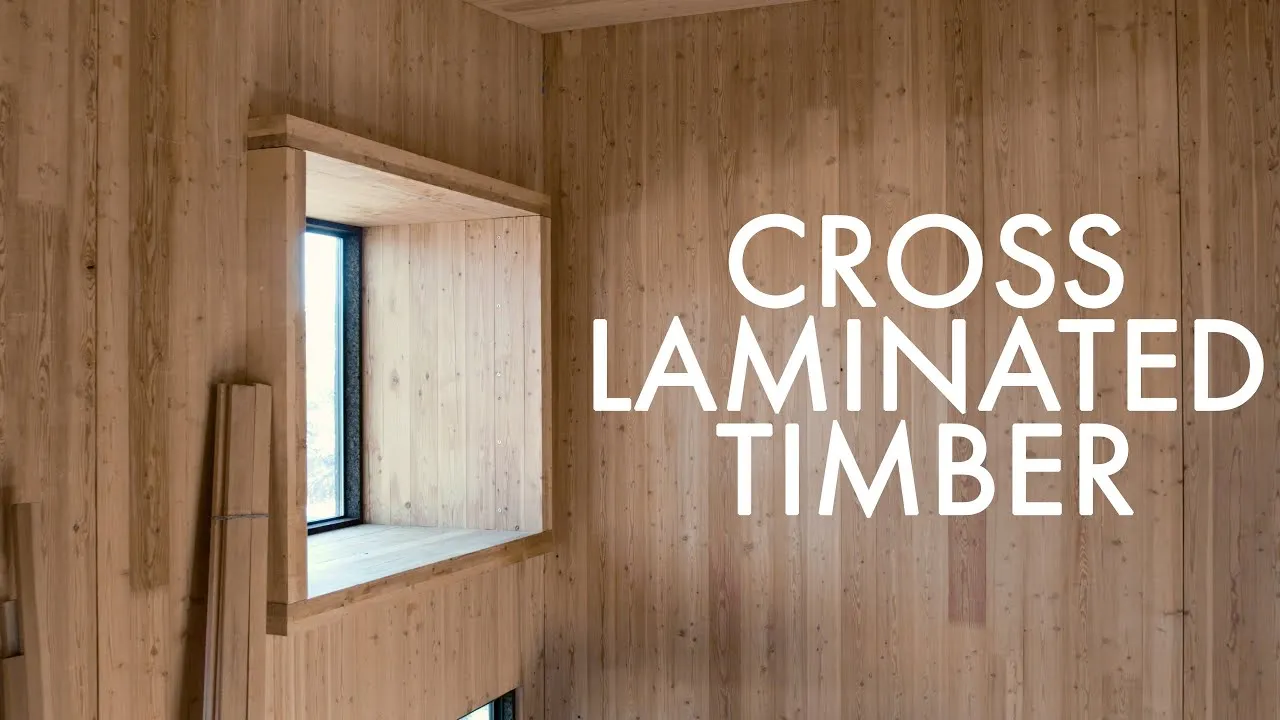
Yeah, I love it. Um, so again, like we were talking about in the last video, what can we do with plants? What can we do with plant-based materials that are carbon-sequestering? Cross-laminated Timber, or CLT, has been a material that’s been getting a whole lot of press lately for that ability to store carbon but also do really fantastic things structurally while also being just a totally beautiful material. And so, everything we’re seeing here is a structural wood.
Right, this isn’t ship lap over drywall and studs. This is actually a thick wood panel. You can actually see the profile right there on that piece, right?
Absolutely, yeah. So, these walls are the structure, the final finish, and then also the substrate for applying our continuous air and water controllers.
Okay, and cross-laminated meaning this piece of wood is running one way, the next piece of wood is running another, almost like a thick plywood, right?
Yeah, and then this is all glued together in the factory, correct, and ships out on big panels?
Yes, so this whole house is about 50 panels in three different thicknesses. One’s three and a half inches thick, one’s about four and eight inches thick, and then the other one’s five and a half inches thick.
Okay, but those 50 pieces all came cut to site with very specific labels that corresponded to our assembly drawings, and we were able to put everything in place and get everything dried in in 10 business days.
Continue Reading
Oh my gosh, and nothing needed to get cut. Holy cow, everything just fit together just like you would want it to, like an ideal furniture assembly, like out of the box kind of world. That’s pretty wild.
Yeah, and what are the spans that we’re seeing here? Like, there are no interior supports, that doesn’t appear to me, so you must be spanning from side to side continuously, right?
Yeah, so when we started working on the design for this, and I was looking at the CLT span tables, I was like, ‘Wow, like I can use a 5-layer of 5-ply CLT and span it about 18 feet for a floor, and then I can take a roof panel, a 3-layer, a 3-ply CLT, and span it about 18 feet for a roof.’
Okay, and so for a house like this, about a thousand square feet, that’s a really usable, a really great span as kind of like the starting point for the design. Um, so yeah, we started with these 18-foot spans from grid line to grid line, and then we were able to use the roof panels and be like, ‘Okay, well, we can actually cantilever these roof panels out towards the West, so that’s the Western, you know, Sun.’ So, these panels are about 23 and a half feet long, totally continuous. And then the floor panel, we were able to cantilever these out about four feet to create this kind of entry and what’s going to be kind of a day bed sitting area over there.
Awesome. Now, this is interesting in that the house doesn’t have overhangs, and it appears that your walls, your floor, your roof are all pretty similar. It feels to me like this might be a little bit of a perfect wall from Joe Steve brick style.
Yeah, so I mean, we’ve been doing projects in Austin for 12 years. That’s awesome. So, there’s a ton of learning you get from building all sorts of houses, doing remodels, and one of the projects that I came across, you know, in addition to a lot of the other great videos, is your perfect wall house, which I think you know, built five plus years ago, and it’s actually about a mile away from here, too far. But that was the first house I went through. I was like, ‘Oh, like wow, maybe the house doesn’t need to have drywall.’ It’s like, ‘Oh, like there’s a lot of benefits to having all of your services accessible.’ Because as contractors, we’re very used to, like, ‘Okay, well, we need to come back in. We need to cut in your drywall. We need to deal with some insulation to get to your electrical, to get to your plumbing, to get to your mechanical.’ And I was like, with this being a structural wall, everything’s exposed.
Yeah, it forces you into this kind of perfect wall kind of concept or perfect approach to an enclosure. Um, where it’s like, okay, here’s your structure, and then we’ve got a continuous air and water control there. So, I mean, that’s what we’ve got over here. Um, so like using these Vapor open, like self-adhered, thanks man, yep. Um, uh, Vapor open self-adhered, uh, air barrier and water-resistant barrier. So, this appealing’s thick, yeah, and this is about 50 perms, okay, so it’s high perm, and wood is obviously, uh, breathable, which I hate that term, I shouldn’t use that, but yeah, meaning moisture can flow in and out of it, it can absorb moisture, uh, and so by having a membrane out there that can move that moisture, you’ve got basically a vapor-open assembly here, yeah.
And so the big deal with this is like these wood panels, when they come out to site, it’s like they are wrapped, but you’re expecting them to get wet, like when we put this together, like there was a maybe eight-inch, like, rain, like there was a huge downpour when this all went together, wow. So, you know, like you always say, and all the great building science today, like, it’s stuff can get wet as long as there’s a way for it to dry out. So, this kind of high perm vapor-open approach, which, uh, you know, Vapor Shield’s got that mass Timber design guide over there, that’s a great resource for dealing with these enclosures, is a big, you know, sort of a big part of that. And then we got our cork, you know, we got our two inches of cork as continuous insulation on the outside.
And ultimately, the house is pretty straightforward. I mean, you’ve got a CLT floor, and when I was looking under your crawl space earlier, it looks to me like you just have a couple steel piles on just the perimeter. There’s nothing in the center here, so you’ve really minimized, uh, both your cost and your impact, probably reduced the amount of concrete you’re using too, I suspect. And then this floor panel went in, the wall panels went in, and then the ceiling dropped on top of it. Everything’s wrapped in vapor shield, and then your cork insulation outboard of that means that you’ve got a ton of mass here with the wood and the cork that once it gets the temperature, it’s going to want to stay at that temperature.
Absolutely, and we’ve seen that already without having the mechanical system fired up. Um, so you know, there was a day about a month ago where it was 45 degrees outside, and it had been colder overnight, so we’d get in here for work at 8 A.M. Um, and it was on the, you know, kind of a little thermometer humidity sensor we have up there, it was 68 degrees in here, yeah. Um, so a lot like a dope, you know, kind of an adobe house, like the wood has a lot of thermal mass, but there’s also this thermal diffusivity kind of property where, um, yeah, the heat is just acting as like a big heat sponge. Um, so it’s releasing heat slowly, and it just takes a long time for it to cool off or heat up, which is really kind of beneficial for, you know, just your comfort living in the house.
That’s awesome. And then this is the kitchen, I’m assuming, which is the only place I’m seeing the whole house that has stick framing, but you’ve got, you know, kind of traditional electrical in that space. But what I like about this is if this kitchen were to come out, there’s no drywall.
Yeah, and in fact, my perfect wall house got a remodel, and there was no drywall, no issues with accessing everything. Do you mind if we walk back, and we’ll show these guys some of the Mechanicals? I think it’s interesting how, number one, it’s super easy to heat and cool a place like this. You just have one two-ton carrier VRF system. You’ve got a good April air pleated media filter in there, so now we’ve got, you know, let’s say a Merv 15 potentially. You’ve got a VRF upflow that’s going to heat and cool the whole space. It’s one big open space, really straightforward, also pretty darn cost-effective.
Absolutely, like, so I mean, with, you know, with mechanical design, like what I’ve learned from, you know, our friends over at Positive Energy, is, you know, distribution is critical, and you really want to be kind of conscious about, like, your ductwork. You really want to do high-quality ductwork and high, you know, high-quality ductwork, you know, costs money, justifiably so. What I was trying to do with this is, like, okay, like, I want to put the mechanical, you know, kind of system in the center of the house, and then I want to create a mechanical core vertically so that I could have short, you know, as short as possible, like, runs. Um, and then up above this, we’ve got kind of a metal duct, you know, a metal duct run that’s kind of hitting, you know, basically hitting these kind of open spaces. So, try to keep the mechanical system, uh, really high quality, uh, really high craft, but super compact.
Yeah, that’s cool. And I’m assuming, like, you’ve got here some three-quarter Birch ply that’s probably going to go here as well, so if you ever need to change electrical, run some new Romex, you know, if this is trim-headed face screwed, pop that off, everything’s fully accessible. As I’m saying that, I’m realizing your bathroom’s finished. That’s a little different than I’ve ever seen for a shower space before. What’s going on here?
This may be the world’s first cork shower. I’m not sure. Um, that is wild, yeah. I was inspired by, uh, by, uh, Jake Bruton with the Build Show, kind of talking about his exterior rainscreen shower. And it’s like, that’s right, we’re, it’s like we’re taking this approach on the, you know, exterior for, you know, protecting from, like, rain and storms. Like, what if I use the same assembly on the interior?
That’s wild, uh, yeah. So, what I did in here was, uh, we used, uh, Panel Shield. Um, so, Evapor Shield’s Panel Shield, so this is their membrane right here, yeah.
So, that’s a little, you know, then this is their liquid flash product, and then we’re actually able to use the liquid flash to sort of set these piece, you know, they set these panels to cork, almost like big pieces of tile. Um, so, and then basically just glued in with some glutes, yeah.
So, there’s no, yeah, there’s no penetration, there’s no screws or anything through the cork, they are just glued in with the liquid flash. The liquid flash, you know, it gets pretty tacky in about 30 minutes, andthen like after basically after 24 hours that’s a little set that’s like originally windshield adhesive so it makes a lot of sense.
Yeah, that’s wild. Yes, and then you got a shower pan base or what are we looking at?
So this is a Kohler, uh, purist cast iron shower pan, perfect, which has a lip in there that you can just shingle it right in.
Yeah, and we’re, you know, we were talking earlier about, like, part of the inspiration of this house, obviously there’s, like, future kind of like forward-looking, like, technologies, but part of it’s also, like, looking back to, like, 100 years ago, like, a lot of the houses that we both remodeled where it’s like, okay, most of the stuff was built by Carpenters. So, this was kind of like, you know, an extension of that thinking, being like, okay, how can we do what we need to do with this house, but do it with carpentry skills?
Yeah, so, you know, uh, Leland, like, our lead, like, kind of cork Carpenter superintendent, he built a shower and was also doing the work on the ex, you know, on the exterior of the house with the cork soap trim on the inside.
Exactly, you’re trimming your mirror with it and use it as accents. I love it.
It’s so cool because there’s not going to be a stitch, a Dremel on this house. In fact, you’re probably not going to paint anything either, are you? We’re gonna seal the floor with a penetrating oil from, uh, from Sanson. Um, but yeah, there’s not gonna be any paint in the house.
Yeah, it’s, uh, it’s pretty, it’s it’s pretty wild and I love it. I mean, when you walk in the house, I mean, you’re never going to get this from the from the video until it, you know, kind of figure this out, but you walk into this house and the first thing that you know it hits you is the smell of fur.
The smell, yeah, and it’s a pretty rare thing. Like, I, it’s this is the only house I’ve ever been to in my experience in town where it’s like, it’s like, wow, this house smells great, yeah. Um, I love it, yeah. So, part of this is like, you know, kind of being like, hey, how the house looks is, you know, is important, but we also want to be thinking about how the house smells.
And again, like all of these materials have declare labels. Um, so we know exactly like what chemicals are in them. So, this is a very, like, healthy environment when it comes to indoor air quality. So cool, what a cool house, man. Greg, thank you so much, really, really appreciate the tour.
I bet we’re going to get a lot of interesting comments. People are either going to love the wood interior and feel at home or, the, which is totally fine. That’s kind of what we do, right? Sometimes we build things that are different. And I love this.
And the other thing I really like about this is how you’ve taken perfect wall to a whole nother level and taking it to a very natural and holistic and plant-based, uh, you know, this whole house. If you want to take this house apart in 200 years, it doesn’t work anymore, put this in a landfill, it’ll be mulching in about, uh, nine months.
And that’s one of the big things, like, we’re actually able to do a carbon calculation with the beam calculator, which is through a group called Builders for Climate Action. And because of the carbon storage of the cork, the carbon storage of the hemp, the carbon storage of the wood fiber, and the, you know, basically biogenic carbon, it’s basically all carbon from the sky that’s locked into these materials. Uh, so when this house was built, it is a carbon-negative home. So it’s about negative 19,000, uh, kilograms of carbon dioxide equivalent. Holy cow, that’s crazy, really neat.
Super cool tour, guys. Hopefully, you learned something today. Guys, if you’re not currently a subscriber, hit that subscribe button below. You know, we’ve got new content here every Tuesday and every Friday. Follow us on Instagram or TikTok. Otherwise, we’ll see you next time on the Build Show.