Designing High-Performance Homes: Why Building Performance Starts During Design
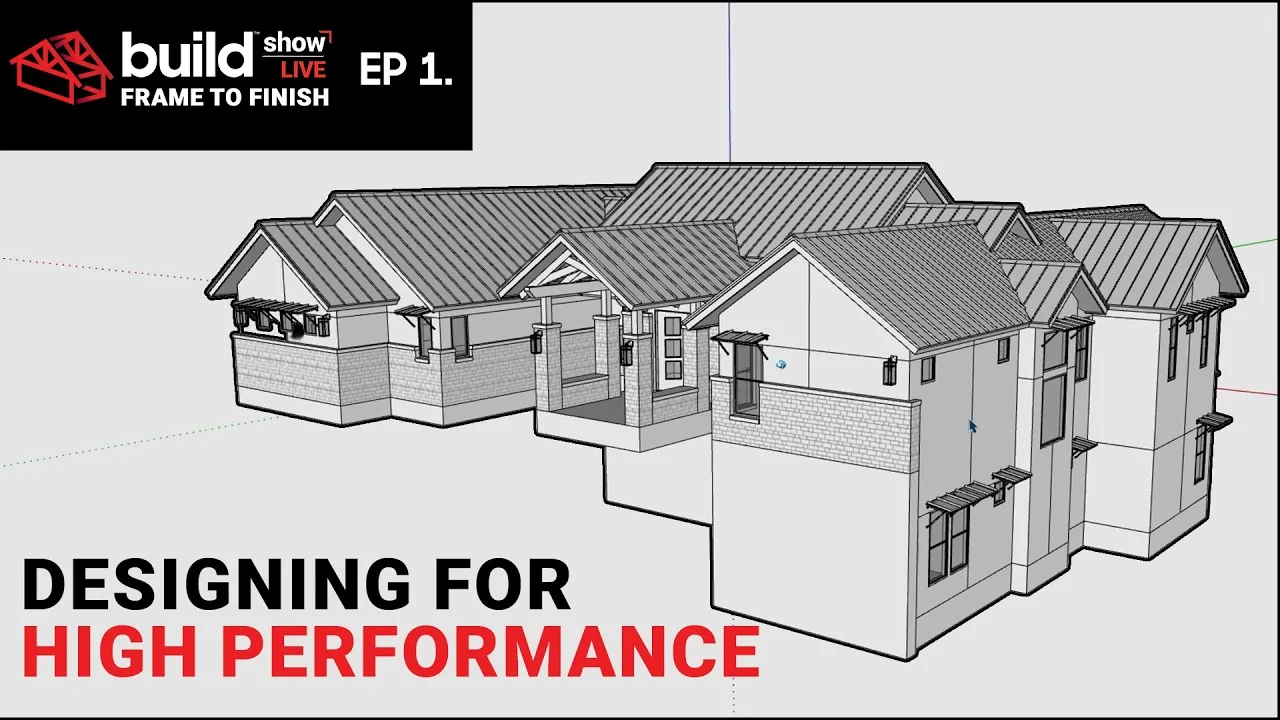
When discussing high-performance homes, attention often focuses on advanced materials, innovative products, and emerging construction technologies. While these elements play an important role, the first episode of Frame to Finish: Designing for High Performance argues that long-term building performance is largely determined before construction begins.
Matt Risinger, Tim Hill, and architect-builder Jim Gunn introduce the Build HD Standard, a framework designed to improve durability, resilience, indoor environmental quality, and energy performance beyond minimum code requirements. Rather than focusing on individual products, the discussion centres on the design decisions that shape the performance of a home throughout its lifespan.
The key message is straightforward: successful high-performance homes are created through a disciplined design process that aligns architecture, engineering, building science, and construction from the outset.
Designing High-Performance Homes Beyond Code Requirements
A recurring theme throughout the discussion is the distinction between building to code and building for performance.
Building codes establish minimum standards for safety and compliance. While these requirements provide an essential baseline, they do not necessarily deliver the levels of durability, comfort, efficiency, or resilience expected from modern high-performance homes.
The Build HD Standard seeks to bridge that gap by focusing on long-term outcomes rather than minimum compliance. The objective is to create homes that remain functional, efficient, and healthy for decades while reducing the likelihood of major renovations, performance failures, and unnecessary resource consumption.
According to Risinger and Hill, one of the most sustainable actions the industry can take is to build homes that last. Homes with longer service lives generate less waste, require fewer replacements, and provide better value over time.
This long-term perspective forms the foundation of many of the design decisions discussed throughout the series.
Site Planning and the Foundations of High-Performance Homes
One of the strongest messages from the episode is that successful design begins with understanding constraints.
Clients often arrive with inspiration images, floor plans, and aesthetic preferences. While these references can help establish design direction, Gunn explains that the process must begin by understanding the project’s underlying parameters.
These include:
- Site conditions
- Budget
- Programme requirements
- Construction timelines
- Planning controls
- Topography
- Climate considerations
Only after these factors are understood can a design team begin developing a solution that balances aesthetics, functionality, and performance.
For the featured project, the site includes approximately 17 feet of elevation change from the street to the rear boundary. Rather than treating the terrain as a challenge to overcome, the design uses the natural topography to create a walk-out basement that captures views and improves site integration.
This approach reflects a core principle of high-performance homes. Buildings should respond to their environment rather than force the environment to accommodate the building.
Roof Design and Durability in High-Performance Homes
Roof design is another area where performance considerations influence architectural decisions.
One principle within the Build HD Standard is that homes located in regions with significant annual rainfall should avoid flat roofs wherever practical. While flat roofs can support certain architectural styles, the team argues that pitched roofs often provide a more durable and forgiving solution.
The reasoning is straightforward. Every roof must effectively manage water throughout the life of the building. Designs that promote rapid drainage generally reduce the risks associated with standing water, blocked drains, parapets, and complex waterproofing details.
This philosophy aligns with a concept frequently referenced throughout the discussion: built-in forgiveness.
A forgiving building is one that can tolerate minor construction defects, maintenance delays, weather events, and natural ageing without experiencing significant performance failures.
For high-performance homes, durability is not solely determined by materials. It is also shaped by design decisions that minimise risk over the long term.
Continuous Insulation and Airtightness in High-Performance Homes
The project also incorporates several strategies intended to improve thermal performance and moisture management.
Rather than using a conventional vented attic, the design incorporates:
- Insulation located at the roof line
- A conditioned attic space
- A continuous air barrier
- Mechanical systems located within the thermal envelope
These strategies have become increasingly common in high-performance homes because they help improve energy efficiency while reducing moisture-related risks.
By locating HVAC equipment and ductwork within conditioned space, energy losses associated with extreme attic temperatures can be reduced. The approach also helps minimise condensation risks and improve system efficiency.
Airtightness is equally important. In warm and humid climates such as Texas, uncontrolled air leakage can introduce significant moisture into the building envelope. By focusing on continuous air barriers and effective sealing strategies, designers can improve indoor environmental quality while reducing the likelihood of mould and other moisture-related issues.
The objective is not simply lower energy consumption. It is to create healthier, more durable buildings that perform consistently throughout their lifespan.
Balancing Performance, Cost, and Space
The design team also discusses the relationship between conditioned and unconditioned space.
Early concepts included larger covered outdoor areas and screened porches. As the design evolved, however, these spaces were reassessed against the project’s broader performance and budget objectives.
The discussion highlights a common misconception. While outdoor living areas may not require heating or cooling, they still require structure, foundations, roofing systems, waterproofing, and finishes. As a result, substantial covered spaces can represent a significant portion of a project’s construction cost.
Throughout the process, the team continually evaluated whether each design element contributed meaningful value to the home.
The principle is simple: the ability to build something does not automatically justify its inclusion.
For high-performance homes, restraint can be just as important as innovation.
Mechanical Planning for High-Performance Homes
Mechanical planning is often overlooked during the early stages of residential design, yet it remains one of the most important components of a successful high-performance project.
Too often, mechanical equipment is treated as an afterthought, resulting in compromised layouts, restricted access, and reduced efficiency.
In this project, dedicated mechanical spaces were incorporated early in the planning process. Consideration was given to plumbing runs, water heating locations, HVAC distribution, serviceability, and future maintenance requirements.
This reflects a broader principle of high-performance homes: building services should be integrated into the design rather than accommodated after the architectural layout is complete.
When mechanical systems are planned properly, installation becomes easier, maintenance improves, and long-term performance benefits follow.
Why Process Defines High-Performance Homes
Perhaps the most important takeaway from the discussion is that high-performance homes are rarely the result of a single product, technology, or specification.
Instead, performance emerges from the integration of architecture, engineering, building science, and construction.
Site planning influences foundation design. Foundation design influences structure. Structure affects mechanical layouts. Mechanical systems affect indoor environmental quality, energy consumption, and occupant comfort.
Each decision contributes to the overall outcome.
The Build HD Standard seeks to formalise this integrated approach by establishing clear performance objectives at the beginning of the design process and carrying those objectives through construction.
As the series demonstrates, creating successful high-performance homes requires more than selecting better products. It requires a disciplined design process that aligns all stakeholders around durability, resilience, efficiency, and long-term performance from day one.
For designers, builders, manufacturers, and building owners, the lesson is clear: the best-performing homes are designed long before construction begins.
Related
House Building – Revolutionary High-Performance Exterior Modern Detail
High-performance Home Building Techniques: Site Tour In Houston, Texas.