
Part 2 of 2: The building industry’s broken promises
What does New Zealand 2026 look like? In Part 1, I explored the systemic issues holding New Zealand back – our short-term political thinking and council structures that seem designed to extract rather than enable. Now let’s look at what I know best: the building industry.
Why the Building Code Isn’t Working
In an ideal world, a building code should focus on outcomes, not methods, enabling innovation and sustainability. Our current code still pushes most projects down the traditional construction path – one that many experienced building professionals know is outdated, inefficient, expensive, and incapable of delivering truly high-performance buildings at an affordable price.
The code has attempted to improve performance by requiring airtightness, but airtightness only works when paired with proper air movement control and ventilation. There’s no requirement for that. The result? Buildings that trap moisture, creating homes that are arguably unhealthier than those we built fifty years ago.
If I were Minister of Building and Housing (I know they’re separate roles), my goal for 2026 would be to remove liability from councils and return it to the private sector. That way, taxpayers don’t foot the bill for councils’ mistakes and the increasing litigation they seem content to entertain.
Our councils are doing too much, mostly without the skills or knowledge to make the real changes that would make a difference. And when they fail, no one reprimands them or replaces those responsible.
Why can certain countries build houses three times the quality, with three times the performance, at under half the cost? Do the people administering our standards and codes know the answer – or even have a plan?
In my opinion, the current building code and standards represent a cumbersome history of missed opportunities. Over 50% of new and existing homes in New Zealand are classified as too unhealthy to live in. Surely we have a plan to resolve this? (Source: Asthma New Zealand)
We talk about accepting certified products from overseas, yet councils remain the gatekeepers of whether a German-manufactured window – often far superior – can be used instead of an inferior locally made unit. I’ve heard nonsense like “our rain is different to Europe’s.” Is it?
For 25 years I’ve questioned why we must reinvent the wheel and re-certify products already proven in more extreme climates. This adds cost, complexity, and delay to any meaningful progress. It’s hard to escape the conclusion that this is simply a means to print money for certifiers, with no real purpose or logic.
We should be rewarding developments that go off-grid and achieve full sustainability and self-sufficiency – not burdening them with unnecessary development contributions and excessive consent fees.
What Are We Actually Building?
Intensification in already infrastructure-challenged areas simply doesn’t work. It changes the character and function of an area, making new buildings look exactly like what they are: an afterthought. Parking becomes a bigger problem. So do tensions, and crimes rise – putting added pressure on the police.
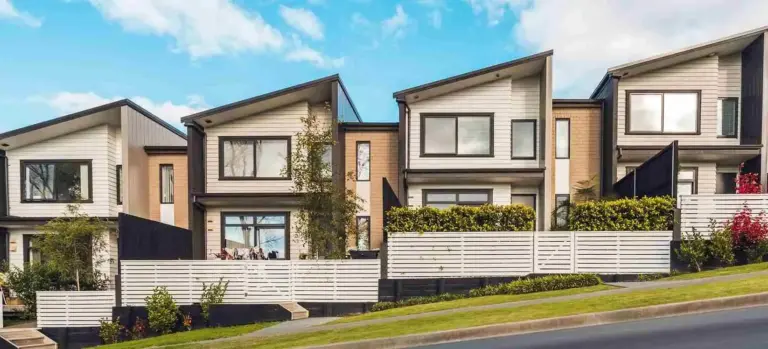
Our mass housing developments are turning into estates without trees, without recreational areas, without off-street parking. Ghettos in the making. Drive down any motorway and see them on either side. Are we building for beauty, for community, for quality of life? Or are we strangling developers into producing the smallest possible boxes that can be squeezed from an impossibly expensive building environment?
I know too many developers trying to sell land they now cannot afford to develop.
This affects how our country looks and feels. First impressions matter. A tourist landing at Auckland airport takes a bus or taxi through congestion to reach the city centre. No rapid transit. No efficient public transport connecting our infrastructure. We pay more to move products around New Zealand than to ship them from Europe. And who owns our busiest container port? Auckland Council, our story’s provocateur.
A Procurement Revolution That Never Came
I’ve suggested to government ministers that they establish a dedicated procurement department to source better-performing, more affordable building materials from around the world and sell them into the industry at fair prices. This would address many supply chain problems, give the industry access to better products, and force existing suppliers to compete on quality and price.
I don’t say this without experience – I run two retail supply businesses in this very sector. The response from government? Nothing. Not even a willingness to explore the idea. Imagine the buying power a government would have.
Where Does This Leave Us?
If we carry on as we are, it’s rinse and repeat. No real progress on affordable housing. No improvement in building quality. Infrastructure that remains low-quality and congested. Young and old skilled New Zealanders continuing to leave.
Politicians routinely inherit portfolios they have no background in. They hire expensive consultancies equally lacking in practical experience, basing decisions on data that’s often incorrect or skewed.
But none of this is inevitable. We still have extraordinary natural beauty, genuinely good people, and a foundation worth building on. Other countries have turned things around. We could too.
New Zealand was once ranked among the most desirable countries in the world to live in. We know it’s not that now. If you’re young, want a good career with good prospects and an affordable home, New Zealand may not be the place for you – at least not presently. If you’re wealthy and don’t need to rely on a New Zealand income, it remains a fantastic option.
I love New Zealand. But I have to question the leadership and direction.
Could New Zealand become Great Zealand with the right leadership, the right plans, and the ability to execute?
An engineer in Auckland, still dreaming
Related
<s>New</s> Great Zealand: What If We Started Again?
The Housing Crisis Is a Leadership Crisis: Rethinking Affordability and Sustainability