Foreword by Ian Thompson, Editor
In today’s video, Matt Risinger and Wade Paquin are discussing their preferred basement construction practices. They’ll be offering three important tips for creating a superior basement, with a focus on insulation, waterproofing, and framing.
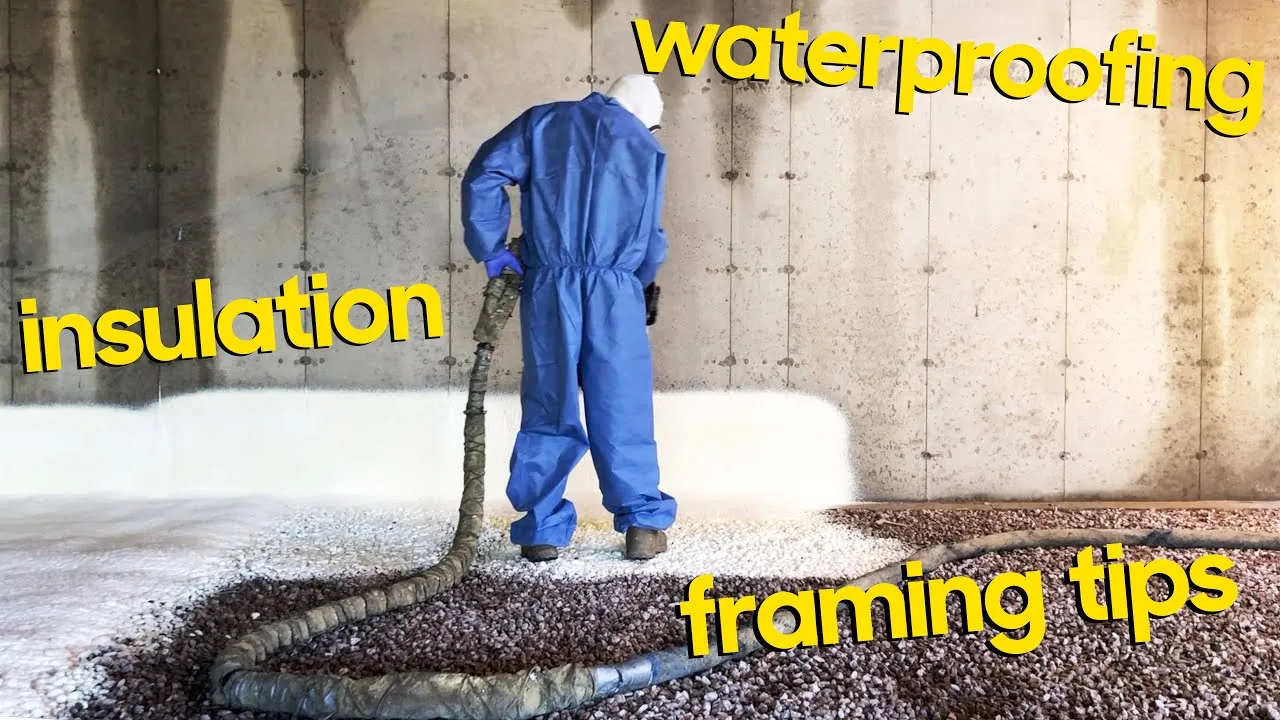
Wade will guide us through his unique approach of utilizing closed cell spray foam insulation beneath a concrete slab, resulting in a fully insulated basement. He’ll also explain why crushed stone is a superior choice over regular dirt or gravel for achieving a strong bond with the foam.
In terms of waterproofing, Wade will introduce one of his preferred products: Link Seal.
Lastly, they’ll explore a unique New England tradition – ceiling strapping. They’ll discuss how it provides rigidity, creates a chase way for electrical wires, and enables the ceiling to be leveled.
Basements can be quite troublesome, especially with water ingress being a primary concern. I’ve witnessed some spectacular failures where the builders got it very wrong. My advice is to not skimp on high-quality exterior waterproofing to prevent water from infiltrating the basement structure.
This on-site video is teeming with practical advice, making it a must-watch for anyone considering building a basement.
3 Tips for a Better Basement Construction (Insulation, Waterproofing, & Framing)
Video Transcript:
3 Tips for a Better Basement Construction (Insulation, Waterproofing, & Framing)
Hey guys, I’m Matt Risinger, and I’m Wade Paquin. And on the Build Show today, Wade and I are going to give you three tips for building a better basement construction. Let’s get going.
Wade builds a lot of them, I do not, and what is under our feet is tip number one. Wade, talk to me about this. This is a detail I’ve seen you do before that I really like. What are we looking at?
Yeah, thank you, Matt. So, we’re standing on top of about an average of two inches of closed-cell spray foam insulation. Okay, so closed-cell foam under our feet and then concrete on top of that, so that now I’ve got a fully insulated basement slab, right?
Mm-hmm, that’s right. But one important thing I found in this application over my experience doing this is a lot of basements like this could be just regular dirt, regular gravel, sometimes you see crushed stone. We prefer crushed stone because what we found is those voids in the stone, when the liquid comes out of the gun and before the foam expands, penetrates into that stone, the voids in the stone, so it’s like tentacles, they kind of get into the stone. And then when it expands, it kind of holds it and anchors the foam down, right? Sometimes this foam might be here for a week or two before we get concrete on it. I found when we’ve applied this to gravel, the foam doesn’t bond to it and actually can lift and kind of float around a little bit. Makes sense, so the stone seems to be a good kind of best practice application from what I found.
I love it. And then I’m also noticing you’ve got kind of a bathtub effect where you sprayed that spray foam not only over the entire flat space but up the walls. Talk to me about this detail back here, Wade.
Continue Reading
Yeah, that’s right. So, you know, whether you’re doing a four-inch or six-inch slab here, we’ve got two inches of foam coming up the wall down here in this zone. And then that’s feathered as we come up, it’s kind of tapered, tapers up. Yeah, so you may have about a half-inch of foam here now. So, the reason for that is after the slab’s done, we want to continue this envelope up to our rim board, top of wall, mud sill connection, right? So, that’s going to allow us to now spray foam this wall and come down and overlap this.
I love it. And then feather it back down, kind of the reverse way, so we end up with an average of two inches or whatever you’re trying to achieve here in the wall. That’s awesome. So, your four-inch concrete slab that’s down here is going to basically float on top of this, and we use rebar on that slab. Sometimes we use a fiber mesh that gets put in with the mix at the plant, okay? Or oftentimes, we’ll use like a wire mesh, gotcha. Because it’s not structural at all, these walls are, you’re holding your structure above. You’ve got a couple steel columns that are bringing loads to a footing, but all this slab down here is just holding people in couches and boxes, right?
Yeah, that’s usually the case. Sometimes there might be a load-bearing wall partition in the basement picking up a beam. If there are no point loads or something like that, typically you’d have a depression there, what we call a haunch. So, you get an average of maybe 12 to 18 inches of concrete wide and deep in that spot. That would maybe have some number five rebar in it to support some of that load bearing on that one location. Got it.
Another thing I want to point out here is when Wade spray foams this wall, this will be after studs get framed. You know, this won’t get framed and the basement walls won’t get framed until the slab is in. Then they’ll come up and, when his spray foam contractor comes back, he’ll be able to spray foam into those band joist areas, which is a very hard place to use traditional, let’s say, batt or blown insulation. Right, right, right. Yeah, it’s a critical connection, right, mud sill to concrete. So, we’ve air sealed our mud sill to the concrete foundation. Now, with the addition of the spray foam encapsulating that, we have a really good protection barrier there. And then, this is also going to be a vapor barrier.
Speaking of vapor, let’s talk water. You know, basements are a place that nobody wants water to come in, and yet on this basement, I noticed you’ve got a couple of penetrations. Talk to me about how you water sealed these penetrations.
Sure. Before I get on that, I should also mention that aside from being a vapor moisture barrier, here is also a good radon blocker. The spray foam is smart, and another nice thing about it is that it’s a monolithic application, different types of foam boards and tapes. Right, so, really much easier, it’s fast and clean. But here with our concrete wall penetrations, right, we’ve got a couple holes here that are core-drilled. Yep, I’m sure you’ve experienced this in maybe a frost wall or I don’t even know if you do frost walls, but any core drilling, that’s below grade, whether it’s, you know, pause with hydraulic cement or a PVC sleeve or conduit, they’re hard to get completely waterproof, watertight, right? They may last for a while, but sometimes they fail.
I came across this product here called Link Seal, which has been a game changer because it tells you, so if you have a one-inch conduit, two-inch, three-inch, whatever size your conduit is, it will tell you what size hole you need to core drill for the Link Seal. So, you can see here we’ve got maybe an inch and a quarter conduit, but we’ve got a much bigger hole, and that hole is designed to accommodate this specific Link Seal. That smart product. So, once again, how does it work?
So basically, it’s like a rubber gasket-type of system here that as you go around and crank these bolts, it’s applying the gasket pressure to the concrete core where it’s been drilled out and against the conduit. So, if you look in here, you can see that rubber really tight around not only the conduit but the outside diameter of this core hole. And I think it’s interesting that this wasn’t a sleeve in the conduit. This was actually core drilled, so you’re getting a much better, tighter, more round hole.
Right, right. Right, we could have sleeved this when we were placing the concrete in the wall and we knew our general location, but you know, we don’t have the luxury then of using the Link Seal. Yeah, so later on, we know exactly where we want the conduit, we can come in with our core guy, set up his machine, core drill it out to the size we need for the Link Seal. That’s pretty awesome. Yeah, I like that product. We’ll put a link in the description for that, guys.
Now, the third tip, Wade, this is one that I don’t think you even see anymore, but as a Texas builder, one of the first things I notice when I walk into this basement is the ceiling, one by three, I think you call it strapping. Up strapping, referring. Talk to me about that. It’s a New England thing, right?
I don’t know when it started, but it was probably many decades ago. It’s all I’ve ever seen since I was a kid on my dad’s job site. That’s crazy. To every job site I’ve ever visited, ceiling strapping is just what we do, kind of like plaster. You probably use sheetrock compound here. It’s blueboard and plaster veneer. So, I guess it’s just a little New England thing, but you know, I like it because it’s doing a few things.
It is allowing us to create a nice chase way for the electrician to run his wire so he can just tack up and staple the wires right to the bottom of the joist and run. The strapping is also giving the floor joists some rigidity, right? So, it’s stabilizing the floor system if you’re using kind of like the old X bracing. Exactly, you know, here we’ve got engineered I-joists, but if you’re using standard lumber like a 2×10, 2×12 KD, you know, something like that, where if you have a 2×12 that’s an inch and 11 and a quarter, you know, sometimes that comes 11 and three-eighths or 11 and eight. And if you’re applying your board, whether sheetrock or blueboard, right to that, you could end up having those waves, right? So now you’re having to shim that down if you’re paying attention to what you’re doing. Here, we can shim the strapping down to create a nice level ceiling through, you know, string lines, a jig, lasers, things. There’s different ways to do it.
So, you know, and it’s quick and easy, it’s not super expensive, the overall lumber for the whole project, and it can get done very quickly by a good framing crew. And right here, Wade, is, I think the thing that really sells me on it. I made a few mistakes on my house under construction with these types of areas, right here. This is a steel beam that’s supporting, or part of me, a steel column that’s supporting this steel beam. The beam’s been packed out, and then you’ve got joist hangers on there. And on top of that, you have a couple of FastenMaster TimberLock Pros on there, which easily any one of those things could bow our drywall if our drywall is hung right to those I-joists. But once you put that strapping on, all those things kind of go away, you know? They’re hitting on that three-quarters, right? You don’t have to fuss around with it now because you’ve basically packed down the ceiling, so to speak. Right, I love it. So now, guys, when your eyes are up there, right in line with that I-joist or with that ceiling strapping, everything’s nice and flat. Wade, great job on this house, man. Thanks, love it, appreciate it.
Guys, if you don’t know Wade Paquin, he’s a builder in Rhode Island, but he’s actually building now here on Block Island, which is about 12 miles off the coast. It’s a very difficult place to build a house. There’s no hardware stores, home centers, no lumber yards out here on the island. Everything’s got to come over on a boat, right? Including a lot of your labor. So, he’s been chronicling this entire build, and we’ve got a once-a-month episode that’s going to be coming out on buildshownetwork.com with Episode One starting next month. In the description will be a link that you can sign up for our weekly newsletter so you can get informed. Do that. But make sure you go follow Wade on Instagram in the meantime. Wade, great job over here, man. Yeah, thanks, man. It’s always a pleasure having you.
Three really good tips for a well-built basement from a seasoned basement builder like you, Wade. I appreciate it, man.
We’ll see you next time on the Build Show
Related Build Posts:
Basement Waterproofing – Fluid Applied Membrane