What five years with a Stûv 30 Compact One wood burner taught us about indoor air quality, comfort and modern living
For most of human history, fireplaces were not a lifestyle choice. They were a necessity. Healthy Homes wasn’t even a subject of discussion.
Two hundred years ago, homes were cold, draughty and poorly insulated. Open fires provided warmth, light and often a place to cook. Families gathered around the fireplace because it was frequently the only comfortable place in the house during winter. Bedrooms were cold. Much of the home was unheated. Smoke was simply accepted as part of daily life.
One hundred years ago, things had improved, but not dramatically. Coal ranges, enclosed fireplaces and wood burners became more common, yet most homes still relied on a single source of heat. The idea of maintaining a comfortable temperature throughout an entire house remained out of reach for many households.
Even fifty years ago, heating one room rather than the whole home was common. Families shut doors to keep warmth in. Condensation streamed down windows. Mould was often viewed as an unavoidable part of winter.
Today, we build homes very differently.
Modern homes are designed around comfort, energy efficiency and increasingly, occupant health. We invest heavily in insulation, airtightness, high-performance glazing, moisture management and ventilation systems. We understand more about indoor environmental quality than any generation before us.
Yet one feature has largely escaped the scrutiny applied to almost every other aspect of residential design.
The fireplace, or “wood burner” as it is often called in our part of the world.
A Legacy from Another Era
Historically, the fireplace was the heart of the home because it was the only source of warmth in the whole house. Architecture, if we can call it that, evolved around that reality. Families gathered around the hearth because comfort existed in one place and one place only.
That is no longer how we live.
Modern homes can provide comfort throughout the entire house. Open-plan living has changed how families interact with their homes. In many households, the kitchen island or outdoor entertaining area has become the true social hub.
The fireplace is no longer required for heating.
It is no longer required for cooking.
In many homes, it is no longer the centre of family life.
What remains is ambience, aesthetics and tradition.
Those are perfectly valid reasons to want a fireplace. However, they are very different reasons from those that justified fireplaces for the previous two centuries.
Which raises an important question.
If we are designing homes around health, comfort and indoor air quality, should we still be specifying combustion appliances at all?
A Five-Year Review of the Stûv Compact One
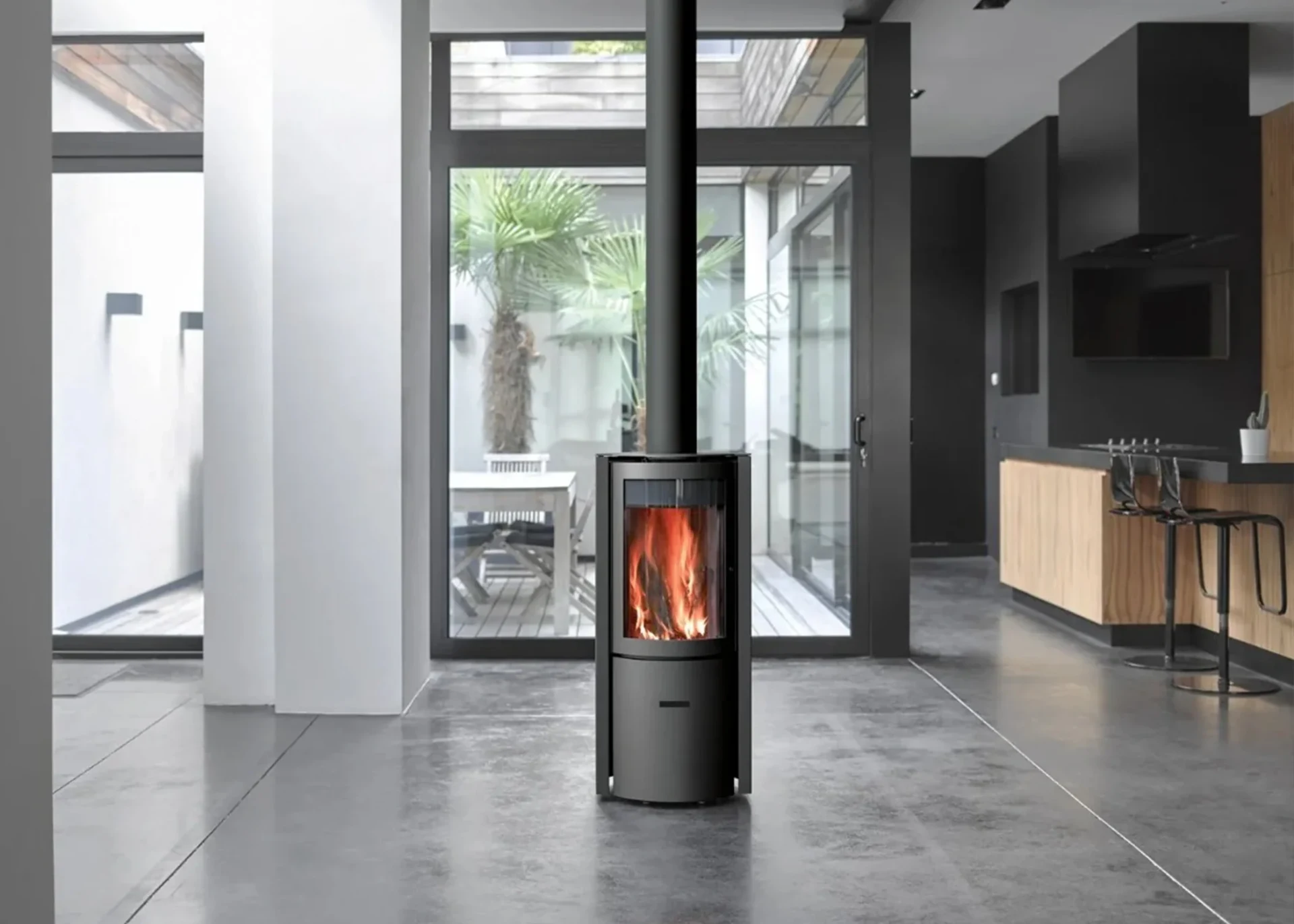
Five years ago, one of our projects required us to install a Stûv 30 Compact One fireplace as part of a premium residential project extension. Part of the project was to convert a 3-bay garage into a studio and build a separate large barn/shed to accommodate more cars and a workshop.
Being a garage, it had no existing underfloor heating, so we specified a wood burner thinking it would provide adequate heat in winter and also add some visual appeal.
The fireplace was installed in the now converted 66-square-metre studio space and represented a significant investment, well over $10k when you consider wood burner, flue, and considerable installation costs
Like many homeowners, our design team was attracted to the atmosphere and visual appeal of a real fire, combined with the promise of modern European engineering and performance.
Unfortunately, the experience has been disappointing.
From the outset, studio occupants reported a noticeable smoky atmosphere and odour when the fireplace was operating. Despite the generous size of the room, the indoor environment frequently became uncomfortable enough that using the fireplace was no longer enjoyable, or even possible.
The result is perhaps the most important measure of all.
Five years later, the fireplace is rarely used. In fact, it’s been used less than 40 times in that duration.
For what was a premium purchase, and promise, that is a disappointing outcome.
The Customer Experience Matters
Products should not be judged solely on technical specifications, or individual failures.
The ownership experience matters.
When concerns were raised regarding smoke entering the studio, assistance was first sought from the Auckland supplier, and then the manufacturer.
Unfortunately, no satisfactory resolution was ever achieved, with Stûv themselves not even responding to emails.
Understanding the underlying cause, possibly related to a product fault, flue design, or operating conditions etc. or a combination of factors is almost beside the point. The practical reality is that a premium fireplace was installed and certified as being fit for use, concerns were raised, support was sought, and the problem remained unresolved.
That outcome raises important questions.
If experienced suppliers, installers, and the manufacturer were unable to identify and implement an effective solution, homeowners are left wondering whether the issue was unique to this installation or whether it reflects a broader challenge associated with modern wood-burning fireplaces in increasingly airtight homes.
Either way, the result for the occupants was the same.
The fireplace became a rarely used feature rather than an asset to the home, because the smoke became a genuine health concern.
The Healthy Home Question
The experience also raises a broader issue that deserves greater discussion within the building industry.
A century ago, homes leaked air continuously. Gaps under doors were often an inch or more. Windows were single glazed and often didn’t close properly. While those homes were often uncomfortable and inefficient, they behaved very differently from modern homes.
Many of today’s new homes are designed to try and control heat loss, moisture and airflow. We build tighter, better-insulated homes because we understand the benefits they deliver to comfort, energy efficiency and health. Not to mention reduce heating and colling costs on our ever-increasing house purchase costs.
At the same time, we are becoming increasingly aware of the impacts of particulate pollution and poor indoor air quality. In New Zealand, where I live, over 50% of our homes are classified as too unhealthy to live in. That’s new and old houses.
This is where the subject of fireplaces become difficult to ignore.
Even when operating correctly, wood combustion produces particulate matter and other pollutants. If smoke enters the occupied space, even occasionally, the issue becomes more significant.
For many years, fireplaces have largely been exempt from the healthy home conversation because they were considered normal. Perhaps it is time to reconsider that position.
If we are spending hundreds of thousands of dollars creating healthier indoor environments, should we also be introducing combustion into those same spaces?
The laws of physics do not change simply because combustion occurs behind a glass door.
Anyone who has stood around an outdoor fire understands this instinctively. Even in the open air, smoke finds its way onto clothing, skin and into the lungs even when you’re standing some distance from the source. It is difficult to reconcile that reality with the idea of creating the healthiest possible indoor environment.
There is another important aspect to consider: the environmental impact of fireplace and wood burner emissions on our communities and the wider environment.
Are There Better Alternatives?
From a heating perspective, there is little debate.
Modern heat pumps, hydronic systems and high-performance building envelopes can provide superior comfort, greater efficiency and lower operating costs without introducing combustion into occupied spaces.
If the objective is heating, there’s been many better solutions for many decades.
If the objective is ambience, the conversation becomes more interesting.
Electric fireplaces and advanced flame-effect technologies have improved significantly in recent years. While they may not perfectly replicate a real wood fire, they can provide visual interest and atmosphere without producing smoke, particulates or combustion gases. I did test a flame-effect fireplace that used unscented bio ethanol, but it still smelt, but was told by the salesperson that the only off gassing was water vapour. So, I guess it shouldn’t be used in an airtight home then?
As healthy home principles continue to evolve and be understood by designers, I wonder if we’ll see less fireplaces.
My Conclusion
For many years, clients requested fireplaces because of the atmosphere, visual appeal and sense of comfort they were believed to bring to a home. Like many in the industry, I accepted that these benefits justified the compromises.
I no longer hold that view.
Today, when clients ask about including a fireplace for ambience or aesthetic reasons, I strongly encourage them to reconsider.
That advice is not based solely on one disappointing installation. It is based on a broader understanding of indoor air quality, occupant health and the realities of combustion within modern homes.
The experience with the Stûv Compact One reinforced that position. A significant investment was made, the fireplace proved uncomfortable to use, health concerns were raised, and neither the supplier nor the manufacturer ultimately provided a satisfactory solution.
However, the bigger lesson extends far beyond a single fireplace.
Having spent 37 years as a civil and structural engineer, designer, and building consultant I have spent much of my career understanding how buildings perform. Over the years, our industry has worked hard to improve our building performance, sustainability, and health. Parts of the industry have invested enormous effort in creating healthier indoor environments.
At the same time, we have largely continued to accept fireplaces without questioning whether they are compatible with those same objectives.
Today, we have better ways to heat homes. We have better ways to create comfort. We have alternative technologies that can provide visual interest and ambience without introducing combustion into occupied spaces.
As a result, we no longer specify fireplaces in our projects and no longer recommend them to clients.
The more we learn about indoor air quality and occupant wellbeing, the harder it becomes to justify bringing fire inside the home at all.
Perhaps the question is no longer whether fireplaces can be made compatible with healthy homes. Perhaps the question is whether healthy homes need them at all.
Stûv 30 Compact One Fireplace Review
Quality and Performance Issues
Quality and Performance IssuesRelated
Is Geothermal Heating and Cooling Worth the Cost? Heat Pumps Explained
Why Ice Sourced Heat Pumps Might Be the Future of Home Heating