Foreword by Ian Thompson, Editor
Building smaller homes on smaller lots, even in backyards, has become commonplace. It provides an opportunity for existing homeowners to utilize their recreational space to construct a house, or a sleepout. The potential of sacrificing personal space for income should not be underestimated, as many people are looking for ways to reduce their existing mortgages, or simply make a profit.
Personally, I value space and privacy. In fact, if it was up to me, I’d prefer living in a remote forest with no neighbours. However, many others view this as a financial opportunity with considerable benefits.
In today’s video, we’re focusing on building in tight spaces, building near property lines, and exploring all the challenges that go with that. Join our host, Matt Risinger, as he explores Toronto’s new frontier – constructing laneway houses near property lines. This is a challenging solution to the housing crunch, but one laden with unique obstacles.
Discover how these compact accessory dwelling units are densifying neighbourhoods in a sustainable manner, by adding rental units or multi-gen living spaces. However, erecting structures mere footsteps from lot lines requires serious regulatory knowledge.
Observe Joel’s ingenious workarounds, such as deck building and tree protection zones, which help maintain harmony with neighbours. Witness the power of prefab panels, screwdown foundations, and continuous insulation for resilience without excavation.
Appreciate how the new HCRA introduces transparency through robust training and certification standards for constructors. It’s a fine balancing act – ensuring code compliance and construction freedom for optimal quality builds.
However, the ongoing labour shortage casts a shadow, particularly in HVAC, electrical, plumbing, and roofing disciplines. Joel emphasizes that inspiring the next generation of tradespeople is crucial for the industry’s future.
From hinging walls for tight squeezes to futureproofing with metal siding, this project epitomizes the cutting edge of construction. Joel leaves no stone unturned in highlighting the challenges and solutions associated with building these compact urban infills
Over to Matt….
Building Near Property Lines and Laneway Houses: Challenges and Innovations
Video Transcript
So, I would call this an alley, but this is not an alley, is it? Laneway – we call it a laneway in Toronto. We call them laneways, which happens to be your company name, is a matter of fact, right? You got it – Laneway Custom Builds. So, Joel builds these really cool laneway houses or alleyway houses, tiny house, tiny lot, a lot of constrictions and restrictions here in Toronto up in Canada. Today’s build show is all about laneway custom builds and all the challenges they face on these laneway houses. Let’s get going.
All right, Joel, talk to me about these laneway houses because around me I’m seeing kind of one-story garages, but you got what appears to be like a two-story house back here.
Recently the city of Toronto updated their bylaws and so they’re allowing people to build, you know, a home behind their home. It’s an accessory dwelling unit, uh, and when they’re in a laneway, we call them a laneway house.
But they’ve actually opened it right up to even people who don’t have laneways. They can build what they would call a garden suite, but they’re trying to combat the lack of housing and trying to gently increase the density of the city and while still keeping that neighbourhood vibe.
So, one of the ways they found to do that was to start, start allowing laneway housing. You can’t sever your property, so the person who will be living in this house will maybe be a tenant from the people who own the main house, or it might be a situation where we have multi-generational living where the grandparents are living out back or potentially like some older university-aged kids might be living out back as well.
I can’t sell it, you can’t sell it off, and I think that’s part of maintaining that neighbourhood vibe and, you know, the way that they’ve allowed this bylaw to happen. It’s something that happens as of right, so you don’t need special permission, and so by taking that piece out of it, by not allowing people to sever the property, it just keeps things clean and keeps things simple. Also, all the servicing runs into and through the main house.
Yeah, so it’s uh, so in other words, this still has an umbilical cord, so to speak, to the services, the sewer, the water, the electrical from the main house.
Correct. Yeah, and you can see the first sign of it right here. This is our for our exterior cleanout, which is, you know, closest to upstream to the laneway house, but this pipe’s running underground all the way to in front of the main house.
Yeah, I’ve got to say this is crazy, but I really… These look like prefabricated, yeah uh, maybe five foot by eight- or ten-foot panels. Yeah, 10 footers, and you can also get little four footers.
We started by renting them and we’ve since purchased some, so we have about 12 frames now and all the all the little uh feet and stuff that go with them, but yeah, we’re um, you know, on all this my sites are fairly small and we only usually need about four sections of fence to cover off the end, so it was just made more economic sense to pick them up.
And yeah, that makes sense. All right, so yeah, is in, is in not so great a shape unfortunately, that’s not on your… No, unfortunately not, but it’s ripe for somebody to uh redo one day. Yeah, yeah, it definitely needs some work. Uh, what’s up with the platform back here? It’s building a deck over here. Oh, we’re going to have, we’re going to be doing a show.
Continue Reading
This is our stage, and we’re going to do a little bluegrass festival right here. No, uh uh, the city of Toronto is actually uh very forward in their uh methods for dealing with city trees, and so they’re always wanting us to protect the tree uh from the construction. In this situation, our tree protection zone actually should have been this big.
It’s usually determined by the drip line of the tree, uh, but you know, they do make special concessions. You can get an arborist report and they will recommend that you can do some horizontal tree protection zone which allows you a little bit more working room. So we had to build this little retaining wall out of four by fours, and then we actually filled it with mulch, um, so underneath the plot was just plain old mulch, and we actually were able to get it for free from a local tree removal guy.
You just call them up and you got any extra mulch and they’re looking for places to get rid of it, so he came here and dumped it all off for us, and we filled it up, and did the plywood stage. We actually have two layers of plywood as specified – it’s all specified by the arborist.
Yeah, and I’m noticing you got a, probably a requirement requirement on all sides. Yeah, I don’t like how you got your porta potty, you got a hand washing station. Yeah, I suspect you got nails or tools. We’ve actually got our temporary sight power here.
Oh sorry, yeah, and uh, and because this happens on all of our projects where we need power to build the house. And so we just have this long cord and this site power, which we can move move from site to site, and uh took a 200 amp panel. Yeah, brand new temp power in there, ran some 220 lines, yeah, ran a bunch of 110 circuits and then put a little roof on them. Yeah, I like it. Yeah, that’s really smart, Joel, very cool.
And then you got some tools, yeah, some fasteners and stuff. Yeah, fasteners and… Pretty cool. So tour me through the house. It looks like some similar building materials that I’m used to seeing, Zip system. Is this pretty common up in Toronto now, Zip system, sheeting?
It is, it is. Yeah, a lot of the builders are starting to carry it, and it’s a great option. Looks like some liquid flash liquid flash along the bottom onto the grade beam. So here this may look to you like a foundation, but it is a foundation but it’s not your typical foundation. It’s only about, from here, about 36 inches down, so we’re not, we’re not down past the frost line, uh, what we’ve used here is we’ve used ground screws and they’re about seven foot long.
They’re a little bit like a helical pile, but they’re different. The helical part is a little different. It’s uh more of a corkscrew and uh fork almost. Yeah, yeah, and so we put those, I guess, around three feet apart.
They’re drilled in with an excavator and then we formed and poured a beam on top of those screws, so the screws are holding all the weight, uh, and that’s a trick that’s sort of gaining steam in Toronto for these laneway homes because it’s a way to do your foundation and to not have to dig in, have to shore right beside your neighbor’s property.
Yeah, other side, maybe. Yeah, no, exactly, and right on that online, it’s… Correct. Yeah, yeah, tough conditions to work in, for sure. For sure, and then this looks like liquid flash right here. Yeah, we got some liquid flash on there, and another thing we actually did was we uh, sort of used the framing as a diaphragm and cocked all of our opening.
So you can see we’ve behind this sheet you would see a bead of caulking as well back there coming up the wind up the door, cross this door down, and yeah, and so around every window, on our corners, on the bottom and on the top, we’ve uh, we’ve put the caulking behind as well. It’s kind of creating like a diaphragm on the wall.
Yeah, and then is there something going on the outside of the zip as well before you’re residing? Down here, yeah, continuous insulation. We call it up up here, I don’t know if it’s the same down in the U.S., but uh, we’ve got our outboard insulation which is going on.
We’re using mineral wool, so three inches of rock wool on the outside. Three inches, yep, and then once you’re cladding on top of that, it’s going to be a sheet metal siding, uh, so we’ll be doing the uh, you know, like a strapping and then a sheet metal siding.
Uh, I feel like a lot of Canadians have metal exteriors. I like that. Yeah, it is, it’s, and the price point’s good. Yeah, uh… durability. Yeah, durability, 100% recyclable, and you’re all done. Yeah, for sure, kind of cool.
Um, one thing that with the with all the continuous insulation on the outside and trying to hang our rain screen, we often, on some projects, find that one detail that gets overlooked is the screws that are fastening the strapping to the structure of the house because we’ve got three inches of insulation and a piece of wood strapping, and there’s that huge space where that screw has to spin through.
Yeah, so we find oftentimes we find that the architects or the designers, that’s not a detail that they might not have on their radar or at an early enough stage. Luckily, with this designer, they’re thinking about those kind of things because really you think about the weight of the siding hanging on all those screws. Yeah, so for here we have a six inch structural screws specified to go through the insulation. It’s not going anywhere.
Yeah, not bad at all. 2×6 framing, just like we see all over the country. Yep, uh, I’m assuming this is temporary blasting, so your windows… Yeah, exactly, keep the rain out, and uh, sometimes like we are, aren’t you? Yeah, for sure, for sure. It’s uh, the last, yeah, since 2020, we’ve been employing this plastic window.
How long does it take you to get windows these days? Uh, this is about 22 weeks on this one. Yeah, yeah, the the patio door surprisingly was only seven weeks, so they’ve been holding it, they’ve been holding it for us until the windows are ready.
No, what’s the curtain I’m seeing all uh, kind of held up up here? What am I looking at? So the common, I guess, uh, term for that on the job site would be called like a header wrap, and that’s where you have your uh, the, the exterior uh, building paper or the building wrap. In this case, we’re, we’ve got the zip sheathing, but oftentimes you’ll have like a product like Tyvek or a Sega my vest or something like that on the outside.
So we’re trying to make it continuous through our second floor, uh, and so in this case we’re bringing the vapor uh, inside vapor barrier in between the top and the, the two in between the two top plates up outside the rim board and then back onto the subfloor under the top plate from upstairs and just keeps everything continuous.
You guys need a vapor barrier in this climate because it’s, it’s pretty dang cold out sometimes, yeah? And we want to make sure that no air and vapor is getting into this cavity and finding a cold condensing surface, for sure. Now with exterior insulation, is that, that’s not as important, right, or no? Yeah, you’re right. Is that the dew points moved out, right? So less important. We’re using a smart vapor bay area here too, so that’s going to allow the wall to, the moisture to move away both ways. Yeah, that’s really smart. I like it.
What’s the, what’s the plastic I’m seeing down here? That’s our vapor barrier under the slab. You might recognize the green from a proprietary… Uh, there you go. Yeah, they make, they make a nice uh, nice product. That’s awesome. And um, yeah, we were specified 10 mil on this project, uh, but the, the availability of the 15 was there so we just went with the 15, but I like it. Everything below the slab is all taped up, and then we have it lapping up so that we can overlap that with our, our interior vapor barrier.
Man, your guys are doing that. You’re frame this yourself? Yeah, we framed it ourselves. Yeah, yeah, how many guys work on your crew? We’ve got five, five guys and one in the office. And what different projects will you do on the job? You’re framing, but are you also doing some concrete work? What else are you guys doing?
Yeah, we did all the formwork here as well, um, and we’re, you know, formwork you said, but not concrete work. Yeah, like well, actually for here we had the grade beam, which we formed and poured ourselves… Minimal finish work, uh, but for the slab, when we brought a finisher in just to make sure it was all.
So you’re bringing another child support and finish it. Yeah, but you guys are framing it up because it’s carpentry work, carpentry work. Exactly. Yeah, some projects will do the siding as well, uh, just depends on availability and how the schedule is working.
And this house is like 20ish by 20ish, what’s our dimensions here? Yeah, it’s uh, 25 by 22. Okay, so just under 500 square feet. Yeah, the two stories. Yeah, I want to take you to frame this thing uh, what do we take, three, three weeks? Yeah, yeah, not bad.
Yeah, we’re taking the time to do all these detail as we go, yeah, so we might be a little bit slower than the, the framing crew that’ll slap it all up, and I’ve had experience with those crews, and they’re, they’re cool, they’re good, they’re quick, but sometimes it’s actually faster to hit some of these details as you go.
And so we’re finding some efficiency that way. We’re a crew of carpenters anyway, so uh, bringing the framing in-house I think has been a good move for us, background too, right? So hey, yeah, he, as the owner of the building company, has that carpenter background, which is really key to making sure these details get done.
Talk to me about these trusses, uh, I saw these once before in a job. What are these things called? Uh, open web trusses. Uh, these particular ones are from a brand called Triforce, and uh, yeah, they’re great. They, you can trim them so you don’t have to order them specifically to your length. They give you some.
Yeah, you could actually, feel right, exactly. You’re allowed, they come with about a three foot long OSB web and you’re allowed to cut a maximum of two feet off, leaving about a foot left. Okay, so as long as you got aa top plate and… Play them. Yeah, what do you think, you like, you like? I do, I like them. They’re uh, you know, a little bit more thought process to order them because uh, regular wood, I-joists, you know, the lumber yard has them so you, but other than that I mean they’re great.
The trades so far have loved them and have been able to run everything inside the inside the spaces. A bit of a learning curve with certain parts of it, um… But their manual, they’re like a 30 page manual, which is actually quite good, and so we were able to circumvent any like, any little issues that might come up from not using the product product before. We were able to nip those in the bud by just reading the, you know, you just read the instructions.
Totally, even if it’s a can of paint, right? Yeah, and uh, it looks to me like your sheet metal guys absolutely doing a fabulous job. I love seeing all this true sheet metal ductwork. We don’t find that very often, uh, as I travel, that makes me wonder, do you guys have a fair amount of trades in this area, are you guys hurting for trades? What’s the kind of availability of uh, the men and women who are doing uh, HVAC, plumbing, electrical, uh, roofing? What are some of the trades I’m missing?
Yeah, we’re hurting for sure. Yeah, especially more specialized trades like this tin bangers or plumbers, electricians, that kind of stuff. You know, there are certain trades where you might find that a little bit less prior experience is required, right?
So those trades might, in my experience, have a little bit less shortage, but a lot of these more higher skilled trades there’s just a nightmare trying to find workers, uh, these days. More young people into the trades, that’s for sure. It’s interesting, that’s true up here in Canada just as it is down in Texas, as it is in Boston, everywhere. Totally.
Let’s go. Well, let’s go up, I’m curious to see what this looks like. For sure, temp stairs or final… There, temp stairs. What do you guys do for final stairs here in Toronto?
Yeah, well, we’re gonna, the guy was actually that was who just showed up earlier when we were talking. Yeah, so he’s got them all measured up now that our subfloor and our floor heights are chosen, and uh… That’s just a simple set of uh stairs with uh, I believe they’re like a red oak tread and then uh, painted riser, painted stringer. Very cool.
Yeah, uh, a foot ceiling, that a bear, eight foot up here, nine foot downstairs. Total building height I believe six meters. Yeah, six meters, which is around 20 feet. Yeah, 20 foot tall and I’m noticing, yes, so our zero lot line size.
Yeah, so we’re, we’re trying to achieve a certain number of minutes of fire protection rating here, and so that’s part of getting to the minutes that we want that we’re wanting to achieve, um, so we’ve got the dense glass here. It’s a 5/8 dense glass, and we had to air, double layer, one layer, but we also have to put the 5/8 drywall, Type X drywall on the inside.
Gotcha, um, so actually that’s why you might notice here we left this stud out because we got to get that drywall right behind this stud, right? Oh, interesting. Yeah, it continues to make it continuous. Totally, totally, and that’s one of the obvious spots that if you missed that, it would kind of start to raise, it raise a few uh, questions up.
You’ll insulate that, and then your… Still, and so that then you can connect this and that sheetrock’s continuous. Yeah, honestly unless there was like a receptacle right here where the wire was coming through, that might be the only case, but other, otherwise oftentimes this stud will just get put in by the drywaller, right, because they can sheetrock this, slip the stud in for me, and then sheetrock these ones.
Yeah, I borrowed this trick from steel stud construction, so in commercial steel stud construction, on any commercial job, they’ll always leave their bottom and top plates short, and then they’ll just leave the steel stud sitting here loose, and then the drywallers. Yeah, the drywallers always finish it off. They’ll put the drywall in, they’ll take the steel stud, they’ll slap it tight. Oh nice… Crap. Yeah, thank you.
And um, and then finish it off for you. Yeah, it’s awesome. Yeah, and then how about stud bay insulation, what are you doing in these stoves, or maybe in the ceiling here? So we got mineral wool in all the walls, but it’s a bit of a hybrid system because we’re using spray foam in the roof here. Okay, yeah, we’re trying to get a really high R value on the roof. We’re going for R54 with the spray foam.
Holy… Yeah, yeah, well with the all-electrical build and with, you know, the colder climate in Canada, we’re really trying to keep that heat in. And so uh, the air source heat pump that we have is going to heat and cool this whole house. And uh, to be honest, it’s actually more than R54 because on top of that R54 we also have a tapered insulation package going on top of the roof deck.
What are you doing up there? Up there we’re doing a mineral wool tapered insulation because it’s a flat roof, right? So we’ve got uh, four scuppers around the outside and we just framed it as a flat deck, um, and you know one method would be to cut purlins, cut sloped cheese wedge type purlins and and slope your roof that way, but we find cost wise the insulation isn’t much more because you save so much on labor of all the ripping and cutting of all these pieces.
So we sloped the roof with an insulation, um, and then using for that taper, so you can, you can go with poly ISO, which is sort of the more uh, budget-friendly product, uh, and then we’re using here a little bit of an upgrade would be the mineral wool tapered insulation. Yeah, something like maybe Rockwool’s Top Rock?
Exactly. Yeah, this is because you’ve got all that mineral wool on the outside. Plus on the top it actually gives you some extra fire resistance too when I’m building, for sure, plus a metal facade, for sure, even more fire resistance. Yeah, that’s really cool. I like it.
Um, what is this system? That’s, we got our water lines there, so that’s just uh, PEX uh, crimp, crimp system. You know, the plumber is putting that in. So here, here we’ve got the bathroom uh, specifically here that’s the, that’s going to be the shower and, um, yeah, it’s just a rough-in for the water lines.
Uh, my guy specifically doesn’t use the red and the blue, but he does mark the red, so this, this tape represents uh, the hot, the hot pipe. Gotcha, that makes sense.
Yeah, and I didn’t mention it, but uh, I’m assuming that that metal angle that I’m seeing there has something to do with shears? Yeah, right. Yeah, that’s something that we sort of add in as an extra layer of strength. You know, the, the dense glass sheathing is considered a structural panel, uh, with the proper, you know, fastening, fasting schedule, but you know, between you and me, it’s still outdoor drywall, right?
It’s, it’s basically drywall on the outside of your house, so I just, I don’t trust it. I don’t trust it, so we always put these in to any walls that have the, the, we would call that a linen brace.
Exactly, yeah, a lead embrace, a, a, wind brace. Yeah, we would often call it that. I mean, you know, the old ones, obviously they would, they would chunk, uh, cut a huge chunk and put in the old two by fours, right, like you curve? Got it, nicely in there. Yeah, yeah, we curve cut it in, and a little known as your carpenters.
Yeah, and do you know uh, that you can just gun those on with your Paslode? Oh, that makes it, oh shoot, right through that metal? Yeah, just boom right through the metal, or something, he goes right. Yeah, yeah, so you just use your regular framing, like regular nail gun that you’re building the wall with, just shoot it on, and here’s one.
Totally, totally, and we got two downstairs, so it’s maybe not quite as high a value as your plywood, but it’s way better than just dryma alone. Yeah, yeah, for sure. That’s a bit of having, benefit of having the business owner who’s actually been on a framing career and framed a lot of stuff. I don’t have that experience, so I’ve had to learn that.
I didn’t learn it firsthand, so this trick for me came from working up in Northern Ontario where the continuous insulation or the thermal brake thing caught on a little bit earlier than it has everywhere else because it’s so much colder up there. So one of the builders I worked for when I worked up there would, uh, omit sheathing all together, and there was no plywood sheathing.
It was just studs with poly, a foil faced poly ISO board, which is in Canada we call it like an Energy Shield is the brand, but it comes in different thicknesses. So we would literally be putting that that polyiso foil face stuff right onto the studs, and this was the product that allowed us to do that, um, yeah, so definitely considered by engineers to have the, you know, the same sheer strength as a sheeted wall. Yeah, yeah, that makes sense.
Joelle, uh, when we were talking earlier, you mentioned something about warranties, a new construction builder has to give their clients, yeah, uh, which is different than what I’ve heard about in America. Can you give us the the basic understanding of that?
Sure, yeah, I’d love to, and it’s maybe not the reason why we try to incorporate a lot of these details is probably not the main reason, but uh, it’s definitely second place reason, uh, because we’re offering a warranty on all these, on all these homes that we build. And so we’re really wanting to hit a lot of these details to cover ourselves for the future.
So in Canada we have this uh, entity or this body called Tarion, and they’re uh, they’re a home warranty program, so they will provide you with a two-year… Or I’m the one providing the warranty, but they’re my, they’re my umbrella, yeah, they’re my backup business.
Yeah, so uh, as as a part of a Tarion warranty you get two years on everything, and you get seven years on structural. Wow, yeah, so uh… For new homes, uh, a warranty is required, and it’s something that isn’t really policed very much. I think it’s uh, well, if they started policing it we would have a serious slowdown in in construction because a large percentage of the people that are doing new construction don’t have it.
Uh, it originally came out for more for subdivision builders, you know, because you’re building 30, 40 homes a year, you want there to be some type of warranty attached with all that. But but really the law is that if it’s a new home you have to have it, if it’s a renovation you don’t. Laneway houses are considered new homes, and so I believe the, the intent is to give the client some peace of mind that they’re building themselves a new home that’s going to come with a warranty.
But also to take advantage of the opportunity that, you know, if we’re going to be building all these new homes, let’s try to build them in a way that’s above code or above sort of the minimum acceptable way to do it. Uh, so so the Tarion uh, organization really encourages like better building practices and stuff like that.
You had to go to actually, you paid for, right, to be certified to be able to actually offer this warranty, right? Yeah, you have to pay for it too, yeah, and there was numerous classes like, uh, you know, a dozen of them, uh, uh, and exams, and uh, you know, it’s a bit of a onerous process for somebody that’s getting into this as a new builder, you know?
Like that’s part of the reason a lot of people don’t have it to be honest, but uh, it’s, it’s ramping up, it’s ramping up. Tarion itself used to be the warranty company and the policing company, they used to do both. Now what they’ve done is they split that, and so we have Tarion as the warranty company, and we have a new entity now called the HCRA, which is the Home Construction Regulatory Authority, and it’s coming. They just, they literally just formed a board a couple last year, and they’re going to start policing builders now.
So they are, they have created a database, and if you go on there right now you can find me as a builder, and you can see that I have no claims against me. If you do get claims put against you, they will be listed on there, and they will also be starting a list of of contractors in Toronto that have been basically busted, basically blacklisted.
Yeah, exactly, yeah, and so as a, as a, as a person who might be a prospective home, build a home purchaser or building a home, you can look up your contractor very easily and see, and see if they, well… This is a whole different deal than Texas, I gotta say.
You’re coming to visit, I mean, we certainly have a lot of regulation in Austin where I am, but the rest of Texas, I mean, a lot of times the only permit people are pulling is a septic permit, and there’s places where you don’t even need inspections. So uh, I’m somewhere in between, you know? I, I see the benefit of it, but I also like the freedom of not, uh, it’s interesting to see what’s going on up here.
Any other interesting projects you got going on nearby? We do actually, we have lucky, luckily enough we have two projects in the same neighborhood right now, so and they’re nicely offset. We’ve got this one, which is, you know, framed up and we’ve got the trades in here doing rough-ins, and our other one, and we’re just doing the foundation on, so we’ll be able to, you know, get them both going in sequence.
Oh man, let’s go check out the other job. Hey Joel, before we walk over to that other site, I wanted to ask you, I like your uh, kind of privacy screen here, but man, your signage is really on point. Has this been helpful for you for marketing or neighbor relations?
Both to be honest, both, uh, one thing is especially a project like this. We’re a dead end laneway here, so we have all the residents trying to get in and out every day, so we try to, you know, explain that we’re doing our best. It’s working in the laneways, we are in people’s work, yeah, we’re in people’s way kind of as all of it does, yeah, but but we really try hard not to be, and a lot of the, a lot of the neighbors really do notice, um, you know, you can tell a good contractor if, if you, they can use their neighbors as references as opposed to their own client.
And so when you have all the neighbors around you saying how good of a job you did, I think that’s a good badge of honor. Yeah, and we’ve got uh, somebody who helps us with our branding who uh, did a great job of our signage and, um, yeah, the the renderings coming from the architecture firm, uh, make it, they kind of make it easy to have a nice sign when you have a nice build. It really is. Yeah, hilarious architectures that he designed the building behind us, yeah.
Yeah, so they’re, they’re great, you know, the time type of, type of project that you can just uh, execute, you know, follow the prescription and not have too many questions. So yeah, let’s go walk over to another one.
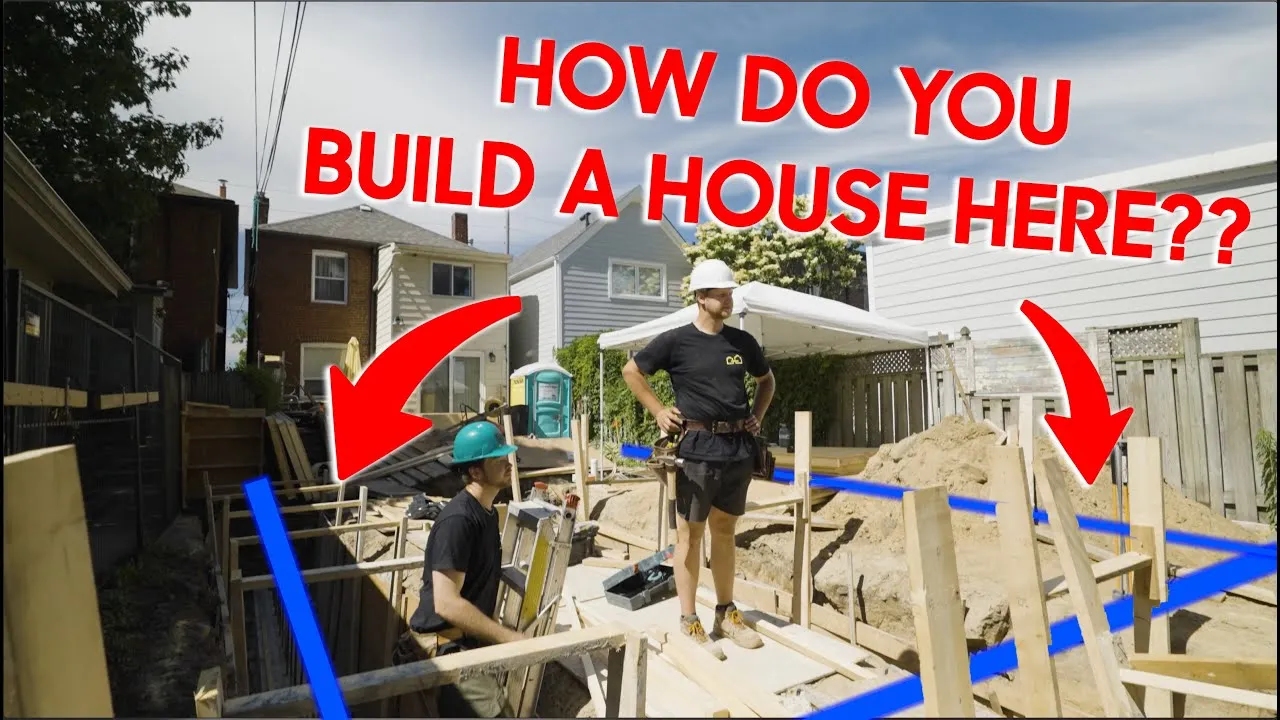
Holy cow, Joelle, you are not kidding about tight lot lines. This is… Dale. Dale, Matt, Matt, nice to meet you. So how tight is this footer right here on your lot line? And if I slide down the side of your house, that thing looks like it’s pretty dang close. It is pretty damn close.
It is supposed to be one inch back from the property line. Oh, the hill, that’s not much room for air. I sure hope the survey crew got those pins right. Well, they’ve been in several times, so they better have.
This side, and I see your forms coming this way, but there doesn’t seem to be anything on this side of the house. That is true, so we obviously need permission from the neighbors to dig larger than the house, okay? And over dig, let’s say…
Exactly, yeah, and some of them will give you that permission and some might not, so in this case we have to figure out a way of getting that side of the house in without stepping foot on any of the neighbor’s property.
Holy cow, Dale, that’s crazy. How the heck do you build, you build a house right over there property line? Well, it’s been a challenge, but in this particular case we’re going to just dig two feet down along that side at first, pour essentially like the upper half of the foundation wall, okay? And then we’re going to underpin it before we, before we frame the house. There we go, underpin new construction.
Nothing like underpinning your brand new construction, so but then also… Also you frame or side, or do anything else, so how do you do that? That is also going to be a challenge, um, definitely we’re going to have to build a large portion of this wall on the ground with siding and everything, and air tightness is going to be a challenge as well, but yeah, but as far as I know that’s the plan, and we’re talking to the engineers about some gasket details and a whole thing to be able to build that wall flat and then lift it up, essentially fully completed, fully completed like siding and everything, is that right Joelle?
Yeah, that’s actually a maneuver that we’re sort of used to working in the laneways because working with these zero lot lines, but in this particular scenario that side of the house also happens to be the side of the house with the stairway, so a part of this, a part of this wall which we will be building on the ground and pre-cladding, a part of it will actually be a two-story wall, so we’ve got a few ideas. You can see the, the constrictions don’t really allow for crane, but we’ve actually got a hair-brained idea to mortise some hinges into the plates and actually, actually hinge the wall up, tilt it up.
Yeah, dang man, I gotta tell you guys, so fun to come visit you. It’s interesting how I may be from a different country and in different states, and yet we all face some, some… I don’t face this challenge, these are hard challenges, don’t get me wrong, but we all face similar challenges. There’s something about builders that just connects us, isn’t there, daily? Roger, it’s so good to meet you brother. You too, well, we appreciate it for sure.
Guys, if you’re ever in Toronto, you’re building a laneway house, you should be calling Laneway Custom Builds.