Foreword by Ian Thompson, Editor
In this video, Matt kicks off a 24-part educational building series that showcases the entire process of building a high-performance home from start to finish – and all on a modest budget.
The project itself is fascinating. They’re working with an existing slab in an established neighbourhood, dealing with Austin’s strict tree preservation rules, and aiming for a balance between high performance and budget-friendly construction.
So, if you’re thinking about building your first home then this series is a good investment of your time as it shows you all the aspects of the build that are worth knowing from an experienced builder. This episode is all about pre-construction planning and all the site considerations we have to think about.
So, whether you’re an architect, builder, or just passionate about advanced home construction, you’ll want to stay tuned. This could be the start of a new way of approaching residential projects, especially for those of us aiming to build better homes without breaking the bank.
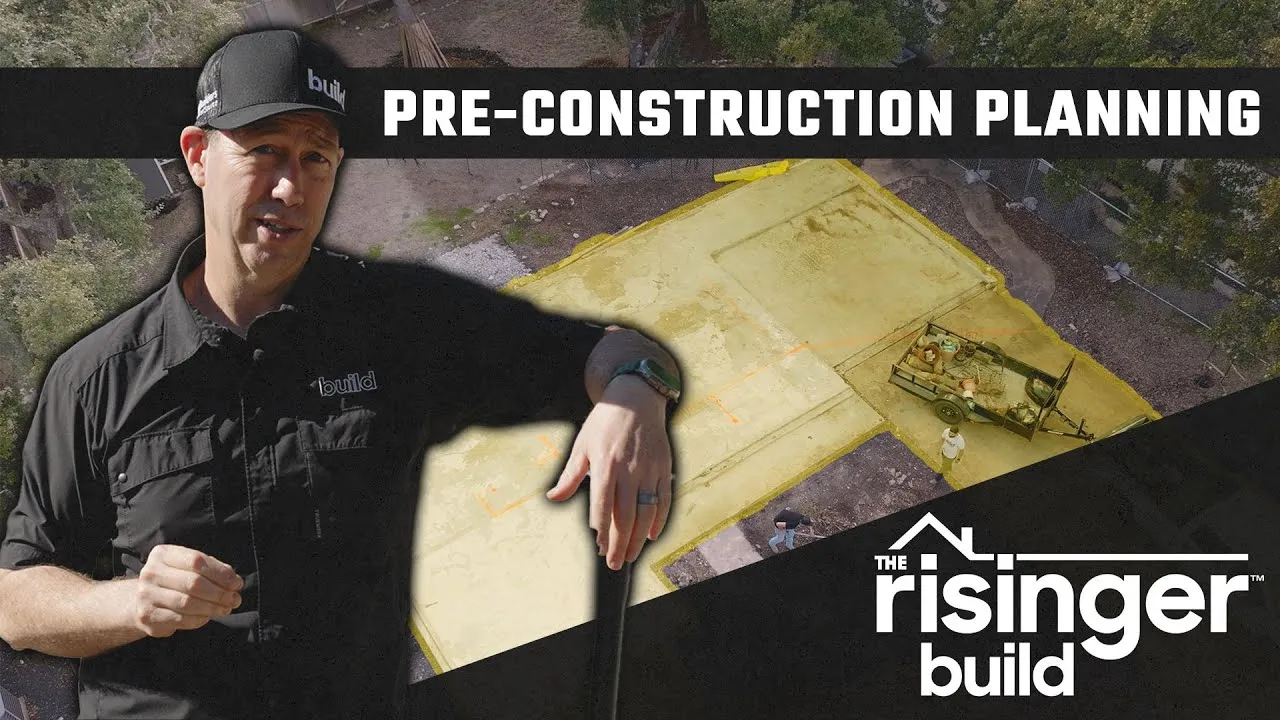
The Risinger Build Episode 1: Pre-Construction Planning
Video Transcript
All right my friends, here we go – day one of a brand new project. If you don’t know me, my name is Matt Risinger. I’m a builder in Austin, Texas. I’ve been making YouTube videos since 2008 and I’ve made a lot of videos about construction, but I’ve never filmed an entire house start to finish. On this Build Original Series, in partnership with my friends at Builder First Source, we’re going to show you the entire build process on this house right here. It’s going to be a high-performance house for a family, built on a little bit less of a budget than you’ve seen me build on in the past. Not only that, but we’re going to show the entire process start to finish – a Build Original series: The Risinger Build. Let’s get going.
A Build Original Series in partnership with Builder’s First Source: The Risinger Build.
Guys, I am super excited about this project. This is going to be super fun to take you through a 24-part series on how to build a fantastic house. It all starts on this episode in pre-construction. You know, this planning phase is vital to building a really good house. It, for a good analogy, sets the foundation for a really good house.
What we’re doing on this video series is something I’ve never done before. We’re going to be utilizing some tools available to builders nationwide through Builder First Source that they call their digital tools. It’s a suite of things that allow me to basically build the house on the computer and understand all the parts and pieces, from the engineering to the ready frame package to the trusses, including all the mechanicals and how they integrate into the bones of the house. This is totally going to change the game for builders across the country, and we’re going to document it and show you this process.
By the way, this house is going to be on the Build Show Live tour as well in November, so you’ll get to come visit this house as well.
Starting in this episode, episode one, here we’re going to lay the groundwork for what’s happening, where the house is, what we’re doing. Steve Basic is our architect, and as I said, we’re going to be utilizing a bunch of tools that we’ve never done before that we’ve maybe had to pay multiple thousands of dollars to outside consultants to do, or super expensive architecture. But again, we’re doing this on a much more modest budget.
I think you’re going to find a new way of building a house that does it on a budget that you will be shocked you can do it for, plus the performance is going to be through the roof. I mean, you know I’m passionate about changing the way we build houses in America. This is the video series that’s going to show you exactly how to do that.
Now in this first part here, we’re going to meet Steve Basic, the architect. We’re going to show you what we’ve got, what we’re building, and where we’re building. With that being said, let’s go find Steve Basic.
Steve, how’s it going, brother?
Steve: Hey buddy.
Matt: So if you guys don’t know Steve, amazing architect out of Boston but works all over the country. Steve, you’re really known for your high-performance construction, not just great architecture. Talk to me about what you’re thinking about when you come up to a lot like this. House is gone, and we’re designing a really cool house, but we want this to be a really high-performance house. And I said earlier, we’re looking for a house that’s built on a bit of a budget compared to some of our past projects.
Steve: Yeah, I mean probably one of the very first things is to understand the fabric that’s around us, right? The scale of the houses, kind of the size of the homes here, the materials that are being used. Because we’re going to come in here, we’re going to put a house here, but we don’t want it to be something totally different. We want the neighbours to be happy, we want these people to feel like they’re part of the neighbourhood when they move in. And so, understanding the scale there, and then kind of translating that understanding into okay, what kind of level of performance are we going to talk here? What kind of price point are we at? You know, we’re probably not doing a passive house here, but we’re not doing a code-built house either. We’re going to elevate some of those standards and get us a really good house.
Continue Reading: Pre-construction planning transcript
Matt: And let me add a little commentary to that. We’re in Austin, Texas. We’re in a city neighborhood. This was originally developed in the 1970s. There are a few newer homes and some whole house remodels. There’s also some existing 70s houses around us. One and two stories, 2 to 3,000 square feet. So I’m assuming that’s probably what you’re thinking for this house as well.
Steve: Yeah, this is probably a three bedroom, you know, two and a half bath, three bath. You know, we have our two-car garage. There’s some things here that the site is kind of limiting us to, that we’re not going to go crazy on. But I think it’s important that we also look to what are some of the things that are good about houses. Like a lot of houses that we do now have an upstairs living room or hangout space for kids, right? We’re keeping the bedrooms a little small, but we’re giving them a community space.
Matt: That’s right.
Steve: And so I think, you know, these neighborhoods, this is kind of a family-friendly neighborhood where you’d assume this person probably has two or three kids that’s going to move in here.
Matt: That’s right. So developing a house for that kind of family living. Now you notice we took the old house down, so we’re starting with this slab and we’re leaving the slab. If you’re not familiar with Texas construction, we don’t have a frost line here, so we don’t need to – like if we’re building up in Boston, we’re going to dig a full basement because we’ve got a 3-foot frost line. We’re trying to get below that to make sure we don’t have heave. We don’t have that here. We also have the issue in Texas of solid rock. If I were to dig down, Steve, here another 3-4 inches, we would hit absolute rock.
There are some parts in Texas that have a lot of clay, expansive clays. This neighborhood is very blessed with massive rock, which means as you look around at these houses in the neighborhood that have masonry fronts, brick fronts, rock fronts – no cracks visible at all, which means we’ve got real stable foundations such that this slab is a good starting point. And what’s the reason we decided to kind of keep the slab and top it, Steve?
Steve: Well, one of the other restrictions that Austin poses that is – and we do work all over the country and this I find to be probably the most, one of the most restrictive things here – is they treat these trees like gold, right? These are the most important things to the City of Austin are these trees. So there are certain dimensions and, you know, radiuses that we can’t operate within on these trees.
Matt: That’s right.
Steve: And some portions of the existing slab are already in conflict with that. And by keeping the slab, it allows us to maintain that conflict. If we remove that slab, we would now have to conform to that. So the idea here is that we keep this slab, we add where we can in kind of those spaces where the trees don’t exist, and we’ll pour a new slab there. But we’ll come over the top of the existing slab, probably to level this out and get it all cleaned up.
Matt: So in other words, Steve, we’ll go on top of this slab by maybe 4 inches. We’ll talk to the engineer about what he wants. We’ll reuse what we’ve got here as kind of a stable platform or base. We’ll raise the elevation of the house by about 4 inches. And at this point, Steve, you’re thinking we might push back maybe in this area here where we don’t have –
Steve: Yeah, we have some void there that we have some freedom from the trees. So, you know, getting some kind of space there that probably can interact with the backyard would be a good choice.
Matt: That makes sense. Now we do have a setback here as well. We got a 25-foot setback, so we’re really not going to be able to go much further out where we are now. And the driveway location is nice and it seems to be in good shape, so we’ll see what we can do in terms of keeping the driveway.
It’s going to be really interesting, Steve, for you to take us to the next step and really figure out what the floor plan is. Ultimately, we’re going to put brand new plumbing and water lines into the slab because it’s a slab construction. Though I personally want to limit the amount of piping in the slab except for drain waste vent, so we’re going to try and maybe just come in with a water line and then everything else will get run overhead. But of course, the sewer lines will have to go through the slab and those are good for decades and decades and decades, no problem. I do have a concern with plumbing into the slab, so we’re going to try and limit that wherever possible.
Steve: One of the good things we have though, that I always look for when I come out to projects, is you know, there’s a lot of history in this slab already – 50 plus years – and it’s still in really good shape. There’s no giant cracks through the middle, so it’s telling us that we’re, like you said, on pretty stable ground.
Matt: Yeah, and for my building nerds out there, this is a rebar slab, not a post-tension slab, which means that the rebar that’s in place, if we cut something as we’re sawing the slab and putting new plumbing in, we can fix that no problem. Whereas if this was a post-tension slab, we’d be really worried about hitting one of those tension cables and then the slab losing its structural integrity. So that’s a big benefit of this type of construction.
It’s also one of the reasons why I really like houses that are new to use rebar rather than post-tension, even though post-tension is a fine system. It tends to be a little less expensive, but I like the rebar for the remodability of it, which is always something, Steve, I’m interested in. Is in 50 years and 100 years, if someone wants to remodel, can we do that? Is that going to be possible and easy for them?
Steve: Yeah, that post-tension system that you talk about, it’s a very finite system that it’s dependent on the integrity of that system as a whole for its life.
Matt: That’s right.
Steve: So you can’t go in and modify it in any way.
Matt: That’s right. So something really exciting about this project, Steve – we’re partnering with our friends at Builder First Source, and the plans and the details that Steve’s developing for this house will actually be available for sale in their home plan library. And as we get into future episodes – you know, this is a 24-part series, Steve – we’re really going to be able to show the entire build process start to finish.
You know, some of these guys know us from buildshownetwork.com or maybe some of my YouTube videos. They’ve seen us do some parts and pieces, but I’ve never built a house start to finish on camera and record the whole thing. And to have your plans available for sale means that Steve can even develop a basement plan on this. So if you’re interested when you get to the end of the series and actually building the same house, you could buy this plan set and you could even modify it with Builder First Source to customize it for your lot, your location, and do some cool stuff.
Stay tuned too – we’re going to be digitizing Steve’s plans and Builder First Source is going to be doing some really interesting things that you’ve probably never seen before. And they’re fairly common in the commercial world, very uncommon in the residential world, in terms of being able to show the bones and the structure of the house. So stay tuned for future videos as we get into that.
Steve: Yeah, you know, doing this for a while, I’ve come to understand there’s this giant gap between where we finish drawings and then when we go into construction. And there’s some needs in there to coordinate a bunch of issues, efforts from HVAC, plumbers, structural integrity and all of that. And you know, mentioning Builder First Source, I’m really excited because they have an idea that can fill that gap and bridge that gap between the end of what the architect does and the start of what construction companies do. So it’s going to be a really interesting journey.
Matt: Steve, I’m really excited to see what you come up with in the drawings for this house. This is going to be a really fun project. I can’t wait for you guys to follow along.
All right, y’all, well the rest of the team does the architecture, which I am no good at. I’m going to do the official groundbreaking. Shall we? You know, most of the time we have a big red ribbon. We got a gold shovel. Now, we, the Build Show, it’s black.
[Matt breaks ground]
Yep, it’s nothing but rock under there. We got maybe a few inches of soil, and then we got nothing but rock. That makes me happy as a builder. That means this house ain’t going anywhere.
That being said, stay tuned for episode two, guys. We’re going to be jumping into those digital tools. I’m going to introduce you to some of my friends at Builder First Source, and we’re going to meet Chelsea, the architect from my office, and Tim Hill, my business partner. We got some really good wisdom we’re going to be doling out in episode 2.
And again, it’s that pre-construction that lays the foundation for a really well-built, high-performance house on a modest budget. This is the Risinger Build, a Build Original series. We’ll see you next time on the Build Show.
Related Posts
The Real Home Rebuild Series – Project Introduction Ep. 1 (buildreview.org)
Mastering Home Construction: Insightful Exploration of Windows, Roofing, and Cladding in the ‘Real Rebuild’ Series
Build Show Network (buildproductions.com)