Foreword by Ian Thompson, Editor
What’s the perfect foundation? The one that works! Interestingly, many countries have a typical or common housing foundation type. For example, the decision to adopt a solid concrete slab or slab-on-grade foundation type a long time ago may have been because it was deemed cheaper and easier to build. However, today, concrete and labour is expensive, and the extra concrete that we use in this type of foundation should be a considered cost factor because alternative foundation types may now make a sensible financial alternative, be better suited, and more sustainable.
I’m designing a house for a project, and I would like to use a suspended ground floor slab so that I can access my services more easily. This is something you cannot easily do with a slab-on-grade foundation. If your wastewater pipe fails under your house, then you’re breaking open that slab and causing a lot of destruction, disruption, cost, and time. Whereas a suspended floor slab gives you that quick and easy access, and the fix could be just a few hours’ work instead of a week or possibly more. Designers tend to overlook these maintenance design aspects because they do not need to live in the house – they just need to provide a building design solution that stacks up.
There are many considerations to make when choosing your foundation type, including the stability of the soil your house sits on, seismic conditions, and the weight of your house. But I still think there is an opportunity for engineers to cut costs and provide more sustainable and easier maintenance solutions; they just need added encouragement.
Please consider that this video relates to North America’s use of concrete foundations, whereas concrete was first used by the Romans around 300 BC.
Over to Matt’s video post.
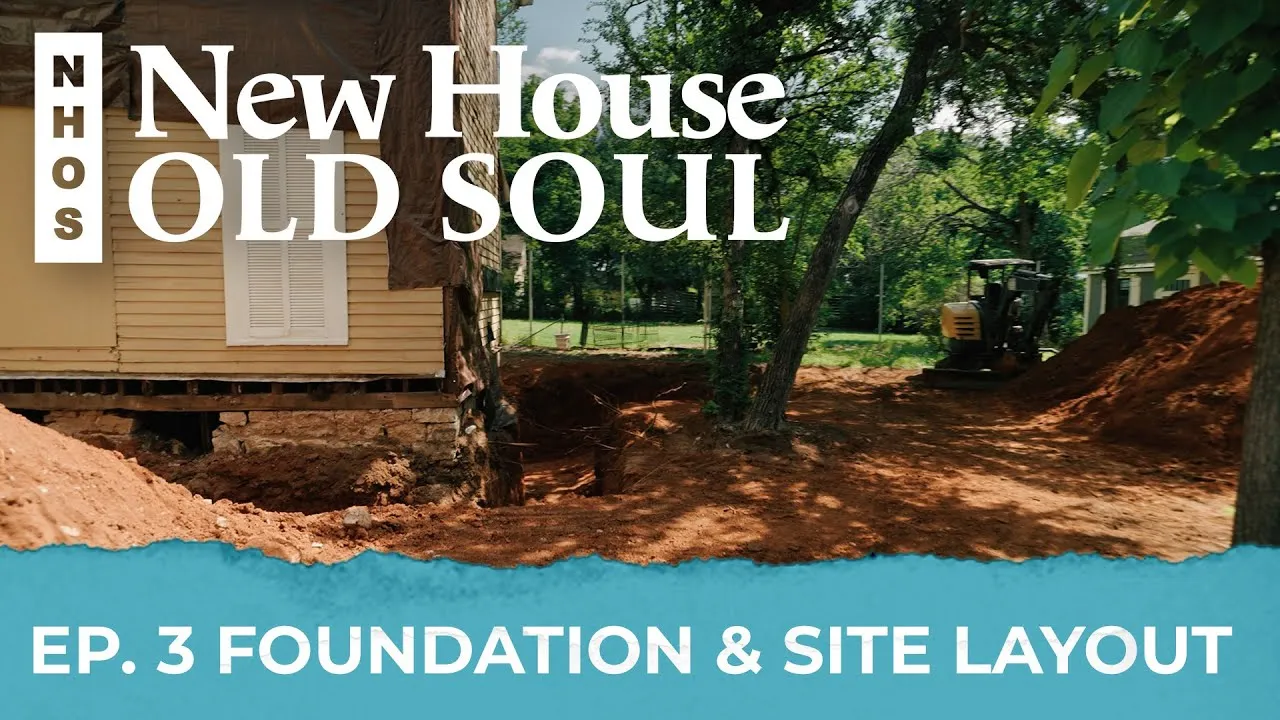
“Foundations & Site Layout” New House, Old Soul – Ep. 3
Introduction
Welcome back to “Build,” the original series hosted by Brent Hall, where we explore the journey of creating a new house with an old soul. In today’s episode, we delve into the fascinating world of foundations. How do we achieve the timeless charm of an old house while utilizing modern materials like concrete? Join us as we uncover the history of foundations, examine the evolution of building techniques, and discover the secrets to creating a house that embodies the essence of antiquity. Our journey is sponsored by Stellar Floors and the Unico System, and I’m your host, Brent Hall. So, let’s embark on this architectural adventure and unlock the secrets of building a new house with an old soul.
Video Transcript:
Welcome back! New house, old soul. How do we get it? We’re going through a number of different steps in the process of building a house. And how do we get a really great house? How do we get a house with an old soul? Today we’re talking about foundations.
Thank you for joining Build, the original series hosted by Brent Hall, New House, Old Soul, sponsored by Stellar Floors and the Unico System.
So, how do you get a new house with an old soul when you’re dealing with a new product like concrete? If you have a slab foundation, how do you capture the old soul? Well, there are a number of different tricks we’ll talk about today of creating the look of an old house but using modern materials. We’re going to look at the history of foundations, the history of building, and talk about how to create that special look for your house even though we’re using new materials. But when you understand the history and the past, it’ll help you build better today.
We’ve got a number of different foundations going around the city that we’re building with. What is that history? What’s going on? Essentially, we’ve got to remember that if we’re looking on this timeline of history, this is Egypt and the pyramids and stuff like that, or the Greeks and the Romans back there. And then this is today. So this is 2020. Zero’s here, and this is 2000 BC or whatever. Concrete is basically, you know, in the last hundred years.
Concrete foundations that we’re using are not something that has been around for a thousand years, okay? Furthermore, if we blow this up, essentially early 1900 is when concrete starts to be able to be used more regularly. Okay, steel and concrete in high-rise buildings and things like that, buildings started changing right around 1900. Slab foundations, right, our post-World War II thing. Even slabs, okay, and that whole idea of slab is also within that little 100-year period here. And then you talk about insulated forms, ICF, insulated concrete foundation forms. That’s even in the last 20 years.
One of the things about concrete early on in the early 1900s is a lot of these houses had no steel in place. Okay, so the idea of using concrete was sound. There are books on concrete houses we actually looked at in the concrete house here in Fort Worth. But at the same time, same period of that house, early 1900s in concrete, I see it done very well. And then I’ll go look at houses and I’ll see it done very poorly where the concrete’s breaking up. Now, now 100 years later, it’s because there was no steel put in there. So realize that even in that first hundred years or in the last hundred years, say, we’ve been using concrete, it took probably 20 to 30 years for there to be a standard quality thing that required a certain amount of steel in the concrete that kept it from cracking up. So a lot of the early 1900s foundations are or can be a mess.
Continue Reading
So, what was the foundation in 1881? Well, we know because of that Victorian house that we’re doing down in Granbury. It has a stone foundation. And so, really, if we’re in America, you know, 1700, right? And so if we’re just looking at the last 300 years of building in America, up until the beginning of concrete foundations in the early 1900s, things were either stone or they were brick. Okay, and so Stone obviously already comes from the ground, already in the ground. If this is our building, then there is oftentimes a rock wall foundation that went down a certain amount. In the South, it wasn’t quite as far as it was up in New England. Why? Because we don’t have frost. We don’t have the ground freezing four feet below the ground. Okay, foundations are deeper to get below that frost line so that they don’t heave. Right? Because if you’re building in this area and the water in the ground freezes two feet below, it could take your whole foundation and push it up. Right? Because the ground freezes, it’s going to lift it up. So think about a lot of houses in the South, they’re up on piers, right? And so the Bodark stump, which is a very common thing if you look going to Fairmount, which is the 1900s, a lot of the piers that are supporting a house, and remember, if this is our house in the early 1900s, the foundation was pier and beam. Okay, pier and beam means that there’s an exterior slab wall, right, and then there are these piers that come across around your foundation that then your framing is laid out on top of these piers, right? And then you build your walls. That pier and beam foundation, looking at it like this way, we’ve got a foundation wall that goes down. This is early 1900s, and then let’s say the dirt is… let me see… the dirt is right in here, right? Inside the house, they might have a pad or something of concrete, but this sometimes was a Bodark stump. Okay, Bodark is a very rot-resistant hardwood that termites couldn’t eat and things like that and became very, very popular as a way. And so then your framing goes right on top of this, right? And then your house is built from there.
Okay, so most houses before the era of the slab, okay, and slab was William Levitt when he started building Levittown, the houses would not have basements. Why? It saved so much money. Slab foundation was cheaper, faster, a quicker way of building. Essentially, this little scenario right now is kind of how those foundations were laid out. This before 1900 is stone and brick, okay, depending on where you are. Now, if you’re out in the middle of the country, in order to make bricks, okay, you would have had to build a kiln. You’d have to find clay. It was quite an endeavor. So brick foundations were, you know, popular and maybe common in a city, but out in the country, you didn’t have those things, so you were using rock. Here in Texas, there would be limestone rock, which is what we find at that 1881 house in Granbury, where that brick wall… we don’t think that there is a spread footing at the bottom, but that whole thing, right, is all stone going up and even going down into their basement, and then it had a dirt floor.
This is a great book. This is Radford, 1911, I believe, and, you know, he’s showing a number of different building techniques and building things. Here’s his one on foundations. Notice there’s a number of ways of doing this. This is all brick construction. Okay, so this had been in the city. But one way of building was actually to drive piles down, most likely a wooden tree driven into the ground was very soft mud, try to find something very strong, and then put a beam right on top of it. So certainly not a three-story or four-story building you build that way, but certainly in earlyconstruction, they would be using piles. But we’ve got brick construction going on here, on some kind of stone or some kind of concrete footer down below. And what this then shows is a number of different bonding patterns that go with these brick foundations, that they would have to be bonded together. And if we look at the stone foundations, how those are put together, I’ve talked a lot in some of my videos about coining, okay? And coining is where these bricks are kind of fingered together in the corners so that they kind of lock a corner together. Very important when we’re talking about laying a cornerstone over a building, the cornerstone would be that on a corner right down at the base that kind of anchors both sides and allows everything to be built off of it. So cornerstones are very, very important.
When they were made of stone, you know, the particular problems that we have in Texas with foundations is we have expansive soils. What does that mean? There’s a lot of clay in our soils, and so clay, when it gets wet, expands, and when it dries out, it shrinks. Okay, so most of the houses in North Texas have foundation issues, and I will put in an ad of, you know, two thousand dollars to level and shim the house. I mean, what they do, quite a common measure, the house, find out where the low spots are, and we’ll actually put metal shims between the floor joists and the beams in order to level the house out because that’s pretty common here. That Granbury house, you know, the shape of it’s like this, and we’ve got that L going off the back, right? This whole thing, okay, is stone on the outside. We are building a kind of an addition and a new basement right here. Now, we are going to build that with concrete. Okay, we’re probably going to build it with block in the infield block. So what we’re going to do is we’re going to pour a beam wall on the outside of this thing. We’ll put our haydite block right up here, okay? The haydite block, that concrete block, if you look down at the top of it, right, it is made like this, where it’s kind of hollow in the middle, and this is all the concrete all around these holes end up getting filled with concrete. So this will become our foundation.
Well, in order to make this haydite block and be kind of porous, we will then tar and then do a dimple mat here and have a foundation, a French drain, okay? So this will all be gravel in here, and we’ll have a French drain that’ll keep this area dry. So we’re going to create a mechanical space underneath this house. But one of the other things we’re trying to do here is we’re trying to make sure that it doesn’t look like that from the outside. So if you look at the house this way, we’re going to be real careful about the height that this outside ground goes to, and we might go back with stone here that’s exposed so that we, even though it’s going to be blocked underneath there, so that we create the look and the feel of that new house, old soul. The point is today you’ve got a lot of opportunity to create great foundations, okay, yet also have something with a new house, old soul. One of the things we’re going to be talking about in this series is the balance that’s required in building, right? Because foundations, I don’t really want to build a stone wall foundation here, one, because I don’t think it’ll last as long as a concrete foundation, I think that’s a superior material. But at the same time, I care deeply about how it’s exposed and what it looks like. So I don’t have a big, you know, concrete base going around the house when I want it to look like it’s 200 years old. We’re doing that great ranch project out west of here, and we spent quite a bit of time working on that foundation.
Maybe the most important thing besides material is maybe how you’re making the basement or the crawl space dry. And so in that case, we had a very tall wall, 14 feet tall, somewhere in that range. We’re going to spread foot into the bottom. This is entirely concrete. But we spent a lot of time weatherproofing the backside of this wall. We tarred it. We put a dimple mat on it. Whether we do it with block like we’re doing it at 1881 house or concrete, the concrete on the barn project out there is because we built that barn into a hill. So our wall on the outside, that basement wall, is retaining a lot of dirt. It’s holding up a lot. And we really needed to make sure this wall had some beef and some heft to it. And so we excavated probably 10 feet behind that wall. We get all kinds of equipment and everything else back there. But then we backfilled this with dirt. But right close to the house, after the tar, after the dimple mat, after the French drain, we really had something that was going to be dry, most importantly, and that was really the most important piece of making that basement usable, is making sure it was dry. So whether you do it with haydite block, whether you do it with concrete, whether it’s the slab or whatever else, concrete is the preferred material today. And you’ll notice that on this house, our concrete will oftentimes stair-step as it’s going around here because wherever that dirt is, we want to make sure we hide that concrete and we just have stones so that we’re conveying a story that it was an original stone building.
Now, let’s head down to the 1881 house, show you that dig out, show you that foundation, and talk about how we’re going to lay this thing out. I really think we’re going to see a difference between building in the past and building today and blending those two together so that it looks great. Remember, as we go through this whole series, it’s really about finding a balance, finding the balance of the best product, the best material for our foundation, while in this case, but also fighting for it aesthetically so that it looks right. But there’s going to be a balance that’s going to take place in there. There’s sometimes I’m going to say, “No, no, we’ve got to do it this old traditional way,” in this case and with say, air conditioning, right? We don’t want to live like they lived in before air conditioning. We want some of these modern conveniences. So we’re going to be, at times, definitely putting in the best product, but also fighting it aesthetically so that we have the right look and the right feel.
This 1881 house in Granbury, Texas, is a smaller town in Texas that really hasn’t been changed a great deal, and it’s really a great opportunity for us to go back and look at how foundations used to be built
How do you get that we’re in the Granbury right now? We’re in the 1881 Italian House. This is a very original house, a very early house for Texas. What we have here, how would they have built the foundation, right? They would have built it with stone. If you drive down to Town Square and look at the buildings here, you’re going to look at the natural quarried material that they had available to them. So most of those buildings are built with this local limestone. We’re in a day and age in 1881 where you wouldn’t have shipped slate from Vermont down here, right? We’re not in a heavy railroad time period at that time, so you wouldn’t have been shipping products from long ways away. So we’re looking at a very natural material for them. We see a lot of it downtown here in Granbury, so we’re looking at a local stone, and this is how they would have built that wall in 1880.
Thanks, so come on down here, guys. I want to show you this foundation and what we’re seeing and what we’re going to scrape back to is this original stone foundation. Now, stone foundations are porous. Now why are they porous? Well, because we’ve got these mortar joints between these stones, and as you get down into here or down into this softer rock because it’s been wet for so long, look how it’s just breaking out. It’s like sandstone, right? So is that just a mortar failing or is the stone failing? We’re going to have to dig into that more and kind of figure it out, but we’re going to carefully excavate down here, expose this corner, rebuild this corner.
Here, you see a stone foundation, guys, and the benefits of it, right? In 1881, before you have a brick anywhere nearby, they can take these local quarry stones and actually build a foundation. Now, if you look at these stones, they have been worked, right? They haven’t been tooled, but they’ve been worked. All of this chipping on the front of this thing has smoothed its face off. So this stone most likely would have been quarried somewhere nearby and then brought here and then worked in order to make this. Notice that we’ve got a coin’s corner here, right? There’s the corner going around over this side, this side is going that way.
Typically, the way those stone foundations worked is I’ve got my stones doing this, right? They’re crossing one another back and forth as we go up this thing so that it can really lock in this corner. So you’re seeing some of that stonework and some of that stuff happening here means that this thing was very well built, means that there was some skilled craftsman doing this. This isn’t something a farmer would have done. This is something that someone with an understanding of good building would have done. So good stuff here, but we’re going to go back with a concrete foundation and we’re going up with a block wall, right? So a block wall is something we can still waterproof on the outside, can still tar, still have our dibble mat, still have a French drain around the outside, still have a very dry basement for them, but something that’s going to last a lot longer.
Thank you.
Okay, guys, so we’re back. What you’re seeing now is the essence of that new household soul that we’re trying to communicate because we’ve got a new H-type block concrete block foundation. We’ve got a new beam right down there, spread footer at the bottom, and then we’ve built a block foundation going up at the top. Now, what you notice there is that stone right at the top of the block. Now, why do we do that? Because if you look back at this corner or you look around the other side of the house, rock was the foundation of this original house, right? They, and we have now built up what would be our new basement in this house. But the important piece in the new house, old soul piece, is that we are mimicking the stone, okay?
The layup of the stone coming across here as if this is the original look. Okay, we don’t want on this historic house and this historic restoration to have, you know, this concrete block coming up because it’s going to be this instant clue, like, wait a minute, what’s going on? When did this get changed? What’s, you know, what’s happening here? This also is kind of that layer of just authenticity that we’re trying to communicate, right? That this was this original piece. Now, when you go into the basement, when you’re down there, it’ll be completely new, right?
So the problem with the old basement was that it was leaking bad, right? And so the water was really going into that space. So we are now going to give her a mechanical space with a really high-functioning basement down there that’s completely new, but from the outside, it looks old. So the real key, guys, is to be thinking through, right? When we have these new foundations, say you have a slab foundation, what are you going to do? How are you going to disguise the fact that it’s a slab foundation if you want it to look like a traditional house? In your beam wall, you do a drop-down, right? You do something so that the brick actually is going to go down, hide that. The grating comes across, and it looks like bricks coming out of there. You might widen the stance of that and put a water table brick right that would look like it’s coming out of the ground as this big brick foundation. It’s always thinking about how is this going to look? What is this going to communicate? How are we going to tell this story so that it works? If you want an old soul in the house, you don’t have to give up all the new technology, new design things. There are ways to hide those things so that you can have a slab foundation, you can use concrete, have an engineered foundation, but also still have the look of that old house.