Foreword by Ian Thompson, Editor
Custom PreFab, Off Grid – futuristic housing!
Introduction
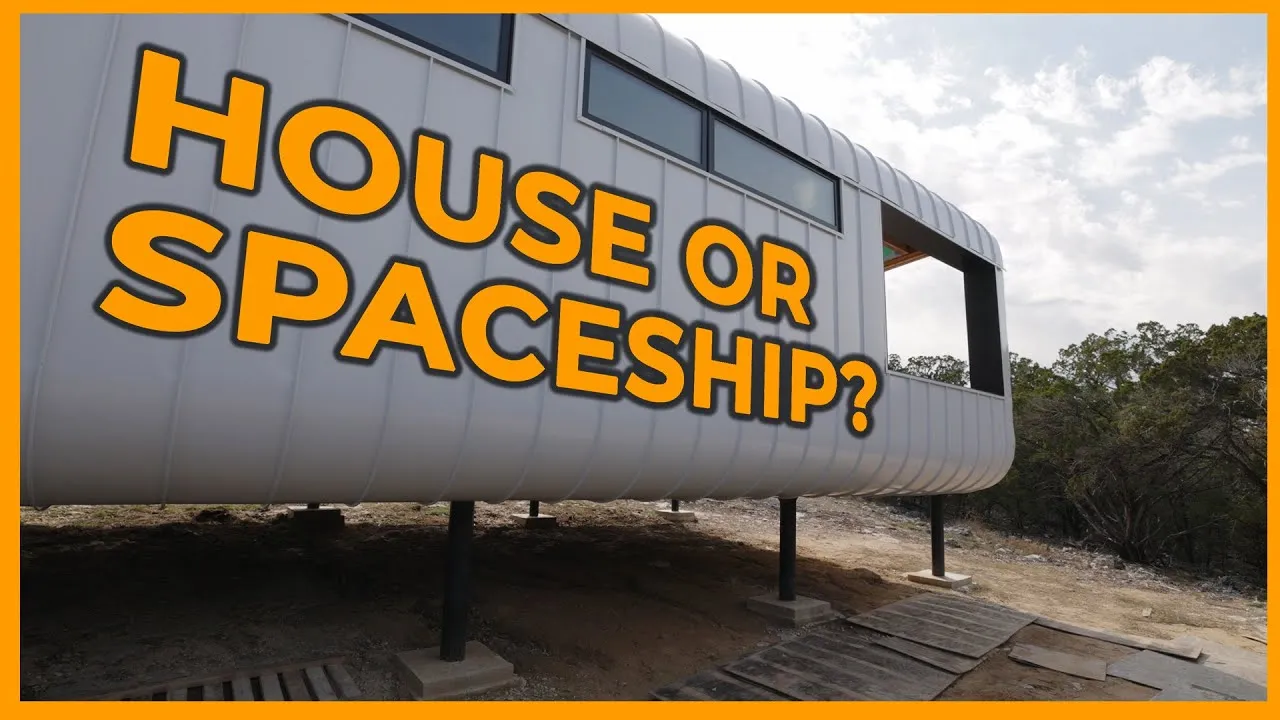
Welcome to today’s episode of Matt Risinger’s the Build Show! We’re coming to you from a Ranch property just outside San Antonio, Texas, where something extraordinary has caught our attention. It appears that a spaceship has landed right here on this vast property. But that’s not all we’re here to explore. We’re about to meet Andrew, the visionary behind gpotamericas.com, who will take us on a fascinating tour of this remarkable spaceship and unveil an equally intriguing off-grid story. Today, our focus is on Andrew’s Ranch, where innovation and sustainability collide. So, buckle up and join us as we delve into this extraordinary project. Let’s get started!
Video Transcript:
Build show is on the road today. We’re outside of San Antonio, Texas, and it looks like a spaceship has landed on this Ranch property. We’re going to be visiting with Andrew from gpotamericas.com. We’re going to give you a quick tour of the spaceship, but there’s also a really interesting off-grid story here as well. Today’s build show is all about Andrew’s Ranch. Let’s get going.
“Alright, guys, let me introduce you to Andrew from gpotamericas.com. Andrew, this is super cool. What is going on? We’re going to go to your house in a minute, but what’s going on with this awesome power module back here?”
“Well, Matt, this is a unique project. We started off with the rainwater and solar infrastructure. You’re standing in the job site office, which was a repurposed container that we connected solar to. We got a 10-kilowatt system that makes all the power for the project. We put it in before everything started. Then we started the construction.”
“So, I see a lot of 20-foot containers on jobs as offices. I don’t see them typically as power stations very often, though. Check it out. So, it’s pretty hard to not notice. You’ve got this really cool array. Would you say 10kW, all kind of on the corners of your pods. I’m assuming that’s strategically placed, right?”
“It is, yeah. The corner castings of containers have an attachment point that’s used to transport and lash the cargo. In our case, we decided to use it for the trackers. So, we fabricated trackers on-site that allow us to get the solar arrays up out of the way, tidy, and relocatable. It works on any container. And because we didn’t have anywhere to put the solar, that was our solution for securing the solar arrays up off the ground when there was nothing out here but these boxes. Makes a lot of sense.”
“Now, this is not temporary, though. This is going to end up being permanent, and you’re not connected to the grid at all, right?”
“That’s correct. It’s totally off-grid. We did this before the construction started because we didn’t have CPS, a local utility provider, on the site, and we’re 1200 feet back from the road. So, this allowed us to do a construction project where we didn’t have to have poles put in and that whole expense upfront in order to do the metal fabrication and construction that we were going to do here. So, we just wanted to show that it was possible to take a box, put the machinery that we need to have to have power on-site, and do it.”
Continue Reading
“And walk me through that. How does that work when the solar comes down and sends that DC power? Where does it go?”
“In there, it goes into these charge controllers, then goes to the batteries, and these inverters would take that power from the batteries and distribute it as AC power wherever you need it, whether we’re charging a Tesla or welding or running a plasma cutter, charging tools, running air conditioners, anything.”
“So, these black boxes are charge controllers. That’s taking the solar, and then those are coming into these batteries. Are those like lithium-ion, something special?”
“Those are pretty basic, Matt. Those are lead batteries, so they’re heavy. But we’re in a container that’s going to be moved by equipment. We’re now moving them by hand more than once. So, we really don’t need that lithium. Lithium is a mobility-based power storage. In our case, we don’t need it, so we use lead.”
“And how much storage do you actually have here on these batteries?”
“Those altogether add up to 200 amp-hours or 2000 amp-hours starting that. And our overnight loads are about a tenth of that, so just 200 amp-hours overnight. That’s enough to do most of the work that’s happening here during the day, and that gives us what we need as overnight.”
“So, in other words, during the day, you’re using the power to basically direct from the Sun, that’s going into this system, and then outputting to your welder, to whatever you need. At night, then, you’re running strictly off batteries, but you’re never dropping more than about 10 percent of your battery.”
“That’s right. That’s how we sized it, and that gives us all the overnight power that we need. Eventually, even when the main building is done, the Villa, that’ll have a limited amount of overnight need for power. So, our overnight loads are what we’re sizing the battery for, and if it never goes below a certain limit, then we’ve done a good job with our design. So, you know, overnight loads are typically the lowest. You’ve got your heating and cooling. There isn’t a whole lot else.”
“This shipping container is great. This is pretty basic, but looks great. You’ve got a window rattler in the end, which we’ve got at our hunting shipping container. You got a job site desk, a spot you can take a nap. I saw some other cool shipping containers. Let’s meet you at the next one. I’m going to show you what else Andrew did with me.”
“Case Andrew, I really like the look of the industrial shipping container. But what are you doing with this particular container?”
“So, Matt, we wanted to insulate it on-site, and we wanted to try this InsFast. So, we buy the polystyrene panels, and they fit. You can see that they are shaped to fit the corrugation of a container. So, this one is rigid. They’re ready to go.”
“So, it’s pretty cool. You just take your adhesive, you apply that, and you bond it to the wall. That’s enough. That’s pretty cool. And then this is almost like an ICF foundation that has this screw holding plastic in there already. So, now we can attach cladding. And if you’re in a neighborhood that doesn’t like the look of a shipping container, you can use this. This also is the right place ultimately for the installations on the outside. So, much better. But you can, of course, do it in both places if you wanted to. And then you’d have a really cool shipping container.”
“I want to point out, though, Andrew, I really like what you’ve done for attachment points. You know, we’ve got a shipping container or a hunting lease, and it’s just on some concrete blocks. I have to re-level it all the time. You drilled some piers here. It looks like and got a pad prepared. What’s going on here?”
“So, these weren’t drilled. These were hand-dug. So, you can hand-dig if you just, you know, it’s shallow soil here. So, in this case, you didn’t know that, but we have a hand-dug footing that has a weld plate on the top with anchors. So, place, we’re in Texas, by the way. There’s no frost line here, no. So, the plate is left on-site. And then when we bring the building in, we connect those legs to the twist lock, and that’s this. Yeah, which makes total sense. I’ve not been on a shippingcontainer boat before, but this must be how they lock the containers so the high winds aren’t blowing them off. So, you basically just took that plate, welded it on, and now this 20-foot container here only has four of these piers, level forever, set it and forget it in this assembly. Here’s basically what’s going on up above for your panel solar panels too, right?”
“That’s right. For our trackers, we use the exact same, just a shipping container lashing process that’s done all the time, every day, and we just use those parts to use those connections.”
“This is storage for you during construction. Eventually, it will be a spa. And this next guy over here, I love too. This definitely speaks to me as a builder. This is your actual workshop, keeping all the welding tools. You can lock it up if you’re going away, right?”
“That’s right. Keep everything secure. And this is really what a shipping container looks like from the factory, which is this marine-grade plywood floor. And then, I think you mentioned you’ve got closed-cell spray foam underneath, and then maybe some 20-gauge steel on top of that to protect that spray foam from the critters. And this one, of course, you don’t need to insulate because it’s just a workshop and storage space. This one will end up being a product later, but for now, it’s just our shop for the job. So, we’ll change it later. We’ll do the same thing, insulation, and finish it out. It’ll be a really slick product later. Right now, it’s just a shop. I love it.”
“Andrew, we would be remiss if we didn’t get a quick tour of the spaceship. Let’s meet you guys over here.”
“Sounds good.”
“Andrew’s super cool modern building. What is the story behind this?”
“Well, Matt, this is our first big prototype that we’re doing for this that we call the Nexus design. It’s kind of an industrialized design that we can do as a site build. So, we’re trying to showcase this in Texas. We’ve got some interesting design choices that we made. Let’s take a look at it. I like it. So, first off, before we go outside, though, I think it’s interesting that you’ve got, obviously, no shade. It’s a pretty modern-looking building, but you added some boxes because we’re facing what, south and west here, I’m assuming?”
“Do south, and what are these boxes on the outside here?”
“Matt, this is a quarter-inch aluminum hood that has a flange that we lag into the window buck. That’s a thermally broken assembly that we’re attaching to, and it’s aluminum, so it’s stable for now and doesn’t rust. We got our white metal outside. We didn’t want it to get rusty, and that’s how we handle shading and window protection without a roof overhang. Makes a lot of sense. And then if you get down on your knees, what have we got?”
“One, two, three, four, five, six times two, twelve piers. That’s all it takes.”
“That’s right, to hold this house up. And I think that’s so cool. You’re on a sloping site. This is kind of the short end, and it’s a little taller on the backside. What’s the Genesis behind that? What made you decide to do that on the design?”
“We’re trying to display what low impact development looks like. So, this is one way to do it. You’ve seen buildings that are up off the ground before, but this is a choice that we prefer to make when we’re in a natural setting. It lets us leave the water management as it was where we found it. It lets us do more of a surgical, airy, floating approach to the foundation, and it gives us a pretty small footprint. So, that’s the whole point.”
“You know what’s cool about it, Andrew, is it reminds me of an old-school Texas pier and beam, but just done in a more modern way. I’ve done lots of pier and beam houses. We’ve also remodeled a lot of pier and beam houses, and there’s really nothing crazy going on here. You’ve got some 2×4 floor trusses that probably came from your local Builders First Source, exactly. You’ve got some inch and an eighth AdvanTech up there, and then these beams look like our double LVls right here running side to side. And what’s the rough dimension of this?”
“The width of the whole building is 24 feet. The span is about 18 feet.”
“Okay, so these LVls are just going 20. They’re just… That’s right, and doubled up. And then the floor trusses are hanging on those two beams. And we do the same thing for the roof. So, the belly and the roof is the same, except that we have a shed roof, so one side’s higher.”
“Okay, so this is just a mirrored image of it. And then how do we insulate the space, and how do we cover that?”
“We have a lot of different choices. In this case, we’re going to do a little bit of spray foam and then dense pack fiberglass, just like we did with the walls.”
“So, maybe two inches of closed-cell on there, dense pack the rest. And then are you going to put some zip panel under here and tape it?”
“Yes, so this has got some zip here. So, we have, on the floor, we have two air barriers, interior as well. We’ve got the sheetrock that’s a secondary air barrier, and the zip on the outside for our primary. Super cool. And then these windows look to be kind of standard flanged windows that you’ve installed in a kind of normal house fashion, even though this looks like a spaceship.”
“These are just Weather Shield triple-pane windows from Wisconsin. They are pretty high-performance. We’ve got a good airtightness. You know, we did a good job in the blower door. We got a 0.3 out of this.”
“Holy cow, you got a 0.3 in this building?”
“0.3, so you know, yeah, it’s using a system and good materials. Let’s walk inside.”
“We got a 60 by 24-foot building that’s arranged. Remember, it’s kind of an industrialized design that we’re doing site builds. So, we have five 12-foot sections of the building. This is our core module. This is just living space. You can see where it’s divided by the shear walls. And then we have our outdoor area outside with a deck module with no shear walls. We did the LVL moment frame all the way around it, so it was all open. And this is the space we got.”
“13-foot wall on the north side, 11-foot on the south side. These walls look pretty thick. What are we looking at here?”
“So, Matt, we have a double-stud wall, and we have dense-packed fiberglass. It’s just Knauf EcoFill in there. And then we got our Weather Shield triple-pane windows. And probably almost the same R-value on all four sides of the box, really.”
“Right. So, we have foam.We have closed-cell foam in the roof, so it might be a little bit different up there. But the trusses are, you know, they’re roof trusses, so there are fewer of them, and they’re a little bit different. So, yeah, hopefully the R-values are really good. How did you get the radius on the outside, Andrew?”
“That’s one of our very unique features that I think is pretty cool. You can buy radius plywood that’s ready to go from the mills, and we use the same since we used the 5/8 zip. We just use 5/8 radius plywood, and that’s how we created the 90-degree corners on the floor, and they meet at an obtuse and acute corner at the roof. So, there’s a little bit of slope, and that changes the geometry a little bit, but it’s pretty simple.”
“And that metal that’s on there, did you make a roofer blow his mind out when he was thinking about how to bend those, those double-lock standings?”
“Even some lasting friendships over the challenge of that. That part of it was pretty tricky. And visually, that’s probably the most outlandish part of this design because I don’t think anybody has radiused the one-inch standing seam before. But we figured it out. It’s pretty awesome.”
“Is that 26 gauge, 24 gauge?”
“24 gauge, even thicker. Holy cow! And it’s probably on a rain screen too. I think I saw some photos on your Instagram feed. We’ll put a link in the description on that. So, you’ve got good building science here. It’s white, so in Texas, it’s going to be reflective. Big thick walls, really good airtightness. I bet this is going to be very little load on your battery array to keep it heated and cooled.”
“You know what you’re talking about, Matt. That’s exactly right. That’s pretty impressive. So, Andrew, if someone watching this thinks this is cool, what you’ve got going on here, what’s available from g-pod Americas today versus what are we seeing that’s a future for your company?”
“We have the ability to deliver plans and projects in most regions. We’re pretty small, and we’re focused on what we’re doing. We’ve got a waitlist if anybody wants to submit a project. They can. We are hospitality-oriented, but we are doing custom homes and other commercial projects that are smaller right now. So, it’s all available. Check us out.”
“Boy, I could see somebody doing a 12 or 24-unit array of g-pod tiny pods that’s maybe on a winery somewhere and looks like a bunch of spaceships that dropped. Anyways, I’ll put a link to Andrew’s website and his Instagram feed. But what, of course, I love about this project is it’s really off-the-shelf components. This is wood framing. There’s nothing here that got shipped from five countries away, maybe some good Mechanicals from another country. But other than that, pretty straightforward construction, really high performance. Kudos to you, Andrew. And I’m going to steal some of the ideas on the sea cans because I think the way you peered those and also the way you dropped the solar on there, super unique. Thanks, Matt. Good stuff. Thanks for coming by. Thanks for the tour, guys. If you want to learn more about Andrew’s company, I’ll put a link in the description below. If you’re not currently a subscriber, hit that subscribe button. We’ve got new content, interesting projects like this one with Andrew that we publish every Tuesday and every Friday. Falls on TikTok or Instagram. Otherwise, we’ll see you next time. On the build show.”