Foreword by Ian Thompson, Editor
If you work with Mass Timber or are planning to use Mass Timber building systems in the future, this video is essential viewing. It provides a comprehensive understanding of the different connection systems available and their applications.
It’s crucial to acknowledge that many companies are now manufacturing their own proprietary connection systems, each with its own benefits and drawbacks. Any structural engineer will tell you that the connection systems are as important, if not more so, than the mass timber panels, beams, and posts themselves. However, careful design and placement considerations must be undertaken to incorporate these connection systems into your final building system solution. This ensures that the mass timber elements are manufactured correctly and that site installation proceeds without a hitch.
By watching this video, you will gain insight into the innovation, utility, and careful design that goes into these extraordinary mass timber connection systems.
Revolutionizing Timber Structures with Innovative CLT Connections
Video Transcript
Hello everyone, let me introduce myself. I’m Mateo Andreottola. I’m a structural engineer. I work for, for a few years as a structural engineer for, for a local uh company which produces and designs CLT structures. And currently, I’m working for Rothoblaas as a technical consultant.
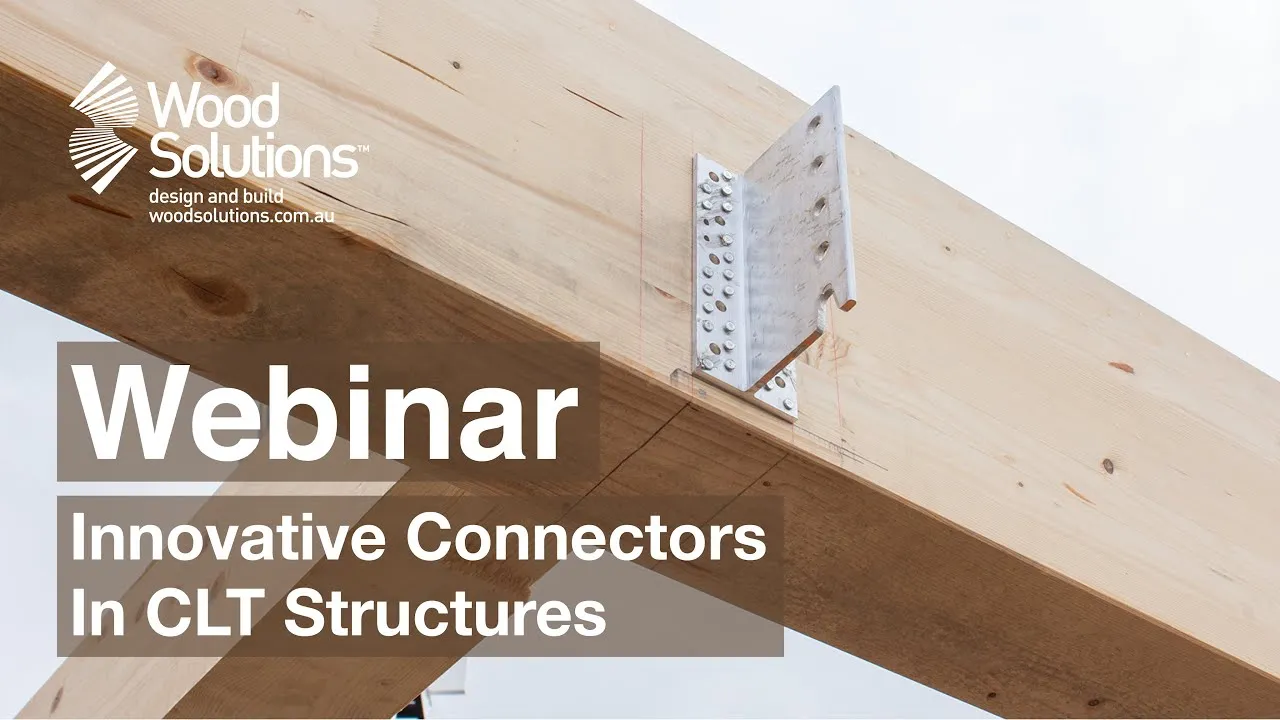
Let’s have a look at the lesson of today. Today we’re going to talk about innovative connections for CLT structures. And let’s have a look at the index so that we, we have a rough idea what we’re going to see in the lesson of today. We’re going to start off with some innovative angle brackets which are the ones that are most commonly used right now, in for for CLT structures.
And then we’re going to move on to the base connection for the CLT structures, which is uh the Alustart. This is a very nice innovative product. And to finish off, we’re going to have a look at other other couple of products, the slot for shear connections of CLT panels, and the spider and pillar.
Now let’s finish with the talking and then let’s move on with the with the presentation. So let’s do a little bit of introduction of how the, the the timber structure works for horizontal loads. So we have multiple shear walls in our, in our structure that withstands all the horizontal loads of of the structure.
And as you know CLT is a quite new product which has a lot of uh, very very good characteristics. And so the product itself is very very uh well performing. And the the only thing is that we have to connect it properly.
So how did the standard approach to connecting the CLT walls worked in the, in the past? The standard was like you can see here, having uh two hold downs one at both ends of the CLT wall panel and a shear connection in the middle as you can see here.
Now we are moving on to, as you will see in the presentation, we are moving on to, you know, different kind of connect, in the CLT panel. And in particular we have, you know, the same connector which can be used as a as a hold down and as well as a shear connector. So we’ll see in the presentation how that works, and why it’s it’s a better, in a way it’s a better approach to the to the issue.
So in a CLT building we have a lot of different connections. So connection between the CLT wall panels, floor panels and so on so forth. In this lesson we are going to explain some of these connections. And I hope that you will be able to better understand and better um, you’ll be able to better pick um choose the right product for one connection or the other.
So just again to start off the, the timber industry is moving uh, is moving on as like in the in the past we were used to see this very small uh, timber structure like the one that you can see here, in the in the picture. So like this small construction, small structures like this mountain hut for instance.
And nowadays though, the CLT structures are becoming, uh you know, are making make it possible for us to, to build very high buildings, multi-stories building like the one that you can see in the in the pictures. Like for instance the the tallest one in Norway for example that is 18 floors, or the Hahoo Tower in Austria which is 24 floors.
And usually these very tall buildings, they have, as I said before, the main issue are, um the connections really because you have these really high forces, these really big forces, especially on the on the ground levels. You have big forces and and therefore you need as well some big connectors to, you know, to withstand those forces.
Continue Reading
In the pictures here you can see some of the connectors that were used in the the tallest building the tallest CLT structure in Italy which is uh in Rovereto. And it’s it has nine, nine stories. And as you can see it wasn’t possible to use, you know, standard connections for for these ones in particulars, they they needed to use this customized steel steel plates for example.
And of course this kind of uh, plates are very expensive, they are they are not certified. So we’re gonna see some of the connections that are available in the market and are already certified, and and hopefully we’ll uh will manage to understand how to use them as well.
So let’s start with the modern angle brackets. Uh angle breaths, brackets have been on the market for a long a long time for many years, but you know as as time passed and the CLT structure became more and more popular, as well the you know those plates became more engineered, they developed as well.
So let’s have a look at what we uh what we achieved through some you know through the years. So this is like a standard connection. And I was, as I was saying before, this in particular is a connection that you can he, that you can use for as a hold down, for tension forces and you can use the same connection as, um as a shear connection for, for for the walls for example. And we’re gonna see how that’s better.
This one in particular it has uh five millimeter, five diameter, five millimeters diameter holes and therefore you can use nails or screws depending on the, and which one you prefer to use first of all and, depending on the resistance that you, they want to achieve.
The the resistance that you get with these connectors is roughly 46 kilonewton for um, is the timber resistance for for shear, and 68 kilo newton the characteristic tension resistance of the panel.
And in particular, it’s interesting that just by adding this, steel plate here which is called a washer in this case, by adding this one into here you are able to use this one, this uh the same connector as a as a hold down, uh to withstand the tension forces onto the ground level.
So uh of course the the connector has uh um, an eccentricity and therefore it tends to to rotate and, uh it tends to fail the steel tends to bend up and and fail. And therefore by adding this uh, reinforcement, this base reinforcement, it’s possible to, to increase a lot the resistance of this connector for example.
And of course you can use the same one, exactly the same one, to to withstand the the shear forces. And there is a very similar connector which is uh you know the shape is exactly the same, apart from the the size of the holes. This one in particular it has eight millimeter diameter holes and therefore you can use bigger screws in in there.
Why is it better to use bigger screws rather than small nails? It depends of course, it’s a, it’s a choice of the designer, but of course when you have less screws to place in, bigger screws but less of them, you you spend less time on site screwing it in. So that’s um, you know, an improvement on side. Of course it works uh just in the in the same way. We have the washer that can be placed for for tension forces or we can use it without washer to withstand the shear forces.
So it is better as we said before, because you can just use a simple drill to, to place the connector on site. This reduces a lot the noise and the vibrations that you, you have on side. And as well as well it can be, faster as we said before. That’s another very well designed CLT connector. And why is it uh, is it a good connector from an engineering point of view?
So as you can see here in the image, we have a series of uh, full threaded screws that are placed exactly where the corner of the bracket is. And that’s very good because it decreases a lot the eccentricity that you have, on the on the on the connection of course.
And by reducing the xm3 eccentricity you create less bending moment. And the less bending moment means that, uh you know, it’s working better the the connection works better and you have more resistance.
In fact, it’s it’s stunning, the the resistance that you get with these connectors here and it is roughly 100 kilo newton of tension. So that’s really a lot, that’s actually more than what you achieve with the, you know, the standard very long connectors like the whd that we provide as well.
And it has a very good, as you can see here um a very good resistance to to shear as well. So it’s definitely something very good and, it has some other very important characteristics. Just one of them, you can see it just right there in the corner, sorry you can see it right there in the corner.
And as you can see for for standard hold on for example, you need a bear then a bar, a threaded bar that passes that passes through the the CLT floor panel. And in this case scenario, as uh as you can see here you don’t need the, the the bar here but you just have the the screws the incline screws that are doing exactly the same thing so they are resisting the tension forces.
And why is that, an improvement? Because as you can see in the image for example, if you have a different thickness of the clt panel on the upper floor which is something very common. Because of course, in you’re going up with your constructions and you don’t need such a big thickness uh because the loads are decreasing.
And so that’s uh something which is very very helpful in multi-stories building for example. And another very very good thing is that in his other images, it’s very clear this connector stays under the the finished floor level that we have on the inside. So if you want to have a visible facade a visible clt panel, you can use this one without any any problems.
And usually the whole sound are longer and of course if the panel is visual it’s a problem of course. Another thing of course that you can use the same again the same connector for shear forces and for tension forces which is something that makes everything you know simple. Because you don’t have to pick the the right connector you just have a bunch of them and you can use it. All of them throughout the building.
These are some pictures of the the testing that was done for for these products and as you can see here in this images here the failure, of course where the nails are. That’s a very good thing for the ductility of the of the connection. And uh we’re gonna explain that further on in the presentation. And another important thing since the the connection can withstand tension force and shear forces as well at the same time, you have a domain of resistance in which of course if you are inside the domain that your connection is verified.
Otherwise it is not verified, so as we were saying before the ductility of the connection is very important . Because as you all know timber is a very you know strong material. It’s very lightweight and very resist, the resistance is very hight.
The only issue that we have with the timber structures, is that the claim timber is a fragile material. So when they, when it fails, it fails without, you know, yielding or bending too much. When it just, when the failure occurs, it just snaps completely, like if you’re snapping, uh, a wood branch in the forest.
And uh, and of course, we need this ductility of the connections one. When we are designing, uh, you know, a structure which is uh, which is in in an area where the seismic action is quite strong because, by you know, by displacing the connection like we can see in the in the image there, a lot of forces goes in here and it makes your structure was as a ductile structure, which is very important.
So let’s uh start talking about the, the connection starting from the ground. And I have two examples right here of uh, ancient uh, timber structures with which came to to our uh, days without you know being, um, destroyed without uh, uh, being you know damaged by the the rain or the humidity. And that’s because, once upon a time, the the people were, of course, very intelligent in in constructions. They know how the the material behaved and they were trying to to achieve the the best things out of every single material.
And in this case scenario, for example, you can see that the base of uh, the structure is done with the, with stones. And just the the out the upper part is done with a with a timber structure. And as you can see, all the timber structure is completely covered by the the roof and the durability of the the structure increases a lot.
So just that was just an example, um, to highlight that it’s very important to, um, design in the right way the connection to the ground. And that’s exactly what we’re gonna talk about in this other part of the lesson.
So uh, water and humidity is the worst enemy of your timber structure. And especially in the, in the ground connection, is where you have to be the most uh, careful of course, because you have uh, the water that try uh, that tries to go up the structure, uh, you know, because of the the capillarity. And as you you have as well the water from rain which is trying to, to get into the structure.
So a very common detail that you you can see in clt structure is this, this concrete uh wall that you have on the ground. This is very cheap and works very well. In fact, you can see it, it’s very common, you can see it in a in many many structures. And the the common rule that we have one, when we are designing this uh, this details here, is that the finished floor level uh, of um, of the, you know, of your structure, of your building should be lower than the the dimension where the clt wall is starting.
So the only issue that we have usually with these little concrete walls is the, the fact that the tolerances of the concrete walls are not exactly the same as the tolerances that you have on your clt structure. You use cnc machines machineries to, to cut your your clt panels and you just pour inside the concrete wall.
And therefore, sometimes you have big issues, uh, because they are not perfectly aligned and that’s a big issue for connections and also sometimes for the resistance of the wall which is not bearing completely on the on the concrete wall.
So um, an improvement is, uh, this product here. This is called Aldustart, for example. And it’s a an aluminum extrusion with some some some small holes on the side right here for for nails, for the shear, for sheer forces. And the bigger holes here, which are needed to to attach this uh, this extruded uh plate, to to the concrete that you have on the bottom.
You can see an image, a better image of the the product right here. And as you can see here, you can use uh, full nailing or partial nailing depending on uh, how big your, your force, your shear force is. And it’s uh, it’s very nice because you have this, this cheeks and they come in two different shapes.
We there are, for example, the the corner ones and the um, the most simple one, which are the linear one. It’s uh, this one. These things here are dimes and they are needed to adjust the height of this little, of the Alustart so that you’re sure that you’re perfectly aligned with your upper clt structure.
So you avoid completely the the issues that you have, that you had before, with the with the concrete wall and the tolerances are exactly the same. So you can be very precise with these things as well.
And the other good thing is that you can take out the the dimes here and you can reuse them for for other structures, for other jobs. So you can see here an example of how to place, how to place this uh Alustart. You can uh adjust it in uh, on the, on the two planes. So a longitudinal, uh, longitudinally and as well laterally, like you can see in this other image.
And to to make sure that your allostar stays exactly flat, you can you can use a little timber or other materials to, as a to to fence it off. And you can pour, you can pour non-compressible grout in, on the inside. So that you’re sure that your connection is completed. And once it’s completed, you can remove the dime as we said before.
And the we have as well on the on the rotherblast website, it is available the, w, the dwg uh, and all the drawings of this product. And uh, of course, you can, we have different dimensions of Alustart so that you can use the same product for different thicknesses of your clt panels.
And there are a few products that you can use together with this uh, with Alustart. As we said before, you can use the small nails or screws for the shear connection. And to connect the yellow start with the, the concrete foundation, you can use mechanical screw mechanical anchors or expansion mechanical anchors.
By the way, also, for what concerns the connection to the the foundation, depending on how big your force is, you can use um, you know, a partial, um, you know, you can use a partial connection and not, when you cannot waste. And in this way you can reduce the waste of connectors that you use in the building.
And why is is it a a good connector this one? You are really trying to minimize the quantities of connectors that you use in your ground connection. So as you can see in the image here, it is not mandatory to use angle brackets for for shear, because of course the shear is is supported by the, uh, the yellow start itself.
So you don’t need all those uh, um, angle brackets. But you just need the the hold downs here to withstand the tension forces. And uh, so tension forces and shear forces.
So there are three kinds of resistances. The first one is uh, the timber side resistance, that is given by the the nails or the little screws that are connecting the aluminum profile extruder profile, to the the clt panel. Then of course, you have the resistance of the material, which is aluminum of course. And that you have the resistance of the connection to to concrete.
So the the final total resistance of uh, your connection would be the uh, the lower one among this tree that we just explained. And let’s have a look at the, the compression resistance that you have on to your alum, Alustart.
Of course, it’s a connection that you find at the base of your structure. So it has to withstand high compression loads. And as you can see here, it can withstand 1486.88 kilonewton per meter of compression. So it’s, uh, it’s quite a lot. So that means you can use it, you can use this kind of connection with multi-story buildings, no problem.
And it’s very, time effective. You you can reduce a lot of time that you need to, to this, do this kind of connection on site. Because as we said before, you’re reducing a lot of the connectors. You’re very fast and very precise and you don’t have to pour concrete on side with issues on tolerances and so on. So forth. So it’s um, it’s uh, very good for this case scenario.
And of course just by adding, uh, hold downs, you you manage to withstand all the forces that you, you have to support at the base of your connection. Here you can see some, some pictures done on site with the Alustart. You can cut it with a regular circular sew. And you can see here details of the connection with the with the membranes as well. And of the of the little jig that helps you placing the aloe in the right place.
Let’s move on to the other, to another a note of innovative product which is which came out on the market in the last few months. This is the slot connector and i will try to explain what is. Its use, its applications and why it can be a very interesting product in clt structures.
So of course when you’re designing your clt structure, you might have very long panels. For example very very big wall panels or very big panels, in general, of course sometimes it is an issue to produce such big panels in the factory or even transporting them might be a big issue. So sometimes you have a job which is maybe up the mountain with a very narrow road and you have to divide your panel into small little units.
So of course you could, you know stitch together again all these little parts of your panel by using simple screws. That of course needs you need a lot of time on site to do this kind of job and as well you waste time. You waste time and also man hours on site which is uh not usually a good thing. You know cost wise as well.
So what this product actually does is you know it it connects one panel to the other so that instead of having a lot of connectors, you need just few of these slot connectors which of course have a higher shear resistance. You can see here some of the most common connections that you have for clt. You know connections panel to panel connection, let’s say and and of course we want as you can see ,here we want our panel to behave like a single unique panel.
And not as a as a double, you know panel like that. Why is it the case because if you have a panel which behaves like a single one here you can just place a hold down in here and another hold down in this position. If you have a panel that works like like this one, you you need more hold downs because this is not behaving like a single shear wall.
So that’s very important, you can see here some images of the testing that was done for this product here. And you can see the resistances that in this case came out 40.6 kilo newton off of shear resistance. Of course as we will see in the next slides, we’ll see how to calculate this resistance and what are the factors that change how the product is behaving.
You can see here what we just explained before that we are trying to avoid having a lot of single units like that, but we are trying to achieve, you know, having a big wall that is behaving all in the, you know, as a single one.
And if you have longer walls, of course, you won’t have such big, you know, uh, tension forces at the uh, at the ends of your walls. And in this case scenario, you will, as well, reduce the tensions and the dimensions of the connections that you need.
This is um, um, a drawing of the product and uh, of course, the product itself does the job, the the sheer resistance here. And uh, it’s uh, it is mandatory to place this uh, extra and screws here so that first of all, the the aluminum extrusion stays exactly where it is put so it doesn’t move. And second of all, you have a little bit of resistance as well, uh, attention resistance between the two panels, which is which can be useful sometimes.
And um, this connection here is uh, it’s time saving as well because again it’s the same concept. Instead of using a lot of different connectors, of little small connectors, which is a very time consuming and not really much, uh, cost effective on on site, you’re using less of those connections and you use a connection for with with higher resistance.
Uh, if you, if you go on the on the rotherblast catalog, you can see this example here. And it was calculate how many, how many nails or how many screws you need to to achieve the same uh, displacement of the wall with the the slot connector or the the screws. And of course, you have very many screws and uh, just few slot connectors.
And here you have a table of the resistance if that you have with this, with this product. Of course, the the resistance depends a lot on the since uh, of course uh, the the area that uh, is supporting the the load is uh, mostly the one where the fibers are uh um, perpendicular uh to the, i mean parallel to the force.
All the places where the the grain is perpendicular are not so, uh, are not resisting just as much. And so, just by calculating the the area where the the grain is uh parallel to the force, you can easily calculate with the tables provided how much is the resistance of this product. And you can use it, as we said before, on wall panels but as well on floor panels or, or on curtain walls for example.
On big multi-storey walls like the one you can see in the image, we are gonna have a look now uh, innovative product, the the spider. It’s called spider because it reminds a little bit of the animal of course, with all those long arms. And i’m gonna tell you where the idea of this connect, of this connection came from.
So it is something that, uh, comes from the the concrete buildings, of course. It’s uh, it’s very common to have concrete buildings where you have a continuous concrete slab which is supported by, um, by pillars, by columns without having, um, you know, a secondary structure made of beams and and stuff so, like the one basically like the one that you can see here in the corner without any beams and nothing else.
The issue that you have on this structures here is the punching through, as you can see in this little sketch here or in the in the sketch that you have right there. So basically what engineers came up with are this reinforcement for for concrete. And basically this uh, this reinforcement were, uh, you know, developing in every single direction so that they could take the the punching shear in the concrete structure.
So with the, with a clt uh, with the clt structure, um, we try to achieve the same thing, of course. It’s very common to have structures like the one that you can see on the on the image now with the secondary [Music] glulam beams and, but you can decide to remove completely all those uh, secondary beams to uh, to have a finish, to have a structure that looks like the one in the picture right now.
This is a is a very famous building in in Canada, Brock Commons, and this is for example, um, a structure that was developed using the same concept without, trying without having any um, you know, secondary beams in the building.
Let’s have a look at how the, the connector works. First of all, how the the loads are are going into our connection. Of course, you have the load that comes from the the upper floors which is going down here. And you have, as well, to to add the load from the, the CLT slab which is the one you can see right here.
You have, of course, this very long, full threaded screws which pretty much are, of course, attached to the the CLT floor panel. And pretty much what, how it works, how this works is that your CLT floor panel is hanged, is attached with these inclined screws to the the arms of our um, spider connector.
And so this uh, these big arms are bringing all the forces down here. And so the total load is uh, you know, is the the loads from the upper stories, plus the loads from the the CLT’s slab.
And as well, uh, these connectors here, the full threaded screws, the inclined ones here, are very useful for another thing as well which is uh, the rolling shear. Of course, in in a situation like this one, of the the biggest failure mode that you can have is rolling shear, of course. And you have another reinforcement, this these other screws here which are there to reinforce the compression perpendicular to the to the grain.
There are some some tables available online, so that you can easily calculate how many of these you need and what is the maximum loads that you can support with your connection, as you can see here. And uh, let’s have a look more into the, the detail how the, how it works and uh, why is it working, um, better than you know normal uh and normal structure with uh, with you know, beams and columns.
So first of all, you have a continuous slab, and from an engineering point of view, that’s better because instead of having, um, you know, a bending moment uh diagram which is uh going down like that, you have a continuous lap. So that and, and therefore, you have uh areas in which, um, the, you know, bending diagram is going up and reduces the one in the middle of the span. So it works better for, for this reason, first of all.
And uh, and this is how, you you place it on site, of course. It uh, completely eliminates, as well, the, the compression perpendicular to the, fire to the to the grain to the fibers that you might have in these locations which is, of course, an issue with the with timber.
And this is how you you place it on side, basically how you place in those long, full threaded screws that we we’ve seen before. It’s very important to use a torque wrench to, you know, be sure that you are placing the screws with, with the right torque, inside the the steel to timber connection. It’s always very important.
And when to finish it off, of course, you place the the upper column and you continue like that for the whole building, of course. This uh, this spider connector has its own, you know, dimensions so it can be too close to the edge of the building because of uh, you know, these big arms which are going in all, uh, directions 360 degrees. But you can uh, use this um, this this connector together with the, the pillar which is another product that we’re gonna explain in the, in the next slides.
You can have two kinds of uh, slabs, so two kinds of CLT structures together with this product. So you can decide decide to have a continuous slab like the one that you can see here. You can have bigger spans with these, in this case scenario.
And basically, you connect the CLT panels one to another with a, with a bending moment connection like the one that you can see down here. And in order to do that, you use steel plates which are connected with the, epoxy resin which is the the sap box in this case scenario.
And um, another way to do the the same thing, basically, is uh just by using the CLT panels down here as a continuous beam and you can place other CLT floor panels on top of those, so that you you basically are achieving the same thing, but without using bending moment connections which sometimes are, uh, you know, uh, difficult to, to design.
Of course, Rothoblaas can give you help, the technical technical support for connections like those ones, but you can see like um, that with this, uh, with this method you are able to achieve, um, spans which are not as big as the one that we saw previously, but [Music], but big enough actually to to have the correct span of your buildings.
Of course, this again is uh, helps off to save a lot of time as well. And the the main, the main savings that we can find are, first of all, you eliminate completely the secondary structure, so you don’t have to waste time on site, you know, connecting all those structures and placing them on site. You save a lot of cubic meters of, of timber.
And you as well save a lot of cubic meters of of the building, so with the same height you can have more stories, for example, you can have more floors. And you don’t have issues with the installations passing through the beams which is always a very big concern, of a big issue, in big buildings, for example. And of course, you have this nice architectural finish which is uh, very minimal and very beautiful like the one you can see in the picture.
Before moving on to the next product, I would like to show you a small video that helps you out understanding all these characteristics of of the spider and the pillar that we’re going to explain in a minute. [Music] [Music]
So another another, um, you know, product that I wanted to explain to you, which is very innovative and just came out on the on the market, is this pillar connection. So it’s a very similar, in a sense, to what we saw before because this one helps to get rid of the issue of the compression perpendicular to the grain, which of course is a big issue in them in timber structures.
So basically, you’re replacing, you have a a little, uh, steel column, which is uh, bringing all your upper forces down to the the other column. And so uh, you can achieve the same thing basically, um, having a structure without secondary, uh, secondary beams and uh, and all the connections that you have for domes for those beams.
It’s a very similar to the building that we that we saw before, the Brock Commons. That’s where the concept kind of came from. It was built in Vancouver. These of course were using uh, they used for this project here in in in Vancouver, all custom made plates which uh, were not certified and they have to be designed by the structural engineer which, you know, it’s always very complicated.
And by using this product, you have already all the values, the resistance values that you you need. And uh, it’s it’s very simple, it’s certified, it’s straightforward, you have the help of a technical, you have all the technical support that you need for this. And, and by the way, let’s have a look at the spans that you, you had here for example, in the Brock Commons, four meter by 2 meter 2876.64.
And as we saw before with this innovative products, we can achieve as well since they are engineered very well engineered. And as well they are tested, you can achieve bigger spans as well which can be useful for offices and other buildings. You can see here how the pillar works, how the connection works.
You can see that here that you can place as well, you know washer to avoid the noise from passing from a floor to the other, from a level to the other. And you it’s very simple and it’s very straightforward because you basically have a bottom plate.
Your steel little column that you have here and an upper plate which gets connected with the the upper column. So it’s very simple. These are the parts that are you know, the components that are um you know are the the pillar. Basically are making the pillar and here is how you you place it together with using simple screws.
Let’s uh have a look at uh how you, how the load is transmitted from the upper floors. The upper stories to the bottom ones, it’s very similar as the one we we saw before. Because you have the the load from the upper floors and as well the load of the floor here.
Instead of being you know you don’t have a clt floor, which is hanged to the product but the the load is passing through the bearing here, that you have from the clt structure to the plate below. So that’s why it is important when the loads are bigger to have these reinforcement screws to avoid problems of compression perpendicular to the fibers to the grain as well.
As we just explained what the reinforcement are for. And uh you have as well if needed the resist an absolute an uplift resistance too which can be very important. We have the same table so that you can and you can verify immediately if your connection is working with the with the loads that you have in your particular building.
And we can place it exactly in the same way like we just explained for for the pillar, so you can have the the continuous lab with the bending moment connections like the one that we we saw before. And you can see here that the spans are quite big, 7 meters by 3.5 meters, so you can achieve very very good spans with this method here.
And you know another method is to have just single panels, and you avoid, you know, having [Music] bending moment connections which are sometimes an issue. And I thank you very much for your time. That’s the end of the presentation. I hope you liked it, and uh, stay updated for other video lessons, and it’s all for now, and thanks again.
Thank you Matteo. I might ask Nathan to join, uh, join the webinar right now. There you are, mate. Thanks for that. Uh, before we get in the Q&A, Nathan, have you got any an ythoughts on the presentation or maybe introduce yourself to the audience?
Yeah, thanks everyone for uh joining in this morning. Um, we had the pleasure of Matteo presenting this video that he put together for us from our head office in Italy. Um, as we know, CLT is an evolving market space here in Australia, and it’s something that has has been in in the European market for a very long time, a lot longer than what we are.
Um, and of course, there’s a lot of connections that we’re uh trying to be innovative with to to sort of open the eyes and and and expand the the scope of how we can design with timber. And while it may not necessarily fit every project we’d like to get into, we continue to try and push those boundaries as best as um, possible from a architectural and engineering perspective.
Um, I’ve been involved in connections and and the fixings industry for most of my life, both from a hands-on perspective and a product development perspective. I’ve been involved with Rotherblast for the last six months, um, and it’s been a pleasure and exciting time to to be involved in the industry. And and you know, it’s evident by the number of people that are attending today, and and their questions that are coming out of it.
Absolutely, we’ve got a whole bunch of questions. We’ll try and get through. Um, firstly, we’ve got Toby Hodgson, so g’day Toby, and he asked the question, “The presented products had the benefit of saving installation time, but when we structural engineers prepared prepare designs it’s basically only evaluated on costs compared to non-timber alternatives. Do Rotherblast have installation time data that can be shared to help justify the selection of more expensive products?”
Yeah, most definitely, it’s particularly with the likes of the Spider and the Pillar connection. Yes, they’re big pieces of metal that are doing a phenomenal performance job, and they are a lot more time consuming to to install as opposed to a typical beam-to-column connection. Yes, we have started to do some time in motion studies and some constructability studies, both from an on-site aspect and then also a controlled aspect in Innsbruck University. So yes, we do, in particular, those two.
Um, one of the things that we we try and sort of put into play is, what’s our performance value compare and putting that up against both time of in-store of the product and the actual cost of installation, so looking at it as a total package as opposed to just the price of the particular component itself.
Absolutely, because as we saw in the presentation with the post and plate system, yes, you might be having more connections with the to get the the two-way action, at the same time, you’re saving material costs.
And then obviously with the posts and plates, it’s the yeah, productivity as well, so it’s a whole bunch of things going to that uh cost equation, which I’m sure Toby’s well and well, yeah, every every project is is going to be different and every project will be unique on its own merits.
And it’s something that the earlier the engagement, um, between ourselves, engineering, architects, CLT fabricators and manufacturers, uh, the the better off and the more efficient we can make that project through the entire construction phase.
Yep, absolutely. I’ve got a question here from Guy Marriott, and he asked, “How does the Alustart, things,o connection work as a firewall or an acoustic wall, seen these are major issues?” So you know, you might speak generally to fire and acoustics there.
Yeah, in in general, fire and acoustics, um, yeah, we’ve seen acoustics. We have Rotherblast develop a number of products throughout their range that account for acoustics in timber structures, and it’s it’s definitely one that we’re keen to try and engage more with, and portion um, with Alustart, yes, it’s it’s a new innovative product.
It’s something that um, hasn’t you know, fire in both Alustart and uh, slot and on all the connections presented today, uh, fire is something that is is taken fairly seriously, definitely here more than what we’ve seen and been a cups custom to out of out of Europe.
And it’s something that we’re continually to to look into, how can we incorporate these into today’s engineering designs and architectural designs, factoring in how we um, how we account for the fire rating, the fire requirements. So it’s something that we continually to look at. At this point in time, um, there are areas where we can incorporate fire protection to those particular components, but it’s something that we haven’t documented at this stage.
Yeah, absolutely, you’ve always got that option of protecting the timber and the connections. Yeah, it’ll come, it’ll come down to whether, you know, we want to try to achieve exposed panels, what are our four floor and wall buildups, can we get our fire protection within those wall buildups and floor buildups, or is there more aesthetics that we need to achieve and have the exposed timber elements, and then how do we address fire and acoustics?
So we’re going just after 12 o’clock, so everyone feel free to um, hang around, but I do acknowledge that we’re going over the allotted time of your day, but we’ll go we’ll go for two more questions.
I’ve got one here from Lisa Watson House, and you are you answered this actually in in the text, but I thought it’d be worth bringing up, “Does the angle bracket with fully screwed threaded screws only work for platform framing framing or also balloon framing?”
Yeah, I did answer that one, and I’m, it’s been a busy morning. Um, yeah, at this point in time, um, we’ve only looked at it and just and and displayed it and presented it in platform framing. A lot of the connections that we will do, look at, will look at how it’s used in the majority of its install in every time it’s installed, um, but looking at it in a in a balloon framing application, it’s definitely something we can look into.
Um, you know, we can bring Matteo in and our product engineers if need be, and look at what engineering we can incorporate into different configurations that area little bit either not presented or something that may not have necessarily been considered a time of um development.
Yeah, absolutely. One of the biggest cases for moving away from so platform framing being the the main way we’re doing in Australia at the moment, where you got the floor panel and the wall panels both squishy on top, not such a big deal when if the the building isn’t too tall because the loads going through the perpendicular grain isn’t too bad, but as we build taller and taller and taller, the case for balloon framing increases, but as you said Nathan, it’s something you could definitely handle when it, when the questions come.
Yeah, so I’ve got time for one more question, Nathan, if you can see the questions as well. Is there any any ones that you’d like to answer as a final question? I’ve got a question on availability here.
Yeah, availab availability, um, if you’ve ever had the pleasure of looking through the Rotherblast range, it’s fairly extensive, and something that I know myself and my colleagues locally here, trying to try and encourage, is to get that early engagement and, um, not every project is the same so specifications and panel thicknesses and different materials that are used varies. So, um, we try and engage as best we can so we can be in front of the projects and what the requirements are.
The Spider and Pillar are a based on project requests. The Alustart is is a very very new product, and we’ve just started to get, I think, three projects out of um, out of Europe utilizing these. The Slot we do have readily available, as well as all our Titan angles that Matteo presented at the start with our long fully threaded screws at the UH at the angle, um, so it’s it’s a continuous thing.
Yeah, we’ve been focused heavily on on project driven, um, requirements, and that’ll continue, but as CLT structures continue to get more uh accepted and utilized out in the marketspace.
Our range and our support will become greater and greater. Yeah and uh and everyone watching right now, if you haven’t done it already the Rothoblaas catalog. It’s absolute gold, if you’re looking to design connections and understand how it works and all the performance data and everything like that. So yeah they can download it at your website. Yeah absolutely.
It’s definitely something that the company prides itself on. Is you know in a way giving more information that you’ll need but having enough that it’ll inspire you to utilize a product on. If it’s not the project you’re working on now, it’s one for the future. And there’s definitely some little brainteasers throughout the catalog to encourage innovation and and where a product could or could potentially be utilized within a structure.
Absolutely, all right. Well thanks so much Nathan for joining us on the q&a part of this webinar. Thanks for having me Adam. Cheers. Okay and for everyone who’s still with us right now next week on Thursday, the 19th, we’re going to have Stephen Gerber, who’s the engineering sales manager at Hein doing a Glulam master class.
For anyone who is learning to really master their understanding of the product, then make sure you’re tuning in. Before you go, your reminder. We’ve got some great youtube videos of how’s it made, showing how behind the scenes, the manufacturing and design and construction of the different products.
So i highly recommend that and also the timber talks podcast. This can be found on itunes, spotify and also now youtube. So a range of case studies from around the world and also industry leaders in different ways we get on the podcast. So thank you everyone for joining us this morning and we look forward to seeing you next week for the webinar on the glue laminated timber masterclass with Stefan Gerber. Have a great day everybody