Foreword by Ian Thompson, Editor
Today, we’re diving into the innovative world of prefabricated construction. Our WoodSolutions Australia hosts Andrew and Ben are pushing the boundaries of what’s possible with prefab architecture in Australia.
Prefab is not all about cookie-cutter designs with limited options, as Andrew and Ben discuss, there are some strong advantages of prefabricated architecture and construction as long as everyone is on the same page, from the design studio – to site!
Some key takeaways you’ll get from this presentation:
- Prefab isn’t just about speed – it’s about quality control, efficiency, and sustainability too.
- The marriage of BIM (Building Information Modeling) and prefab is a match made in construction heaven.
- Modular doesn’t mean boring – these projects range from sleek modern designs to Passive House certified marvels.
- Prefab isn’t limited to just volumetric modules; panelized construction offers flexibility for challenging sites.
You’ll learn how they’re tackling everything from tight urban sites to steep, bushfire-prone areas, and even how they’re incorporating thermal mass into their designs. Plus, they’ll bust some myths about prefab’s limitations and show you how they’re pushing the envelope with creative solutions.
Unlocking the Potential: Prefabricated Architecture Efficiency and Quality Insights
Video Transcript
So we’re construction, so we can still operate at the moment in Victoria. But, uh, unfortunately we have to wear masks. This table is not quite a meter and a half across, but um, we’ll project and hopefully be heard.
Well, you may also see some flashes behind us. It’s uh, not a not a photography shoot. We’ve actually got some welding happening in the factory today, which is a bit unusual for us because we’re mostly timber. Yeah, thanks Alastair.
And Wood Solutions, um, the the program of CPD events Wood Solutions provides is excellent, and it’s a privilege to be invited to this, um. We’re a design-led prefab builder that has evolved. We actually evolved out of an architecture practice. And I guess because of that, design always comes first with us. We don’t like to be pushed around by standard module sizes.
Um, primary infancy, there’s always been a focus on timber construction, a but new material to work with. It’s practical, and of course, there’s very good ecological benefit, um. Our relationship to ecological sustainability also extends to Passivhaus, so we’ve completed a number of Passive House certified building, um. And for the uninitiated, that’s a benchmark for the, I guess, the highest performing building, um.
So a brief outline of what we’re going to talk about today. It’s three, three sections. We’ll cover an introduction, introducing the main terms of prefab architecture, i.e., benefits, the concepts of design for manufacturing assembly, also designing for transport. After that, we’ll look at a lot of case studies, projects we’ve completed. And we divided them into two groups because we build in a couple of different ways.
So the first set will be, is I guess expose the traditional modular or volumetric fields, and then we’ll be followed by panelized construction.
Introduction to prefab architecture. Off-site construction is a term we often like to use. It’s uh, it’s a clear picture. Since the dawn of the industrial age, there’s been a shift in most manufacturing processes towards a factory environment that increases overall efficiency and quality, um. But the prefab of buildings has been rather late to the party. However, in the last decade, I suppose it’s, it’s really taken off for the the benefits of a factory construction can finally be realized in an architectural prefab building. And they are:
Faster construction, so trades can work on several projects in one place concurrently and keep working when it’s raining, like it is today in sunny Victoria. And with that speed and timing, is comes certainty, so we can keep to program a lot better than a conventional construction mode.
Efficiency. Try to use standardized parts and construction details where possible. But also just working in a factory environment, by its nature, is going to be more efficient, um. And again, there’s a certainty of a, there’s an increased certainty of cost that we can bring.
Quality control, uh stable environment, so it’s much easier to uphold standards of construction. Reduced waste, um, I guess one way we achieve that is by, there’s two ways. One is by being clever about how we design the building so we could have minimal offcuts of sheets etc. But also any excess from one project can easily be used for the next one, if it’s, as long as it’s a transferable material.
And safety, I’ve been able to work in a indoor environment where there’s safety protocols that are much easier to follow, is a benefit.
Prefab buildings are often compared to the motor industry, where the key drivers were efficiency and quality control. But there are two key challenges in translating this to whole buildings. It’s pretty obvious the first one: scale. It’s a bit can be a bit of a trick trying to build a large double-story building inside a factory and get it to site.
But then there’s also the issue of customization. And because of these, it’s simplest to prefab buildings, well it’s the simplest way. And I guess for most of prefab history in countries like Australia, prefab buildings have been limited to either being very small, so there’s just one unit can be moved to site without connection to another.
And if they’re exact copies, so e.g., you get uh prefab site offices or uh caravan park cabins, which I think, um, kind of paints a uh, a picture in some people’s minds of what uh prefab can be, or all prefab is rather.
Continue Reading
So the history has led to a perception that prefab buildings have poor amenity and boring. But um, maybe that’s just an Australian thing though, because for instance, in Japan, prefab is becoming to be seen as a premium product, not something which is less.
Prevalent construction companies like ours overcome these challenges by building houses and larger buildings in manageable chunks, I suppose, that can be easily transported and assembled on site, shifting away from that Ford attitude of building exact copies, to allowing some flexibility. So if you like, we embody a post-Fordist approach.
This allows us and other design focus prefab builders to produce buildings that break the mould, so to speak, the production line shed. But despite this, there’s a there’s still a tendency in some of our projects to, if you like, celebrate the box, to produce something that embraces a modular aesthetic, such as the bathhouse project in the top right corner there, um.
Just because we, we build as a, the most efficient way to build as a box, doesn’t mean we necessarily have to avoid it. There’s something kind of nice and elegant about that.
But then another design approach that we, I guess we’re following more and more these days, is to blur the distinction of the modular project. Our South Crescent project in the bottom right-hand corner there is actually four modules connected together on site. But the integration of some site-based masonry makes the lines between the modules very difficult to spot.
We use prefab to build the projects, but you don’t have to let it drive the architecture. We employ several prefab building methodologies and are open to using some site-based elements where necessary, which provides us a good deal of construction flexibility.
Now prefab isn’t just modules, um, I suppose you can consider it always a spectrum. There’s even the most, even the most conventional construction really has an element of prefabrication. Windows uh prefabricated generally, um.
If your builder said to you “Oh we’re going to the site-based build, we’re going to build the windows on site,” you might get a bit nervous. “Hang on, is that going to be a good window?” Surely you can’t, that can’t be uh, “Would they should be made in factories? It’s a higher standard of construction.”
So maybe the same idea could be translated to building whole building, um. Other aspects of regular buildings that are prefabricated of course, are wall frames, trusses, and even manufactured cladding materials. In conventional construction, the prefab elements form only very little chunks. But there’s really a spectrum between this and fully finished modules.
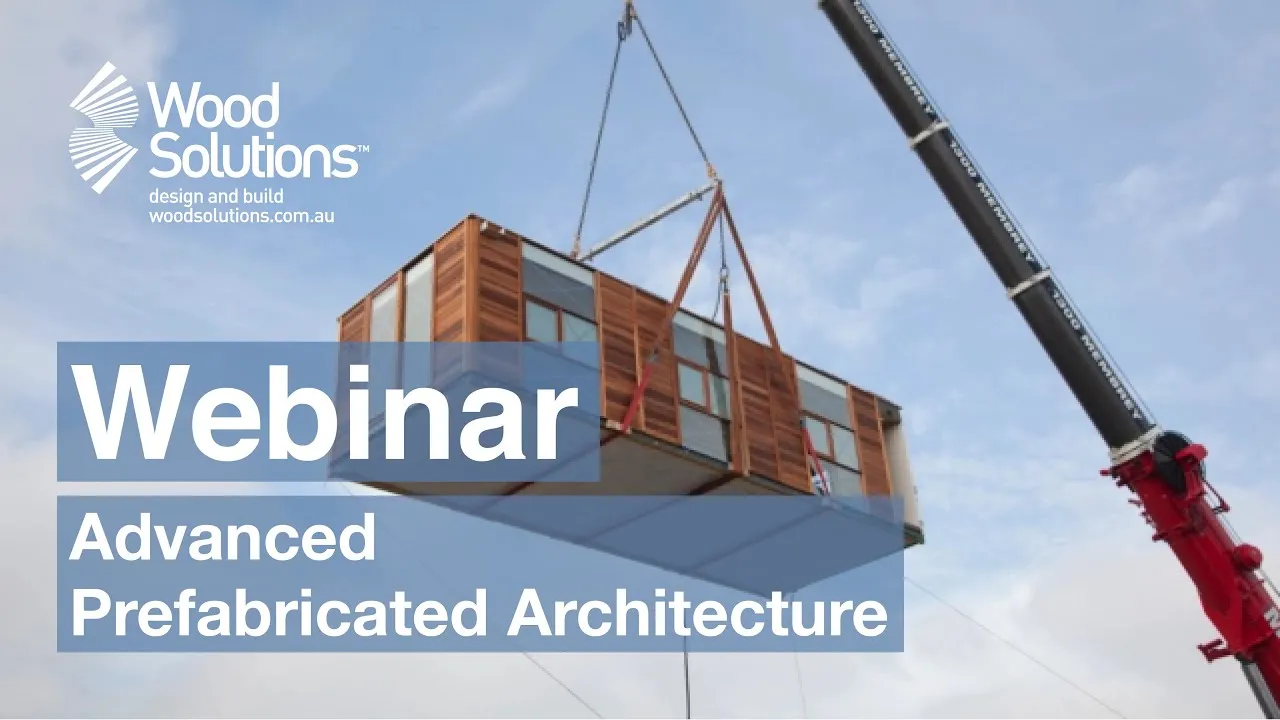
Modules can be, so such as the one that’s been craned in on the left-hand side there, can be more or less finished. If it’s just a very simple building that might only be one module, or even a few that are joined up, they’ll be tiled, grouted, appliances and plumbing fixtures installed, and ready for mains connection. So really all that needs to happen on site is just pop it on a footing, which could be happening concurrently to the finishing up of that module, so they can be overlapping program. Any other modules stitched together to it and service services connected.
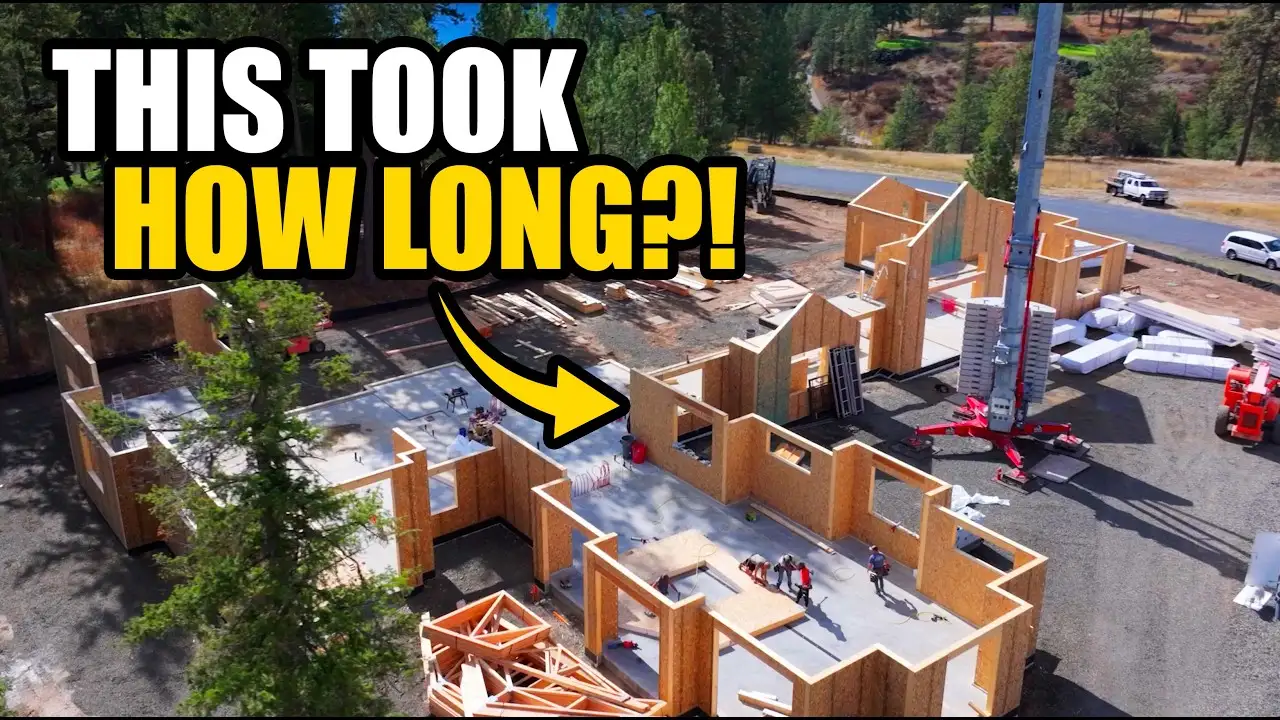
The next one that we, so there are quite a few different approaches, but I guess this is the three main approaches we follow, um panelised in the middle, um. Think think flat pack sometimes on certain projects, site accesses can be very restricted, but you just simply can’t get a module to site. So in this case floors, walls, and roofs are all built as cassettes. They’re broken up into cassettes and assembled and fixed together on site.
There’s quite a lot of variability with the degree to which we can finish them off off-site, um. But the goal is to do as much as possible before we get to site. So you can see here the one in the middle, um, the final plating is not on, but the framing has a building wrap and battens in place, ready to go. Often with floor cassettes, they might be lined on both sides.
The decision of what size chunks to build is determined by a number of factors. It could be site access or the design itself. But whichever prefab approach has taken an understanding of design for manufacture and assembly and design for transport is pretty critical. And um, Ben’s going to pick this up now.
Excuse me, thanks Andrew. Um, yes, as Andrew was saying, we think the benefits of prefab are real, um. But it’s not just a matter of taking any given building design and deciding to pre-fabricate it. The benefits are best accessed by bringing a manufacturing approach to the construction of buildings.
And this is where you come across the term dfma or design for manufacture and assembly. And it’s become a bit of a buzzword in the construction industry when talking about prefabrication and off strike construction . So i thought it was worth doing a little bit of a deep dive. It’s actually quite a deep topic .
So dfma actually originated in the manufacturing industry where it’s these approaches have been used to bring to gain huge efficiency in the manufacturing of mass-produced products like toasters and cars and so on. And we find with prefabricated building bringing while vfma was not created for the constrained construction industry, we find that bringing that dfma type of thinking to uh building prefabricated buildings we can gain a lot of benefits as well.
So this is what that process looks like for us. We produce you know detailed 3d models and drawings of the building for fabrication. So obviously in this process bim is absolutely critical. So we go through the process of doing a detailed framing model of the project.
Modeling in all the structural elements and the timber framing elements and then pulling off a series of framing drawings that are fully dimensioned with cut lengths and angles and so on that we can pass to our workshop to build the components. Thank you so this is what that process looks like in our workshop now, as the name suggests, designed for manufacture and assembly. There’s actually two aspects, uh, to the concept.
Um, design for manufacturer deals with the ease of manufacture of the collection of parts that are used to form the product. Um, in the immunity here, I’ve got one of our guys working on building a wall frame, but you could just as easily apply or think of each stud as a part or each module as a part. So there’s parts of imparts um, and the other part, but the other side of the coin with the FMA, is the design for assembly approach.
An image is a module being assembled from the wall panels or parts. Thank you. So it’s a little quick look at DFMA, and the interesting thing is, when we take that DFMA thinking to prefabricated buildings, there’s another layer that you need to consider because, unlike manufactured tools, prefab building elements need to be transported and installed on a construction site.
So yeah, I mean just looking at these images here, um, there’s nice images. Um but there’s certain, when you interrogate it, you start to think, let’s realize there’s quite a bit going on here to consider. For instance, the module that’s sitting on the back of the truck on the left-hand side there, the whole module’s not sitting on the tray, there’s quite a bit hanging over the edge.
So that has to be factored in when we’re designing these modules or any other building elements to be transported on site. How, where is it going to bear on the site? Is there going to be something hanging over? And does the engineering allow for that? And the answer is yes, we always make it happen, but it has to be, has to be considered.
Um, there’s the modules also being attached, so there’s strapping going on or attachment points to make sure it’s uh, can not roll off, turning around a corner. And then looking at the right-hand side image of a module being craned into place. So that building is going to be, the crane has to attach onto it in some way. How’s that going to occur?
Um, does the building, does the module allow for that strain? And then is that attachment method going to get in the way when you try and land it inside? So in the next few slides, we’ll go into those more pragmatic issues uh, to just simply spatially working with a module or a panelised field.
Um, so we’ve got an understanding of the principles of designing for manufacture and assembly and design for transport. Now we want to build as large a building sections off site as possible to minimise on-site work. What can you fit on the road is the inevitable question? The adage goes that the width of a horse’s rear end dictated the width of a car, the width of a road lane, railway tracks, and even, apparently, space shuttle dimensions.
Um, the… these uh, dimensions for roads has led to us for a very, uh, set of sort of cold vehicle size limits to work within. And um, I’m pleased to announce it’s a happy accident that we can, uh, that what we, what can be fit within the envelope of an oversized truckload on a standard roads, overlaps quite well with logical chunks of a residential building.
These, these are images. Image here I think encapsulates probably what I like to call almost the ten commandments of um, prefab construction, what you can fit. It’s working at our office here, it’s one of the most important things to understand straight up, how much can you fit on a truck in one piece?
Of course we’ve always seen, we’re seeing images on some of those TV shows about, you know, huge double story buildings overlapping four lanes on one or two trucks being transported down the road. Um, where there’s a will and deep pockets, there’s a way. But the reality is this kind of thing is normally cost prohibitive.
What’s more realistic is utilizing the envelopes permitted under different classes of legal or oversized truck loads. Um, the diagram here summarizes three basic strategies we employ. So there’s, there’s more, there’s more avenues than this, but we’ve found from our experience these are the most practical.
Um, basically, with these, the bigger you go, the greater the house volume, but also the bigger cost trade-off. Um, so the, when you, for instance, so from left to right, basically it gets more costly to transport, and also maybe other approvals. And um, at least with the, definitely with the oversized number two down the end there, you need pilot vehicles, um etc.
Left-hand side is the simplest. I guess think of that as a standard truckload you see going down the road, you know, shipping container type size. We might use that kind of load for penalized construction. You have to stay within about two and a half meters wide and 3.3 high, so it’s not really suitable to a standard module. You wouldn’t get a very nice space within that kind of volume, so that’s a penalized construction.
The one in the middle would be our bread and butter. You can actually fit a good c size chunk of a, of house for instance. And I’ll show you an image in the next slide of how this might work. But it could be, say, a bank of bedrooms or a living space can fit quite well into that.
Regarding the height, um, 3.9 meters overall, we work to. I mean we definitely allow a bit of tolerance. Often we’ll design a bit less because you never know there’ll be a bit of, you know, flashing or something sticking up just a bit above to drive your nuts, and you’re trying to get it out the factory.
Um, but with that 3.9 meters, if you consider the floor structure might be 300 mil, and then a minimum pitch roof and ceiling could be about 600 mil, we might be able to achieve, you’re left with three meters. So we can, three meter high ceilings are achievable within this and one to the right.
Sometimes there might be a need for slightly wider living spaces, so we can go um, go a bit wider. But an important consideration also is that not all sites can receive the maximum oversized envelopes. So if a road’s very narrow, lined with large trees, crossed by powerlines, this can often reduce the maximum load for a particular site.
Um, an early stages like this, this ties in quite well with the design for um, transport concept is the coordination with the transport companies is critical to establish this, because the last thing you want is to have a module ready to go and it’s just sitting there at the end of the road, can’t go any further.
So this is an example here of a floor plan. This is a lockwood street project. Um, it’s a nice courtyard shaped building, and the red dashes there indicate how the module breakups occurred. And so the bigger ones are at the top and bottom, the uh, that they’re all fitting into a pretty standard uh, module size.
So you can get a full living room dining, kitchen, and we’ve even stuck in a uh, powder room laundry butler’s pantry behind this kitchen in this case. And in the bottom, that module contained three bedrooms, two bathrooms, and a row and a hallway. So it’s a, it’s a nice accident that uh, these sizes for uh, road transport work out so well, um, for this.
And we don’t have to be limited to this too. Um, we do a lot of, say if you want a living space that’s, you know, much much wider than this, we actually do school projects too. And um, classrooms are wider than that. And the way we approach that is simply leave off might be two modules and leave off a wall from each one and then connect them together, maybe leave some of the linings floor coverings off and do them on site, and make it all seamless.
And that’s why we can achieve those larger sizes. We can also do the same thing with that vertically to achieve double height spaces. And I think Ben will have a um, example of that to talk about later.
Um, and the final slide for our intro is uh, again relating to um, design for transport. Uh, crane logistics is an important consideration too. So you’ve got it to the side, you’ve managed to dodge all the power lines and the trees and whatever.
Um, then having a, train methodology is an important bit of coordination with our projects. So in this example here, we don’t do this all the time, but it was pretty critical for this type of site, had to show where the crane would be sitting on the site, where a truck would pull up behind it, everything has to be planned so that the, often the boom arm of the crane is, can be very long.
So you need to be able to lift up the module, swing it across and over onto the site. Sometimes we find that that module might actually, we try to avoid it, but sometimes it has to pass over other structures. And so there are permits that we must get to do that. And we can thankfully say that we’ve had a 100% delivery strike rate with modules
All right, thanks Andrew. Excuse me, now we’re going to jump into some more detailed case studies of some of our recent modular, modular volumetric projects. Um, as we’ve sort of already said, the the biggest advantage of a volumetric modular approach, so it lets us complete the maximum amount of the building work within the workshop, really minimize the amount of work that we have to do on site.
So we, you know, we’re typically doing cladding, roofing and windows, internal linings, finishing and fixtures all in the workshop.
The first modular project that we’ll look at, it’s probably going to be the main one that I’ll talk about, is a recent project we’ve finished in Don Vale, the Dumbbell Passive House. So here’s some renders of the building we produced during the design process.
The brief is for a generous family home on a large greenfield site. This is the facade of the building that faces into the garden. As you can see, there’s quite a lot of glass here and a couple of outdoor living spaces. These are positioned to make the most of the future gardens that the clients planned for the site.
Let’s looking at the other side of the building, the reefs are building. There are the private spaces of the house, but they also face into the garden, the federal glazing. And here you can see on the roof of the building, the height windows that are used to bring light deep into the middle of the house. So, and jump into the floor plan because it’s a three bedroom house with additional space for a dedicated study and a media room. So it becomes more like a five bedroom house.
Um, when we’re pre-fabricating a project like this with our modules, the first step is to figure out the best way to divide it into the modules. This shows how we did the module break-up on this job.
Yeah, in this case we designed the main living space to fit just within the large transportable module dimensions, and use the same dimensions for bedroom wings, that’s the blue and the yellow areas there. And then we had two smaller modules that make up, you know, the rest of the house, the entry area in the master bedroom.
Um, where possible we bring the edges of the rooms and module junctions together so that we can have a duplicate wall in each module to support the roof structure. So the modules can be structurally independent. These walls are often called a marriage wall. So there’s four modules on the ground and then there’s a fifth module when on the roof which was for those highlight windows that we looked at previously.
So again, as we sort of looked at already, in order to build these modules away from the site, we produce a precise BIM model of the timber framing. And this is where we’ve found there’d be quite a happy marriage between pre-application and meeting the requirements of the Passive House standard. If I said before, but this, yeah, building is built to the Passive standards.
Sure, for those that aren’t familiar, there’s sort of five principles, but the main implication of the principles is that you must achieve a really airtight thermal envelope with continuous insulation all throughout.
So as we’re looking at before, because we model buildings and structure in such detail and looking closer at the sequence of construction, we are really able to analyze that thermal envelope and look closely at the amount of thermal insulation there is, identify any thermal bridges, ensure those air-tightness layers are able to be continuous around the structure.
And as an adjunct to that, I guess the use of timber frame construction is fantastic because it really eliminates or reduces the thermal bridging that you can have. So jumping in the construction of the project, is the floor framing of the modules taking place in our workshop. So in order to be able to transport our modules and lift them into place with the crane that we, we need to make a really rigid base. So we achieved this by using quite deep floor frame members to then support the roof and the walls module.
The import, the other thing that’s important to note here, is we try to make a very level interface between our modules and what the, what they land on on site. So here’s a typical of what we see on site, our footing system with, these are screw piles, but you know, the same principle for other footing systems.
We try to make a flat level top to it and then we drop our mods directly onto it and eliminate any sort of vertical cleat plates or plates that would stick up and clash with the modules. And the fixing is just done by fixing up from underneath the building once it’s been landed.
So jumping back to the workshop, so the rest of the walls are timber framed with some additional bracing to tie back to the floor structure. And this is a Passive House job, so we’re actually building it with a 140, uh, timber frame to get the additional insulation in there that’s sort of needed for the Passive House requirements.
This is the roofing stage or the roof framing stage. In this project we did a truss roof to make the assembly process as efficient as possible. But on other projects we do a friend a more conventional frame proof, you know, just depends on what’s the best outcome for the project.
So here we’re seeing the highlight window module that I was talking about. Um, we sort of take this approach a few times where we stack an additional module on the top of some lower modules to create it more space than you could fit within the transport limits for the main modules.
So as a quick aside on that concept, we pushed that approach of stacking the modules to get that internal volume, um, a lot further on the project you see here. We made quite a large first floor module with an open base that we then stacked on top of the lower modules to create this fantastic two-story void space that you can see in the end there.
Um, the red dash line sort of indicates where the modules were broken up. You can see the timbers in the base of the upper module, they’re just for bracing during the transfer process. They were removed once it was all landed on.
Yeah, back to the Don Vale project. Sort of a really great use of timber in the project was char timber cladding, the Japanese name for it’s san shukiban, creates a really beautiful and low maintenance, low maintenance finish for the timber. Also as you can see here, you know, the modules are fully clad and windows installed and roofing is done in the workshop.
So looking at loading the project up and delivering to site, this is one of the two larger modules loaded for transport. And they’re smaller modules with loads on trucks in a similar way. Here’s our flying building shot for this project.
So important to note here, on most of our projects, we use a bottom lifting approach to install the modules. So lifting gear runs underneath the module to support it. And here’s the roof module landing as well. An interesting thing with a bottom lifting approach when you have these stacked modules, is you have to ensure that the lifting gear will be able to be removed from between the modules once they’ve landed.
So as part of the process when we’re designing the framing for this, we allow some little pockets or holes where that lifting gear can be withdrawn once the modules are landed. And on to the finished project photos, there’s the front entry of the house you see that beautiful charred timber and offsetting that against some clear finished or natural finished timbers as well.
And the use of timber, you know, there was an extensive use of timber on this project, um, extends to the inside of the house. We’re using black butt internally for the flooring and joinery finish. The windows were built from Victorian ash with an aluminium cladding to the outside to make more weather resistant. A lovely detail that we did of the wine storage racks in the project in the kitchen.
Another great use of timber in this project was a solid timber bathtub. It’s actually made by a surfboard manufacturer in Byron Bay, I think it was. You know, a very heavy thing, so this actually had to get installed after the modules were landed since they had to leave the glass out of that window there and bring the bathtub in through the window and put it on the floor.
So I think this is the last image of the Don Vale project, just looking again from that the garden side, uh, the charred timber, and then uh, black butt timber external finishes. Now obviously the client has a large master plan of landscape works that are going to be done.
Just sort of nestle the building into the site. And the next modular building we’re looking at is the north and north addition. We’ve done in North Melbourne, so you can see the new addition on the top. It’s an existing two-story townhouse and if i wanted some additional living space, given you know it’s a pretty tight site, the solution was really just to go to another level to build up.
So this wouldn’t be an easy building in any context on a tight inner city site. So bringing prefabricated solution offered a lot of benefits. So we could do a lot of the work off-site and just land our building onto it. Another note with this project using timber frame constructions for our modules allowed the new modules to sit directly on top of the existing structure without having to do additional reinforcing of the old building.
And so forth brand for the new project pretty simple just a lounge sort of bathroom and stairs and a deck area. Looking how we broke that up into modules um for a small edition like this. You’d like to do it as one single module but ultimately the width of the plan of the project meant that a single module would be too wide for the should fit within transport limitations, so the solution was just to break it up into three sort of mini modules, you know.
The other option would be to try and squash the whole build in the addition to try to put it within one module, but as Andrew was saying, we don’t let the modules push us around. We try to bring the best solution for the clients that we can.
So again, you can see here we’re using the internal walls between the rooms to create marriage wars so modules can be self-supported during transport. And you know, just another quick note with uh modular construction, it’s really helpful if you can keep things like bathrooms and kitchens, where there’s a lot of finishing and fixtures, uh completely within one module, um so that you don’t have to do any of that work on site.
Okay, so more workshop shots of this project being built, uh similar to the first project we’ve got the the rigid floor frame, um and the rest of the timber framing is sort of built on top of that, and the floor frame provides support. So there’s our modules loaded up and ready for transport, again fully clad, lined, windows installed, roofing installed.
It’s interesting to note on this project, you can see in the photos that the cladding is actually lifted up from the base of the modules, um as this these modules are going to fit within that existing building, um and we’re just making sure that we can get the flashings from the bottom of the cladding onto the existing roof structure, make sure it’s all waterproof.
And here we have another flying building shot, you can see the module’s getting nestled in position on top of the existing building. There’s the project nearing completion, not a great photo, we haven’t had a chance to get the photographer to go through there. The last thing on this project was again, it’s just some of the internal detailing, where we’re using timber as much as we can, is the new internal stair that links up to the first floor edition, um so we’re pretty excited about this.
We’ve um hung the new stairs on steel rods from the exist, from the new module that sits on top, and then we’ve got some great solid hardwood timber treads that are gonna step down into the existing house.
Okay, the the last module project we’re going to look at is a dual occupancy project, recently or nearly completed in Glenris. So again, we have some rendered imagery we do as part of the design process, this is the view from the main street, and it’s a, you know, a two-bed I’m sorry two three-bedroom townhouse development, again we’re using timber here with some, as a main feature of the facade with this pattern plating on the outside.
Um looking at the project in section, you can see it’s a sloping site, um and our building forms are following the slope of the site, a reasonably complex form, and it also means it needs to be a fair amount of site-based works done before installing our modules. So looking at how we break that complex form up into a series of modules that can be stacked alongside and on top of each other, and the complexity of the install and the need for fire rated walls, let’s jump back.
So this is looking at the project in section, um the townhouses are mirrored along the centerline of the site, with a firewire rated party wall in a pretty conventional manner. So in order to maintain the integrity of the firewall, rate of all, we didn’t want to do what we normally do the bottom lifting approach, as we would have to leave holes to allow for the withdrawing lifting gear once the modules are landed.
So on this job we looked at a top lifting approach, so yeah this slide’s just explaining or showing the difference between bottom lifting and club lifting. So bottom lifting there on the left with strapping and lifting gear that actually goes underneath the module, and on the right top lifting, we were actually connecting directly to the top of the module, which allows us to sort of land these much closer together, and have continuous finishes and variables.
So that so this is a shot of the modules being fabricated in our workshop, and that top lifting approach meant that we had to integrate some steel into the modules that connects directly to that rigid floor framing base. We can see we’re still using the majority of the structure framing as timber.
So again, our modules were fully clad with windows and roofing installed in our workshop, the module is being loaded up ready for transport, and here’s our flying building shot for this project, you can see that rigging set up connecting directly to the top of the module, and this allowed the modules yeah to fit very snugly together when they learn and so on, so as you can see they came together pretty seamlessly.
This project is also very nearing completion, with additional site works and finishing and currently being done.
Pass over to Andrew again. Thanks Ben, um for the final section we’ll talk about, uh, projects where we broke the buildings up into smaller chunks to prefab loss up three examples here: Tucker House, Showroom, Berry Street.
Um the reason why, i guess the key driver that I hinted at earlier for opting for a pre-panelised approach is is largely access, and we’ve been asked, we’ve been asked to look at uh, many projects where take one look at the driver, the access, and go, ‘This is not going to be easy to either’, the roads too steep a grey like that one on the left there, or there’s just overhanging trees, rows and arrow power lines, etc.
Um, um it also the other advantage as it offers, two is, even though a modular approach can give us quite good height, you can get three meters ceiling height, sum, if there’s a desire to go higher, that’s, um, there’s an increased flexibility there with a panelised approach, you can build those walls as as tall as you like. It’s an approach that, somewhere between fully offsite and fully on-site, and there are, there’s still significant advantages to gain uh with the amount of prefab that occurs, in a panelised construction to warrant it as a, as a process.
Tucker House, um here’s Tucker House wire river, um, we’ve done quite a lot of projects in um wire river and gotten to know the personality of that place pretty well, um there are a lot of challenges to deal with in my river. Firstly the roads are very steep, um you can’t get modules up there to deliver a modular approach.
And why do people come to us in the first place, like these sort of locations? I suppose it’s, as soon as you get out the metro area, and parts like this, it can be quite challenging to find a builder who’s willing to go out there for, you know, 12 months to slog away at building a house, um and there might be and it might cost more than say metro project because builders to cover themselves.
So the more you can do offsite the better, so prefab becomes a viable option in places like y river, um white river also has uh, landslip risk issues, so all our projects there end up having and conventionally we’d have a screw pile type system, but here you can’t do that, we generally opt for, well with the guidance of consultants, ends up being something like a board pier system with a steel frame, um holding up the the floor.
It’s also a bush fire risk area, so the projects are either generally bow 40 or bowel have said, which is something that, um we can achieve quite easily, um, sometimes we get questions about ‘Hey it’s timber, timber framing, isn’t that a problem in bushfire zones?’
And the answer is no, because the Australian standard is all about keeping embers out from getting beyond the uh building skin in the first place, and i guess regardless, even if you had steel framing, once the embers get beyond that cladding, you toast anyway regardless of the framing because, you know, the only barrier is really the thermal insulation and, um, plasterboard.
Also in my river there’s very limited services, so often you’re looking at a waste water treatment system, etc., um and this building here, i mean, this captures the beautiful views out to the ocean, like many doing in wire river, it’s a, it’s a very simple plan on the right, it’s um a great big livings all in one living space, it looks out to a generous deck that wraps around, three bedrooms, a couple of bathrooms, um it was a very fun project to work on.
This is some shots from the construction of that project in the factory, so we’re building just panels here, these pictures are all about the floor panels, soon the top left there you can see the whole floor has been broken up into, there’s fine lines between that where that whole expanse of floor is divided up into cassettes, usually we pre-lined both sides and they’re insulated with services integrated.
We’re practical, often we’ll leave off a strip of floor sheet to allow connections on site and to knit together across flooring junctions, but also as convenient points to attach straps to lifting. And you can see that on the right hand side there where there’s a floor cassette that’s being landed with a bit of flooring left out of the way to be sutured on site.
In this case here these many of these wide rear projects we’re landing on steel bearers running across and it’s very important to coordinate closely with the structural engineer in these situations to make sure that the nature of the cassette break up is going to gel well with that with those supports. And here are some of the wall panels going in place.
We often try to try to finish them as much as possible in this case here there was in addition to the wall framing itself the cladding was finished. And the way these the detail here for the top left-hand corner was i think the stud wall framing would sit on the floor cassettes but then the the cladding layer. The fiber cement would continue past that uh that edge.
Sometimes in some of our earlier projects we actually tried to restrict the panels to being only say 900 wide and being built in such a way that a couple of people could lift them. We wouldn’t need a crane. This is an example of that methodology here but I guess over time we’ve started to opt more for maxing out the uh the panel that can fit on a legal truck. And then just have it have a crane on site.
But this one here has got interesting. Anyone who’s um been following us on instagram over the years will know that some of our earlier projects had this kind of you know timber. Beautiful timber, detailed external plating and that was pPartly I guess it came from our origins of being this, you know, building a kit of parts, so to speak, where um, we could have this con, this similar detail of the horizontal boards.
And when you attach those panels on site, you can stitch up the junctions by putting down a timber batten across the top to keep it all in place and to hide the gap.
Um, these panelized projects have a lot of similarities, and the differences are, this one here is sitting on more of a conventional, or one of our more conventional footing systems. They’re sitting on, uh, screw piles I think. But the, I think, in this case, the intention of the project, I really love the plan of this project by the way.
It’s one of my favorites. Big fan of being able to break up program over, um, had to go outside to get to part of the house. In this case here, you have to go outside to get to the guest suite. Um, and I think the planning was perhaps originally intended for it to be a modular build, but then whatever happened during the process, whether the roads turned out to be narrower than expected, or the buildings grew a bit, ended up being a panelized build.
Here we can see the, I guess the production line of panels being made in the factory. So as Ben was talking about earlier, we can generate a whole suite of shop drawings that show every single cassette to be built. So someone sits there on the top left picture, there’s a group of workers who are looking at the plans, building one floor plan, insulating, putting lining on the top, stacking it up.
On the right, just keep going through until you finish them all. We end up with a nice neat stack of them, truck them to site, crane them in place, attach them together.
Um, also just forgot to mention that another thing I like about this project again, we’re using a black, a dark timber cladding. I think in this case it was simply, uh, oiled uh timber, but it contrasts very well with the the rich green and olive green uh texture of the surrounding site.
This image here shows just kind of snapshot of the documentation. On the top there is a floor plan, a full floor cassette breakup. Um, there’s three panels in yellow there and below you can see the red dashed lines indicating where those panels attach.
The blue dash line is indicating where the supports are in the subfloor, so you can see that each panel is sitting on two supports with a bit of cantilever happening, and then they’re attached in situ.
And this, when we’re preparing this we came across this as someone on site must have taken a photo of a little sketch drawing to kind of communicate something. It’s hilarious drawing, but I think it communicates the final step that is putting a penalized ceiling or a roof in place.
So here the idea is it’s either, I can’t work it out, it’s either a giant scorpion or a crane, I don’t know what you think, lifting the cassette to place and that it is, uh, fixed to the sides of the uh, the wall panels.
Um, oh, very strict. This is a small one that we’re just finishing up and the, the constraint here is it’s a accesses only by a right-of-way. It’s a terrace that’s built, you know, boundary to boundary, so you can only bring things around the back, the route right-of-way is tight.
So um, it has to be a penalized build, and here we’re taking advantage of the height there, so I think it’s a bit higher than we normally achieve for a module and from finish to the extent of having building wrap on it.
Thanks Andrew. Um, all right, to finish off I’m going to quickly look at a another pacifist project we built a couple of years back.
So this is a project that was actually designed by John Moore Architects. This is a render that they produced. As you can see, there’s some fantastic architectural forms here. Um, so this made it quite a challenging project to build and we were able to really push the limits of our pre-fabrication skills on this project.
Um, as I said before, I think this was also a Passivhaus standard um, but the solution for a project like this was to use a hybrid prefabricated approach. We have both wall panels, or 2D elements, and some three-dimensional components or sort of mini modules.
This is a drone shot of the site during installation. You can see the complex shape of the building and plan and various bits and pieces that were installed. So the ground floor was actually on a concrete slab, um, and then we’ve got ground floor walls, first floor floor, first floor walls and a roof on top of that.
Um, uh, this is the shot of you know some typical shot of some of the wall panels that we’ll bring you to site. So these were fully wrapped and insulated in our workshop um, to provide the thermal envelope commitment, passive house requirements.
An example of some of the three more three-dimensional components of the building that we’re bringing to site again, fully wrapped and insulated and then installed on site. Uh, here’s another element, uh, this is a section of the first floor, uh, it’s illustrating some of the really interesting shapes of the components we had to bring for this job.
Uh, so this is yeah where we left that project. We were going to say building a thermal envelope under, you know, another builder we went on to draw the internal and external finishing on site, but yeah, you can see it all wrapped and sealed.
And I think now that, sorry just to end that, I think now the project is getting close to completion, I think is getting published in various architectural media uh, around the place. And um, yeah, thanks man, that brings us to the end. Uh, thanks again Aleister and uh Wood Solutions, thanks for everyone who dialed in. I hope being able to offer some insights to how we operate and the benefits and key considerations of a prefab architecture.
Fantastic presentation Andrew and Ben, thanks very much. I might just get you to unshare your screen for a sec, I’ll just share mine back.
Yeah, some amazing, some amazing work there. Yeah, clearly uh, beyond people’s previous expectations of what you can, just do with offside prefabrication, just some great designs. Look, we’ve had some terrific questions here. I’m sure we’re going to get through them all, but um, we’ll certainly work through as many of them as we can.
Get a question here from Richard, “For the volumetric and panelized prefab systems, how do you satisfy the requirement of the building surveyor being able to view the internals of the walls?”
Um, I guess I’ll talk that. Yeah, it’s an interesting one and I guess you certainly need to have those consultants on board with what you’re planning to do early in the process, um, but often we will get an inspection undertaken in our workshop before these elements are delivered to site, um, but also yeah inspections are done on site as well.
I guess often what we do is actually have an inspection from the structural engineer who’s done the structural design of the project, and they’re able to sign off as well.
And Nitnik asks, “In cool climates thermal mass is a primary element of good solar passive design, so how do you incorporate that with your prefabricated systems?”
It is a challenge. Um, I think generally in places like Melbourne, we can, um, we can get across the line by boosting up other aspects of the performance of the building, but if you go a bit cold in that, yes, there are benefits to including thermal mass and it’s something we have done. We’ve looked at doing, uh, buildings where we do a panelized build on concrete slab, so that’s one way of getting around that.
Yeah, it’s in, in the slides we didn’t, I don’t know if we really pointed it out, but you know we’ve done a modular project where we installed our timber frame modules and then essentially built the brick veneer walls around it on site afterwards. So that’s an approach, but I guess that’s not using thermal mass.
But another point, at the moment we’re doing a job, we’re about to start a job where we’re installing some modules and then bringing a brick wall up through the floor of the modules once they’re landed on the site. You know, so that’ll give a thermal mass wall inside the building.
Now you would have expected to get some questions around costs. Don’t imagine cost comparison, so I’ve got a question here from Trent, “Have you undertaken a cost comparison to a conventional site build uh of project versus modular? I mean obviously there are some time savings during construction, but curious to know if there are, if there are cost savings or not with these types of projects overall.”
It’s pretty much break even with an architecturally designed project. It’s um, it’s life alive, I guess. I guess this is part of what would like to see the fabrication industry sort of move forward is, it tends to be the assumption or people sort of look into prefabrication in the first place because they’re looking at it as a way to cost, or to save costs on their project, um.
You know, in other parts of the world where they’re more focused on manufacturing approaches to these things, they actually see prefabrication as a premium product, a higher quality product, similar to how you get a car, you know? You get a manufactured car. You wouldn’t want to get a car that’s just been built, you know, in your driveway.
Most significant benefits to prevail over conventional construction are the efficiency of time, um, that we, because we can simply build quicker in the factory, and also there can be that overlap of uh, program where you can be finishing up something in the factory while you’ve started something on site. Yep, and you guys did mention in the presentation about the benefits actually building regionally sometimes with these type of homes, so we’ve got a question here from Michael.
“Um, what’s the cost difference in transport between the 4.8 meter wide and the 5.5 meter wide modules if you were having to go say from metro up to 150 kilometers from Melbourne?”
Um, I don’t think it makes metro to a bit of a distance from Melbourne is not much of an increase.
When you go into state, it jumps up a bit, um, but I think, and the size of modules, I think likewise if you go from metro from a 4.9 to a 5.5, I don’t have a clear answer here. It can only give you, you know, general terms and um, welcome anyone to get in touch with us directly if you want some actual numbers, um, but again, I think you don’t pay an awful lot more for a 5.5 module, but it’s the cost, extra cost might be in the pilot vehicle, etc.
Yeah, but it’s not, it’s not a deal breaker basically, you know? Yes, there are increased costs, but in the grand scheme of the project, it’s not really going to make a huge difference.
Yep, a question here just asking about the software you use internally for creating your module shop drawings. Is that something special or is it a sort of standard type of software?
Um, at the moment we’re using uh, just Revit, Autodesk Rivet. We find it ties into our architectural drawings very simply, um, but it’s something that we’re sort of constantly looking at. There’s certainly more dedicated uh, specialist software that you can use for these things, um. You know, we’d love to potentially take those things up in the future.
Yeah, we’ve experimented with a few different um, kind of bespoke uh, tools for this, um, at the moment though, I think that’s the future and I think the dream is to get to a point where we can even start to introduce robotics into the fabrication and for that we need some special stuff, but at the moment, you know, just with a general BIM environment is, is good. I think a lot of, we both come from regular architecture practices I guess, and BIM’s often a bit underutilized, but with what we do it’s very useful, you know?
You can give every, it’s not like we sit there and model every single stick, um. We set up systems where we can have, you know, like a generic front uh, wall frame, and we adjust the number of studs to suit, but then from that you can spit out the um, the cut lengths etc. A question here from Charles, he just mentions it looks like you have to design for a highly rigid structure with minimum flex.
“So if you had any issues with window glass cracking or render cracking or tiles with, your, when you’ve finished off areas?”
Uh, no, I guess it’s part of the design process we go through with our engineers is ensuring that our modules are, not so much the wall panels but the modules, have that rigidity to be transported and installed, um, as I stopped showing, we have that really rigid base to the buildings and then we have additional OSB bracing that we put on the walls of the projects.
Yeah, we do, we do simple things. I mean, I think the engineers go above and beyond, so just to you know, double up thicknesses of beams or whatever for transport, but we often do just a few extra things which don’t really make a huge difference to the cost but make a huge difference to the rigidity, things like say for example the timber ring beams for a module might be expected to be um, uh, 300 by 45, um, then the joists in the middle might only be 190s or so.
We’ll just have plenty of 300s lying around so we’ll make, we’ll use them as well, which forms a consistent bed depth when you’re sitting on the truck and it adds a bit of rigidity. It’s just a bit above and beyond that makes a difference, but also we do details like rather than just have um, brace board on you know, a couple of key areas, we just wrap it all the way around, it makes detailing an awful lot simpler too.
In terms of some of those um, construction techniques, um, um, the question was here asked about “Can you do cathedral type ceilings and other types of ceilings? Have you done them very often?”
Uh, yeah, yes we can, um. We’ve got some yeah projects we’re looking at at the moment. I guess in the projects that we showed, the modular projects we showed, they were truss roofs so they were having a flat ceiling, um, but at the same in the same way you can build a pitched roof uh, similar to what, how you build that on site, um, and fix plus to the underside of that cathedral ceiling, um, but you know, using a panelized approach the skies it’s much more of a case of the sky being the limit really, um.
You can make the walls much taller and have a roof panel that just stands between them on a steep angle, yeah.
Yeah, you can do it. We often uh, look at doing our pitch roofs in just a single module and the reality is because of the heights, you know, you’ve either, either got a, you either got to have um, a lower pitch which is you know not ideal often, or you just down the, the walls.
There might be a lower clearance there where you might integrate that and make it more where joinery goes et cetera, or of course you go to a double module approach or some of those examples where you have a, build a double height space or you might build the roof as a separate module, but it comes on to uh, the main body of the house below.
Look guys, we’ve got a few more questions but it’s right on midday so we do need to finish up, so I’d like to thank you once again on behalf of all the attendees. It was a fantastic presentation, um. I do remind people that um, the presentations are recorded, so if you want to go back and have a look at this again or any of the other presentations, just go to the Woodsolutions website, click on that webinars download section and you can access those.
In terms of um, webinars coming up, we’ve actually got one this Thursday, so Andrew Dunn is going to be talking about cost planning for assisted living and portal frame type structure, so if you’re interested in those types of applications, certainly tune into that one, and then next Tuesday, but Tuesday the 22nd.
So we’re our bi-weekly webinars, we have Professor Jeff Borton talking about building to resist in high wind side climatic force areas and using Cyclone Seroja as a case study, so Jeff’s a real expert in these areas. If you’re interested in building in high wind areas, this will be certainly one to see as well, so uh, thank you once again everyone, thanks Andrew and Ben, and we look forward to welcoming you at some more webinars in the future, you.