
Pro Tip: Building on Expansive Clay Soil
This is an older video from Matt Risinger. In this Pro Tip episode he’ll give you a way to know if the soil under your property has a high Clay content, and he’ll talk about why expansive clay can wreck havoc on your concrete foundation.
Matt has extensive building experience in Texas, USA. Your chosen country and building location may have different soil characteristics. My recommendation is to make sure you use a Geotechnical engineer to assess your land in and around the house footprint even before you buy the land. Sometimes ‘getting out of the ground’ can be very expensive and understanding your land stability and how easy it will be to build on may make or break your project even before it’s begun.
For more tips on building & remodeling Today, we revisit one of Matt Risinger’s posts about constructing a house on expansive clay. In this Pro Tip episode, he will demonstrate a method to examine the soil beneath your property to determine if it contains a significant amount of clay. Furthermore, he will discuss the detrimental effects that expansive clay can have on your concrete foundation. It is important to note that Matt’s expertise lies primarily in building in Texas, USA. Therefore, it is crucial to consider that different countries and building locations may possess distinct soil characteristics.
I highly recommend engaging the services of a Geotechnical engineer to evaluate the land within and around the proposed house footprint, even before purchasing it. The process of building foundations can sometimes incur substantial expenses, and comprehending the stability of your land and the type of foundation required can significantly impact the success of your project from the very beginning.
See the full video link in the comments below.
visit Matt’s blog at www.MattRisinger.com
Video Transcript:
I’ve got a pro tip for you today about clay soil. Depending on where you are in the U.S., you may have clay soil underneath your property. Where I am in Texas, there’s a lot of parts that have very expansive clays. Today’s episode, I want to give you a quick gauge on how to tell how much clay you might have and also talk briefly about how that can impact your foundation.
So first, let me talk about why expansive clay can be bad. You know, clay soil, because it has an expansive property, can wreak havoc on a foundation. I’ve remodeled a bunch of houses that had slabs that had actually tacoed because that clay soil was exerting pressure on that slab foundation. Clay, because it expands when it’s wet and then contracts when it’s dry, can exert tremendous forces upon your foundation. And if you know you’ve got clay soil, your engineer is going to specifically design your foundation to resist those forces.
I want to give you a quick gauge on how you can tell how much you might have on your property. But remember, everything I’m going to talk about today is no substitute for getting a geotechnical engineer involved in your project before you design or engineer that house. So that we can tell how much clay is in there, we can get it tested for its plasticity index, which basically has a gauge for how much it’s going to move. And then we’re also going to be able to tell from that boring whether we have rock and how deep that rock might be.
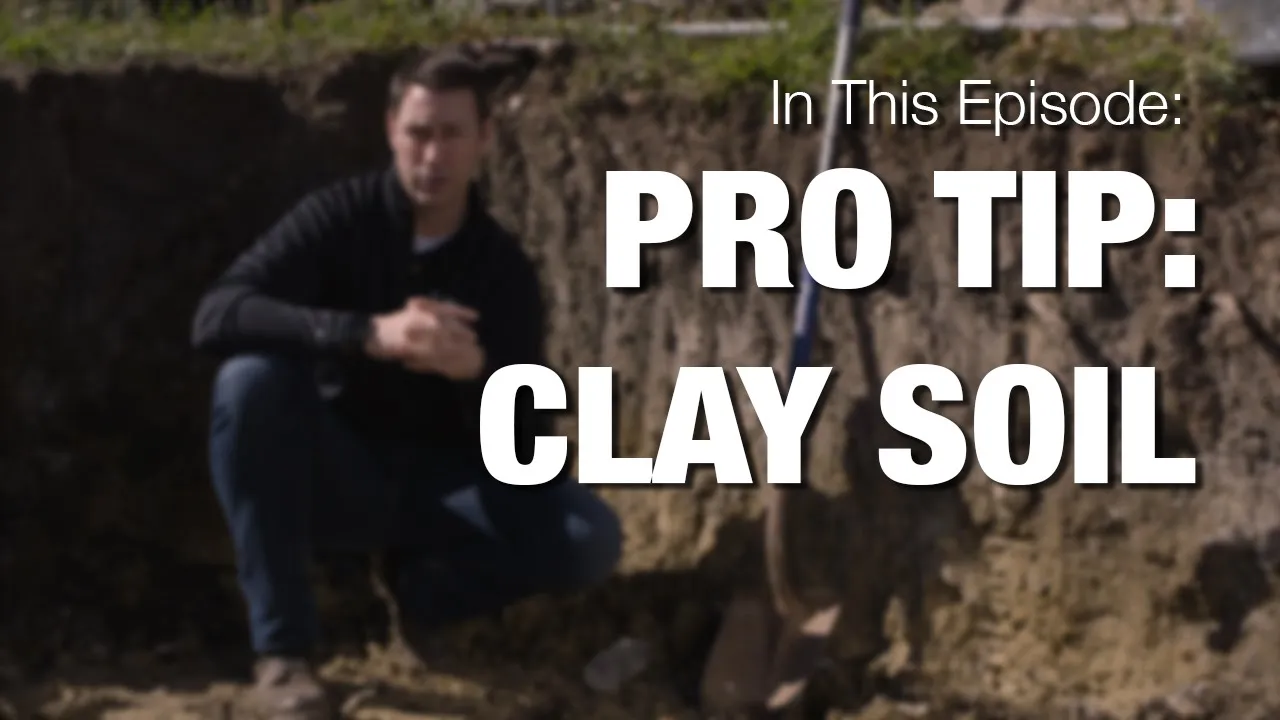
All those things are going to help your engineer decide what kind of foundation to use. So, I’ve cheated a little bit here on this lot instead of using a shovel, we brought in an excavator. Here, you can see I’m about three or four feet down from the original grass level, and this is our first indication of what’s going on with the strata.
You can look here, and we’ve got, say, the first one or two feet is very black soil. That’s what we want to see; that’s a great soil. Lots of the country has nothing but black soil, but where I am in Texas, we’ve got clay soil in a lot of areas. Look how that color changes from black to very tan at about that two-foot level. That color change is my first indicator that we’ve got something going on here.
Here’s a quick gauge that you can do: grab some of that clay layer. If it’s totally dry, add just a little bit of water to it and drop it in your hands and roll it out. We’re basically treating it like play-doh here. You can see here I’m able to take that soil and roll it into a nice, thin roll. And if it looks like play-doh and acts like play-doh, that means we’ve got a lot of clay in there. The thinner we can roll that before it breaks apart, most likely we’ve got an even higher level of clay in that soil. And you can see that’s we’ve made a really thin one here, and it’s very sticky. It’s holding together really well. This black soil, if we were to do that, it would turn into mud, and it wouldn’t stick together. So we know we’ve got a quick gauge that there’s some clay here. Stay tuned for a future episode on the foundation we’re building, actually on this property, and I’m going to walk you through the steps that we took to resist the expansiveness on this clay and build a foundation that’s going to be around for generations to come. We’ll see you next time.
Related building posts:
Pier + Beam Foundation with a Conditioned Crawlspace
External Youtube Content: Can we build on clay soil?