Introduction
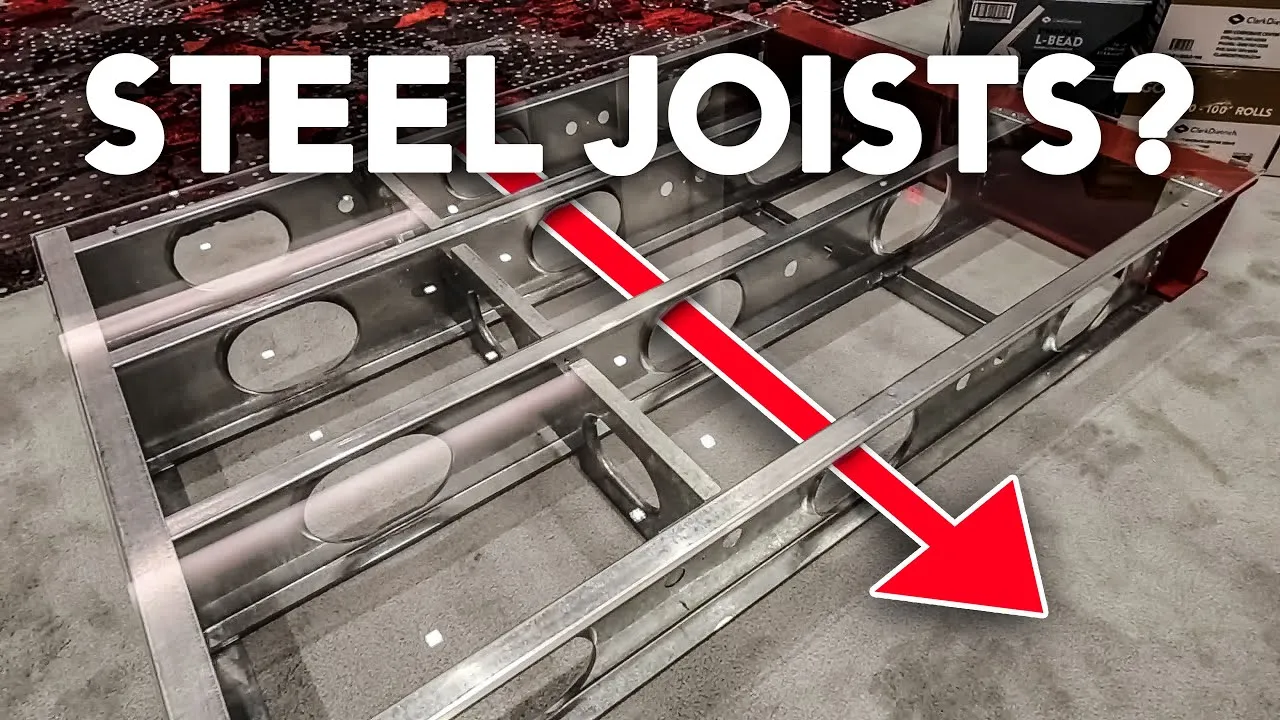
In this episode, Matt Risinger ventures into the world of metal framing and residential builds. He discovers the fascinating TradeReady Steel Joists by Clark Dietrich. While metal studs are commonly used in commercial construction, the TradeReady Steel Joists offer a unique advantage for hiding MEPs (mechanical, electrical, and plumbing) within the floor cavity. With strategically placed punch-outs, these joists allow for efficient placement of plumbing and electrical components.
The connectors at each end provide secure connections, with the Rim track offering flexibility in spacing options. If you’re in the USA seeking a dead flat floor and considering steel as the solution, contact Clark Dietrich’s technical sales managers can guide you through load tables and span calculations. Discover how these innovative steel joists can revolutionize your projects. Also discover some new products at the BUILDERS FIRSTSOURCE where 750 suppliers gathered in Las Vegas BFS National Event.
See also:
Video Transcript:
Buildshow is on the road. We’re at the BFS 2023 National event. It’s lunchtime, so it’s a little less crowded right now, but we’ve got a show floor with all kinds of manufacturers. We’ve got a ready frame house to visit, and we’ve got some new digital tools to talk about. We’ve got a lot of cool stuff here at the show. Today’s build show is sponsored by BFFs. Let’s get going.
“We’re gonna do an MDF trim around these, but we’re going to do solid wood McLaren and two Travis. What’s up, man? Hey, dude, how about we walk to the show floor and see what we can find? Let’s go check it out. There’s gotta be some cool stuff. It’s got to be something here.”
“Hey, we’re over here at the Builders First Source show, and, uh, you know me, I had to stop by the Badger Booth. But they’ve got this Duramark Chalk Shot, which is something I’ve never seen before. This is super innovative. It’s a little gas charge with a special tip so that as you’re laying out plate, you know, you’re looking at your drilled hole for your wood product, you’re going to want to go ahead and secure that. Okay, so like this is your bottom plate on the house, and you’re thinking maybe these are your drilled bolts you’re going to put in or something. For sure, you’re blowing through and you’re drilling your wood bit, but you can’t get your pencil down in that hole to make that mark. Yeah, and you can blunt your drill bit and mark it that way, but that’s slow, and it’s going to vibrate and move the stud. So with your plate pre-drilled, you can just go through and with a little, like you’re spraying breath spray, you get that little puff. That’s so awesome, and there’s your lines. Super simple, man. That’s brilliant from Duramark. I’ve never seen that before. Very cool. Duramark Chalk Shot. That’s got to be one of the coolest things I’ve seen in a long time. Brilliant.”
“All right, we’re at the BFS Booth. I got Mickey. Floor is yours, my friend.”
“Thank you. So what we’re talking about here is mybldr.com, and this is a new kind of project management tool we’re making for home builders. So when we say new kind of project management tool, two big things about it. One, it’s totally connected to your suppliers, and two, it’s powered by super advanced digital twin capabilities. So right here when I log in, this is all of my existing jobs I’m already doing with BFS. If I’m a builder, this is like a move-in ready product. No project setup and all that boring stuff. I’m going to show you one of the houses that we’ve built out here. So this is the Aspen by BFS.”
“Um, and this is, first and foremost, this is, you know, document storage for everything you need. We’ve got the plans, but advanced renderings, videos. You’ve got all your files here. I’m going to click into the main plan set, and we’ve got all these sort of rich viewers built right in. So this isn’t like your downloads folder and flexing around with that. Wi-Fi is kind of slow here, but right when I click into this, what it’s actually doing is rendering that whole plan set right here in the browser. So I can, you know, go through here, and when the Wi-Fi catches up, you’ll see, you know, I can get into anything. This is usual for us on a job site to take a minute for something to download. Yeah, not too bad, though, right? So if I’m starting to… Uh, it’s, you know, it’s not a video file, so it’s not ginormous file size, right? Exactly. If you’re familiar with plan markup tools, you’ve got all kinds of powerful stuff here. So, you know, if I’m working on a… We know we’re gonna have to… You know, rework the roof angle on this card.”
Continue Reading
“Right, all your usual markup capabilities with all your files in one place. Jumping over to preview here, this is where that other one I mentioned gets… This gets super interesting. I’m gonna actually hand it over to my colleague Carrie. So with Home Configure, what the product is doing is taking that same 2D plan that Mickey just showed, turning it into a 3D model, and then actually showing a photorealistic visual of that model. There are a ton of features that go into this thing, but I’ll hit a few just to start. So the first thing that we can do is we can change all of our different exterior products. We’ll just change the siding color to show you what that actually looks like. And then, in addition to actually changing kind of fit and finish details…”
“Alright, so when we go to the inside of the house, we can see here what we have is we have a full 360-degree view. We can spin around in a circle, and we can actually look at different plan options, and we can begin to change things like flooring details and wall details as well. So if I just open up the window question here, I’m going to turn the window options on, and what it’s going to do is it’s going to just change the actual geometry of the house, where we can see upper windows added. We can see more light coming through, and it just makes it a whole lot easier for our buyers to be able to see what’s coming from the 2D plan and making that into something that they’re actually going to walk into. Really what we’re trying to do with the product is give the everyday buyer transparency into what they’re purchasing, much like how we purchase a car today online by configuring it. So there’s all kinds of things we can do with this 3D model. Another capability you might notice, this finished frame toggle down here. I’m actually going to switch to the frame view and look at this.
We’ve got a full three-dimensional framing model of this house. So this is all accessible on your iPod and everything else. So if you need to double-check, you know, that’s the best part of that. I mean, showing clients, but for me, actually on the job site, that’s the best part right there, for sure.
So we got this full framing model, and like I said, this is fully connected to your suppliers like Builders First Source, right? So we built this model obviously to get your material lists right, and that’s available in our materials tab here too. So when you request your bid from your OSR BFS, they, of course, do that full takeoff for you, organize it into your packs for delivery, first-floor framing, and so on.
And what the material section does is it sort of gives you the comprehensive dashboard on the million parts that it takes to build a house, right? So this is organized by each delivery you’re gonna get. This is a first-floor framing that’s ready for purchase. You can click into it, actually place the order, okay, right from this thing.
Yeah, this is the first time that we’re actually transacting online with our builders. And of course, you can always call your sales rep. We’re here to help. Yeah, but you can do all this on the go, and it has the address and everything already built in. Absolutely, right here on the job itself. It doesn’t have that, so it already will know if it’s a crawl space or a first slab or anything like that, obviously. Yeah, that’s helpful.
And so then as that build progresses, you know, we place that order, we’re gonna confirm it, you’re gonna see when the delivery is coming, you’re gonna know exactly when that material is out for delivery. And best of all, when that is delivered, you got job site confirmation, the delivery photos of the drop-off at the job site, all within this one platform. So that’s materials.
The next thing I want to show you is back over here on schedule. So, um, do you use, how do you do your scheduling now? Yeah, yeah, we know there’s a lot of software out there like that. Yeah, and so, um, you know, schedules have this core, it’s a list of materials. You can do all the usual stuff you would expect in here with your task groups and so on.
The really exciting thing for our schedule and budget tools, let me jump over to budget, is that it shows you the best. Yeah, it again, this is all integrated, so the cost of your jobs with BFS, full I mean, orders to BFS for this project, fully integrated here. These ones are from BFS, so those are automatically imported into your budget. Okay, of course, you can add all your other costs here if you want, all in one place.
And then, Cruz, this is where we think about it as, you know, managing, uh, one of our guys tells me he counted 550 people setting foot on his job sites. We know it takes a village, right? And so, um, what I want to show you here is how we keep all of those stakeholders on the same page. And not for this, let me actually open up my iPad here. So I’m going to invite in my Gmail address here. Pretend my Gmail. This is like maybe this house has some really complicated masonry work or something. I’m going to add my Gmail here. And if I get this going on my iPad, you see that email pop up, right? I’m going to tap into that. Let me just tap into…
So, your subcontractors, they don’t have to set up a password, they don’t have to do anything. Literally one tap and boom, they are right in the job. No downloads, no passwords, no nothing. Here’s the real… Here’s my favorite part, though. One last step, one more thing. Okay, this is my subcontractor looking at this plan. Let me jump over here. Over here, I’m the Builder. I’m in this. Let me get back into this plan.
Okay, so here I am as the Builder, right? And let me go to the same… You know, let’s say you’re working with your Roofing guy on this, right? And so, while I’m over here, you know, making a note of something here, “Oh, wow, it’s all live, real-time. I’m the roofing guy, right?”
We need more sheathing here. I’m making a note of it here and then look back over there. So, this is holy cow, check it out. See what goes from one to the other right away. Yeah, these are totally real-time. So all of your subcontractors get them in this tool, everybody’s working on the same page. No more mistakes, no downloader, no app, no download, no passwords. Yeah, that’s the best part because that’s your promise. How much do you want another password, another thing they gotta remember? And just to jump into my two cents, then all of this could go to you moving. Eventually, you’re ready for him. Yeah, right, because the whole house is built in 3D, so it’d be no big deal for them to then ready frame cut your package. Yeah, I’ve seen you do the videos of them, so it’s definitely something I’ve thought about. Yeah, pretty cool.
And then the best part is all of this is just the beginning, man. This is the tools that are like, you know, right out of the box. But there’s tons of services you can get through US Build Optimize. We can, you know, reckon we can take that same framing model, pull it in, and start work modeling up your HVAC, solve all of your collisions. Those are all extra services. That’s not just click it through the software itself. But, you know, start working with your local team, and we’ll get you set up. Cool, perfect. Thank you, I appreciate it. Thanks, Peter. Thank you, I appreciate it. Alright, guys, next up, Kelly gonna give us a tour of Build Optimize.
So, Pete, Build Optimize is all about taking a 2D plan into a 3D model and then all the other things it’s able to feed within the Paradigm offering. This is just a short little clip we’ve got where it shows what a house looks like when it’s all in 3D and we really start slicing it up and what are we looking for? Errors, issues, conflicts, anything like that that happens at the job site. We want to stop predictable problems, right?
As this starts slicing this house back, you can start to see where we’ve got issues with the floor system. Right, we noted several conflicts within this project, having coordination meetings with all the stakeholders we talked about it. We’re not here to design the HVAC system. We’re here to model it, yeah, yeah, so that we can point out those types of issues for you and any of the other stakeholders, right? And then have you meet with your trades and say, “Hey, let’s move this trunk line. This HVAC system, this attic scuttle hole, this is a better location. This is where it would fit better.” Okay, okay.
So that’s all about creating that 3D model, 2D plan, 3D model. The clash detection reports, those reports are something that, you know, we use as we coordinate, but we can provide those to you. It helps you move to the next level, right? We’re not here to replace the architect or engineer. What we’re here to help do is give additional information that gets left out, yeah, absolutely, right? It’s all about at the job site, what do the trades start doing, making those decisions that you may not be involved with, that you should be, right?
Our workflow, again, we kind of hit on this an execution plan. What are your goals and objectives of having a BIM model done? What do you want to look at? What do you want to see? That’s what we want to know beforehand, and then we model it, and then we do the iterative process of where we look at the model and get on the phone with you, get in meetings face to face, whatever it is with your trades, and we loop back through it. Here’s the issues, how do we fix them? Okay, right? And we’ve done it numerous times. There’s 20 issues, we fix all 20, we find two more, we go when we do it again, right? So we just keep working through it until we get to a point where everybody’s satisfied. We got it.
And in some cases, after we get those 3D models, homeowners are looking at those plans going, “You know what? Can we do something different in that space? Can we move something? Can we… I don’t like the way that window looks, right?” That’s something that we’re able to help with. Or it’s like, “Man, this could be a tricky thing for us to frame on site. Maybe we ought to do this balloon wall first.” Right? It helps the staging. As they’re at the job site, they can see how some of that stuff goes together that we’re doing it here virtually instead of at the job site, yeah, where they’re wasting time.
Okay, you know, one example we had, we were able to really slice it up, and they had electrical, I’m sorry, they had the HVAC system in three places depending on what drawings we looked at. The architect was like, “I’m so embarrassed. I can’t believe we did that.” We helped them out. Next thing you know, the builder is like, “That’s why we have HVAC systems every time we built this house. Every HVAC guy put it somewhere different.” So we helped him really solve through that, right? And it’s saving money. You’re not having the guys come back, you’re not having the trades come back, you’re not having hot shots for lumber warranty issues, things like that. So it’s really key, and everybody wants to know what does it cost. We’re going to the layered approach, right? To do the framing, we’ve got a price in there, and then we start laying around the HVAC, the plumbing, the electrical. In some instances, people say electrical, you know what, those are boxes, that’s easy. So we’re not gonna, don’t want to pay for it all, right? So we can peel that out, but it allows us to help tiered approach, help budget things like that in order to get the model all the way designed. Okay, okay.
So that’s kind of a high level of what Build Optimize does for us. Hey guys, let me introduce you to Peter. Peter is a builder that I just met this morning, actually at breakfast here at BFS. Peter, it sounds like you’ve seen the Build Share before, though. I have, yeah. I’ve watched your Instagram page for the last, I don’t know, a couple of years, and I’ve pretty much watched every video you’ve made. So I appreciate the stuff you can put out, and it’s actually quite interesting and teaches us a little bit. And I said it earlier, the honesty is the best policy. That’s what I like the most about it. You’re very honest, and I’ve spent the last three hours talking to you. You’ve been absolutely honest the entire time. That’s the most fun thing about this. Everyone here has been honest, but it’s been honest. We’ve talked to you like that.
Nice, Peter. I appreciate that. Hey, we’re at the BFS Paradigm booth. We just took a tour of two kind of interesting products that BFS has acquired through this company called Paradigm that they bought a couple of years ago. And we talked a little bit about mybldr.com and some of the tools that are available. And then we also looked at once you get some of those digital tools, here’s what you could do with them. Correct? I’m curious from your perspective. He builds, by the way, Peter builds in Raleigh. What’s the name of your company again? So Gido Enterprises Inc. is my GC license, so that’s what I built under. So just a small little corporate, you know, me and a couple of guys. And tell me about the product you build and kind of how your volume. Yeah, so I did 51 homes. I closed last year. I did semi-custom and spec builds. I did from a price range of 1.1 million to 150,000 dollars. So yeah, so I spanned the gap range. And I did from 900 square feet to 4,000 square feet. And what’s your average price point? What are most of the houses under? Under 400,000. That’s where I want to be. I was one or two off just because of the lot, but under 400,000 is where I want to be. Gotcha. So I would say pretty affordable, especially compared to some of the dumb expensive houses. I do, we were definitely at a different price point. I try to stay at that first-time home buyer. That’s what I’m looking at. So talk to me about what you’ve seen here at this BFS Paradigm group, their digital tools. They’re calling it what might be helpful for you in the future.
So, the first thing was the rendering was actually really cool because I can’t tell you, even as a first-time home buyer, people want to be able to pick their siding color, and if you show them this little sample siding and say, “Pick your whole house based on this,” yeah, it’s challenging. And then you’re like, “Well, look at pictures of other houses,” and then, and then the picture, they can’t zoom around or look around. I’ve seen a couple of 3D tours you’ve done of the houses where you had that Matterport in the middle. That’s almost what it looked like to me, but with much more rich detail. She even saw the sunlight coming in through the windows, which again is not something you would consider as a builder. So, it was really cool to see that.
And then the other thing that was most impressive, I thought, to me was actually seeing the framing, the 2×4. Even if you’ve done this house 50 times, you think you understand the house, but you don’t when you see it like that. You go, “Wow, I didn’t know I was framing that wall that way. I’ve done it that many times, but it’s just really interesting to see that detail level of the framing that you didn’t see. So, one for the buyers and then two for you, to see the framing was actually incredible.
It’s pretty interesting that these guys have really you and me in mind. Where I’m only building, you know, five, six houses a year, usually kind of upper-end custom, it’s really helpful for those people as well. I just saw other tools at work at a house that we’re building in Austin for Luke, one of my project managers, and his wife. And his wife, in particular, said this was super helpful for me to see the house 3D. You know, Luke, who does this for a living, I already pictured what it was going to look like, but Lori said to me, “You know what? Being able to see the kitchen and understand what this house is going to look like enabled me to make several changes, including feeling comfortable with some of the choices that she made—cabinet colors, sconces, wall colors, even things like that.” It was really helpful for her. But you and I, when we see that 3D framing, your reaction was priceless. That was awesome. I mean, again, I’ve always wanted to see a product get to there where you can actually see the house, especially if you’re going to start a new project like a new house that’s going to be your base model, and you really want to go and show everyone. And to be able to sit down with your subs and take that and go, “Hey, guys, I can’t tell you how many times you’ve gone and cut up a wall that you were like, ‘Man, we thought the plumbing was going to fit here,’ and it’s the easiest things in the world. And because I frame it, the lower the modest price home price point, I, it matters a lot. That extra wood just makes a huge difference. If you’re building a $150,000 house and you could cut your lumber pack down or even your trash down by 5-10%, that dumpster alone would be worth it. Right? A dumpster is $500-$600 a pop. You lose two dumpsters, that’s $1,000 you just made in profit right there. Yeah, I mean, that could be 1% of the cost of the house build. Yeah, a dumpster cost. If you save that, yeah, absolutely.
So, you’re not at ready frame yet, but you’re there, at least being able to see it before you get to that next step of, “Hey, let’s make this house perfect.” Do you think ready frame might be in your future?
Yeah, I’ve talked to BFS about it a couple of times. You’ve got to figure out all the pieces of it. At my price point, at your price point, and the higher-end price point, they’re your margins allow for you to make a little bit more of adjustment. So, for me, I gotta learn. I can’t do it and go, “Oh, I’m gonna learn,” because if I learn and I lose money, it doesn’t work. So, I definitely like the idea to at least get me there in baby steps. This felt like an incremental step to getting to the next iteration, which is obviously, “Hey, let’s get this house completely ready for you and see what we can cut cost at.”
Peter, so good to meet you, man. I appreciate you taking time to be on camera with me, too. Let’s go see what else we can find at the BFS show here.
Travis back at Huber, yes, sir. Here at the Builders First Source event, we’re over here at the Prove-It Tour trailer where Huber’s got all their good stuff spread out. But I’m stoked to always pull out the AdvanTech subfloor adhesive gun. You know what? What is this? What is this? Talk to me about this, man. But it’s in a can. What’s up with that?
So, if you really want Popeye forearms, you can go with the old school. We have a big sealant gun. And if you like to work fast and clean, you can go with the formulated for their product, the foaming glue. So check it out. It foams like it’s, you know, a spray foam you might seal a penetration with, but then it falls almost immediately. And if I understand this right, Travis, this is 100% polyurethane, right?
So the moisture in the air actually helps it to cure, so you don’t have to worry about wet conditions. If you think of Tim Mueller, awesome framers fighting through the rain, yeah, this works for him every time. Doesn’t matter if it’s wet, that actually enhances the cure. Open times great. We don’t really have any issues with that. And the yield, the can yield, is exceptional. Eight times the number of tubes of adhesive and Popeye forearms for one pull of the trigger. Awesome.
And, Matt, you were pointing this out to me earlier. I feel like I have to mention that if you think about using great subfloor AdvanTech, you’ve got an adhesion issue if you do go to the traditional glues because there’s so much high-level chemistry that the OSB panel itself doesn’t really adhere. Here’s the sample. There we go. So, there’s some internet AdvanTech, and it’s a super stiff product. Travis, I’ve used it for actually about 15 years now after I had a big issue with plywood failing on a job. It had a bunch of cupping. But what, sorry, I cut you off. What you’re saying, though, is that traditional glues don’t stick very well, right?
Because this is smooth and flat, the material doesn’t integrate as easily. So, you really need this better adhesive to get the maximum benefit out of that subfloor product. So, fantastic stuff. Save your forearms, get yourself a glue gun, brother.
All right, at the Builders First Source conference, I’m here with Keith Johnson of Clark Dietrich. Keith, you were kind of walking us through something that’s new from you guys. Obviously, I know you from Straight-Flex and some of the other products you offer, but I didn’t know you guys made hangers.
Well, they’re not just hangers because we have two segments. We have a residential connector and we have a commercial connector. Most people know us for our commercial connectors because that’s our main focus is steel framing. But about six months ago, we developed and tested and got third-party evaluation reports on some of our clip products for residential. So, they’re sized nominal for wood instead of your typical steel products.
Nice. Well, we’re familiar with a lot of the other big guys that make them, but it’s great to have options. And now that you guys are in the game on that too, that pairs well with your other offerings.
We’ve got Clark Dietrich’s metal studs, and then this is super exciting to me. Obviously, we’re familiar with metal framing more from the commercial world. But I have only seen this in magazines, man. Talk to me about TradeReady Steel Joists.
So, you can use a regular steel stud for a joist, but what’s unique about the TradeReady is it allows for your MEPs, your plumbing, your electrical, and your HVAC, and everything to be hidden in the floor cavity. That’s where you get these larger punch-outs. They’re typically two feet on center normally, but they’re one foot from the end on either end and then two feet on center, whatever that makes up looks like in the middle. So, like a 14-footer, it’s gonna be, you know, even spacing. On a 15-footer, you’re gonna have like a two-foot space in one or three-foot space in one of them and then two, two, two, two. So, regardless of where I’ve got to drop my closet flange and get my three-inch toilet line running out, I’m not too far. I’m 90 this way, 90 that way.
Right, uh, that’ll make my partner Joe happy. He’s a plumber. I’m the electrician, so, uh, this is all easy for me. But talk to me about the connector at that end versus this end, okay? So, we talked about the residential versus the commercial.
Yeah, this is our typical residential or, I’m sorry, typical commercial hanger.
Yeah, so it sides for an inch and 5/8 lens stud versus an inch and a half wood stud, of course.
Okay, so that’s what goes on to an I-beam connection. And then down on this side, we have something called Rim track. So what we do is we take a punch and we fold out a tab that goes and works similar to a clip, uh-huh. So you can connect the joist directly to it. Now, it’s different spacing. It’s 12 inches on center, 16 inches on center, 19.2, and 24.
Gotcha. So this is not an off-the-shelf product. It is all made to order, okay? Uh, the Rim track is pretty normal, I mean, it really is.
Right, just comes on what punch you want to use. But all the studs are made to length because you need that edge distance on either end. It’s got to be fixed to make that secured connection. It can’t land in the hole.
No, if you cut it right through here, you’re going to have a web crippling issue. Of course, you can’t put a wall on top of this because you’ll have a web crippling issue.
That makes perfect sense. So this is something that if somebody wanted to know more about, if they were thinking, you know, I want a dead flat floor, Steel’s the way to go, uh, they’re maybe going to want to reach out to you and get involved with the engineering stage because you guys have tables for spans on all this, yeah?
Yeah, you don’t necessarily need to get into engineering. We have five technical sales managers, and that’s part of my group, okay? So they can reach out to us directly, and we’ll help them guide through the load tables, the span tables, and everything we have. And if we need to go to an engineering, Clark Dietrich also engineers as Engineering Services, of course. So we’ve got four of those offices across the country and about 60 engineers across the country.
Well, that’s super cool. I’m trying to find a way to utilize this on our projects because everybody wants everything dead flat. Steel’s a great way to get there. I appreciate the time.
You betcha. Thank you.
Thanks a lot.
I ride the Velux Booth. What’s up, buddy?
Hey, have you seen our new skylights?
I haven’t. Give us the quick tour.
Ball, here’s our newest solar-powered skylight with solar blinds.
Okay, let’s say you’re watching the Super Bowl.
Yep, and there’s too much glare on your TV. You go ahead and cut the glare out with our solar-powered blinds.
Sweet, so, no, uh, that’s a battery or the solar that’s going to recharge it and no cost?
It’s facing the sun, yes.
How about that? So let’s say you guys are from Texas and it’s a little bit too hot.
We’re gonna open the skylight with our solar-powered skylight.
Yeah, love it. And so you don’t have it on display here, but this would be the exterior solar panel, right? That would be mounted, and then this has a battery in it too, so again, constantly charging.
Fail-safe close if it doesn’t have enough power.
Fail-safe close if it doesn’t have power.
That’s pretty sweet. So it’s always got enough power to close it.
Let’s say your kid’s playing with it all night. It’ll work at night too because it has a built-in battery inside the chain drive.
Got it, so constantly working, charging. We give a no-leak guarantee of 10 years if you use our flashing kits.
How about that? That’s pretty awesome for builders like yourself. I know there are some federal rebates going on, right? Those apply to you guys?
Yes, sir. 30 percent federal tax credit on product and labor.
How about that? So basically, you’re gonna get the skylight for almost no cost after taxes. That’s pretty sweet. Not a bad little deal. Very cool. Thanks, Paul, for the intro, brother. Thanks, Matt. Look who I ran into, Carlos.
Hey, how you doing, man? Welcome to Las Vegas.
How’s it going?
I’m doing good, guys. If you didn’t see my video, I made with Carlos. We did, like, an hour-long video at your LA showroom. Carlos is the man. If you want to know about windows and doors, Carlos is the guy. Come see him in LA at the Mar Vista.
Right, that was on Mar Vista.
Our Marvin’s the showroom, but Carlos and I are here at the Anderson booth, and they have something new that’s specific for the California market. What do we got here?
So this is the Anderson 100 series flush fin window. So they finally came out with the retrofit fin on their 100 series window, so huge for retrofitters.
What does that mean, a retrofit fin?
So it has this fin on the outside, as opposed to your typical new construction-type window would have a nail fin on the center.
Correct, on the center. We’re usually about one inch set back, so the stucco can bind up to it. Now, in California, we have these houses with aluminum windows, stucco exterior. We leave the frame inside, we take out the glass, and now this window goes over the top of it here, so you don’t have to break any stucco. It’s really clean, it’s a nice easy install.
So I’m very excited. We’ve been hearing about it for a while. We’ve been hearing about it for a while. I’m just gonna even admit that, but we’ve finally got it. So it’s finally out, and we’re super excited.
So this is a 100 series window, meaning it’s this composite.
Yeah, it’s a composite product.
So you’re not actually going to nail through this, though, right? You’re actually probably going to screw through the frame.
Correct, so you’re going to screw through the frame. Your beaded caulking will go here. You’ll put it in place. You put another bead of caulking. But again, your screws will go into the side, so it’s really clean. It’s a really nice look. It’s a little bit of glass visibility, but overall, you’ll save a lot of money without having to break any stucco and repair work.
So that’s really cool. That would make a great, easy retrofit, right?
I would tell you, though, put a sill pan in on this when you do it. You know, you could use a flexible flashing-type material for a seal pan. And the other thing to remember is this is intended for a dry climate, right?
Yeah, I wouldn’t do this in Seattle or some, you know, 35 inches of rain climate. This is California where it’s dry, typical houses that have overhangs too, right? Because we’re not going to be able to do as good of waterproofing detailing that we might do on another retrofit job.
Oh, it’s so good to see you, bro.
Good to see you too.
Thank you, Matt.
All right, guys, in the Anderson booth, we’ll see you.
Oh, what’s going on, Kirk? Good to see you.
Good to see you too.
I’m stoked to see you guys here at the BFS show. Thank you. Anytime I see the Badger logo, I get all excited because Joel made my bags custom for me a few years ago. It was one of the best investments I made in my career. And so I’m always glad to see the growth of the brand and what’s going on with you guys.
Well, I’ll tell you, another dream. If you look at this wall, everything from here down to the Badger line, and I got this belt here, everything is made in the USA. So many people are taking their product overseas, but I can tell you this cowhide is from a cow that was in the USA. And then we have our tan in that everything done here, and we’re very proud of that, right?
Right. So now Badger is something that Joel, you mentioned Joel’s a great guy. He comes out in the field all the time, the founder of Badger, right?
And he wanted to design a bag that says, “You know what? I know what’s out there. I’m gonna buy a bag that is, uh, I’m gonna build a bag that’s better.” And it’s all gonna be from products from the USA, maybe some thread from Canada, but everything else in the USA.
And I’ll talk about it real quick, but this one has a, uh, it’s ballistic nylon. The younger people, as well as people in the weather, might get some sweat and, uh, the weather, it clicks on you got a, uh, a whole system. Then we got it in a trim bag, carpenter bag, and a framing bag.
Yeah.
And it’s an excellent product. Well, I think one of the things that is lost in a lot of manufacturing for broader markets is the customization. And that’s one of the things that’s special about Joel and what he offers. You can get that in 16 different colorways. You can get it branded with your company on it. You can get, like, for me, I’m an electrician, but I also am a cabinet maker. So I’ve got sort of a hybrid bag set up that he made just for me to my specification. So I love that you guys are supporting us domestic production. I love to see the customization that’s available. And I’m just stoked to see you guys out here supporting.
Uh, thank you. Appreciate it. Thank you.
Thanks a lot.
Walking through the BFS First Source Builders show here, we’ve got Travis from Honduras. What’s new, my friend?
We’re showing Panel Lock today. And so Panel Lock is our take on multi-point locks and solving some of the issues that people have had with multi-point locks over the years. So multi-point locks have had a long history of being either expensive or hard to deal with on the hardware side. Panel Lock addresses both of these things by using standard off-the-shelf hardware. So this is any hardware that you could get from any retailer, whether that was Schlage, Kwikset, Baldwin, or any other number of hardware, and it interfaces with a set of adapters, which I’ll show you in a second. And when you flip the deadbolt, these top and bottom tapered strikes come out and give you three points of sealing along the door.
So this solves an issue that I’ve been complaining about for quite a while, where we spend a lot of time and money on a beautiful house with high-performance windows and low air leakage, and then we put in a basic box-store door, and it just doesn’t seal well. That three-point locking system is a game-changer, and being able to match the homeowner’s desired hardware just makes it all the better.
Yeah, yep, and gives you a real consistent seal across that weather strip and deal with any seasonal deflection or thermal bow that you might get in that door panel.
Fantastic. So this is the internal hardware that it’ll work with any of the manufacturers.
Yep, and so this has a series of adapters, and based on whatever hardware you choose, whether it’s a knob, a thumb press, or a lever, you can correspond that with the right adapter, put that in, and then you’re able to make the lock operate.
Stellar. So what’s new from Honduras on the other side of the booth? I saw you’ve got something going with the Fusion Frame.
Yep, Fusion Frame is kind of our take on a maintenance-free frame. So what we did with Fusion Frame here is we took a FrameSaver, which is a product we’ve had for a long, long time, and we’ve used it to a LVL core, so it’s strong like wood, and then we also took that and put a composite skin over the top. And so you have all the benefits of a rigid wood frame door, the non-wick water performance of FrameSaver, and all the maintenance-free performance of a composite door frame. So no more noodling at the outside edge, and then the center section, the mull, usually the weak point, is actually probably physically stronger just by the virtue of the stronger, yeah, because we’ve laminated wood on the inside of that mull, which is a big difference. So you can strike against that or hinge off of that with no issues. We took Fusion Frame a step further, though, and we made it so this cover is removable, which means you can conceal all your fasteners. So if you have a pre-finished door or something like that, you can put your fasteners through here and then come in and put this over the top and fasten it and hide all your fasteners, no touch-ups.
Love it since we had access to that core, which we’ve never had before. We also built in a level inside the door frame, so you can actually use your door frame as the level. So it’s got a bubble level in there, so you can go through and you can level that door with the door frame itself. Unreal! So what that gives to you is you got a door that’s sitting in the opening perfectly level, and it’s operating just the way we should. What happens if that wall is out of square? We have a return leg on the brick mold here, which will basically allow you to float that brick mold in and out of the unit to make sure that that is level with the wall. So it still engages. Yeah, so your door is sitting there level, your brick mold is flush against there, and you’re not trying to kick out the brick mold and put caulking or anything like that in there. That’s brilliant.
Now, I know this last thing’s been around a little while, but I needed it last week and I didn’t know about it, so bring me around to the replaceable sill. Yeah, so RDS is a problem, RDS Replaceable Deck Seal basically deals with construction damage. You have seals that get beat up, you know, you have a Mason that drips, that drops a brick on or brick wash or stucco or any number of things can beat these things up. Historically, you were trying to scrape these things or you were trying to glue something over the top to try to fix these. Basically, all RDS does, you take a putty knife, you go through and you break this away from the substrate here, you know, and then take this, throw it away, bring a new one out, and then you’ll tap it on, engage it underneath, and then you’ve got a brand new seal ready to go. That’s fantastic, man. I appreciate that. You guys are solving all the problems we need our solutions for here in our industry. There’s a lot of things that you guys have thought of that I’ve been complaining about and just didn’t know you had them for me. Yeah, thanks for all the work, Travis. Appreciate you.
All right, y’all. Let me introduce you to the head guy, though. Tim, good to see you, brother. Yeah, great to see you. So, Tim, you’re the head of the Digital Tools by Paradigm group here at BFS. I wanted to ask you, what’s kind of the future of what you’re doing in my industry for building? Yes, what do you see coming?
Yeah, Matt, we’re going to continue to make investments in digital. We believe that digital has to play a bigger role in the future of home building, driving efficiency for builders like yourself. We’re going to continue to consolidate more and more tools and capabilities within the MyBLDR platform, and that’ll be things that allow you to better connect the front end of your building process, design and planning, structural design, etc., all the way through to material procurement and construction. We really want this to be a home building platform. We’ll continue to make investments that drive a tool that has home builder feedback to drive the greatest level of value for our BFS customers.
That’s awesome, Tim. And how much of, you know, we got a bit of a tour earlier on the MyBLDR.com. How much of these tools are available to builders today?
Yeah, there’s a lot that’s available today. So, for example, the Home Configurator product is available today, drafting, build, optimize, plan library, render, all that’s available today. MyBLDR, we’re rolling that out on a pilot basis starting this month. We’ll open it up to all home builders that are registered with BFS in February with limited capabilities. But over the course of 2023, we’ll continue to make investments and roll it out to more customers and more markets and continue to increase capacity.
It’s exciting stuff, Tim. I appreciate you having me out, man. Yeah, Matt, we’re really excited to have you here. All right, brother. Have a great rest of the show. We’ll see you later. Thank you very much.
All right, guys. Next up, ReadyFrame. I’ve queued up Terry, the head guy, to give us a bit of a tour. Uh, Terry? There he is. What’s up, Terry? How you doing, brother? Thanks for stopping by today. We truly appreciate it.
Definitely. So, Terry, somebody watching this is a builder who doesn’t know ReadyFrame, not familiar with it. How do you explain it? Give us the quick tour here.
We’re taking a builder’s two-dimensional plan and creating a three-dimensional image so that we can review the connecting points within the house and make sure we do not have anything that is causing conflict during the build to slow it down. We want to go through that process ahead of time so that we remove all of those things that cause you to pause.
Got it. And you can actually show us that, right?
I can show you that right here, Matt. If you come over here to Gary, he has one of our ReadyFrame models up on screen. We have the layout of the house here, and we have a three-dimensional image that we can turn and look at in order to find these connections that are not matching up.
So, in other words, you take the plans from the builder and the architect that are 2D, and you’re able to turn that into this 3D framing plan. And this is not, well, this is not sharing floor trusses, roof trusses.
Yeah, this is really just the wall framing package, correct?
And in a minute, we’re going to show you guys how that turns into this fully framed house here. Anything else that we need to talk about on kind of a brief intro to Ready?
So, part of the process, Matt, is reviewing this plan. And once we’re solid and we have a solid plan together, then we take that information and we send it to our ReadyFrame saw. Okay? We take that information and send a cut list. And so, how many locations in North America do you have that have ReadyFrame saws and have this capability?
Yeah, we currently have 32 locations across the United States that have ReadyFrame capability. Last year, in 2022, we produced over 33,000 ReadyFrame units across the country.
Holy cow, that’s crazy.
Yes.
And this house is an example of that, right? Talk to me about this house that y’all built on the show floor here.
Exactly. So, what we’ve been able to do, Matt, is by creating all of the different links, we’ve been able to put a frame package together here that has been pre-cut and labeled with all of our ReadyFrame marking. So, if you guys have seen my videos before, what you’re looking at here is a bottom plate that came pre-cut to the correct size and labeled. You can see that X there, and that’s going to be just a stud off the stud pack. And so, all that happened as part of that 3D process that the cut system knew what to do, and then this got delivered to the job site, right?
Correct. So, when we were able to put this package together and communicate with our framers as to when this package is going to be here, they have solid information that they can plan on in order to have the right amount of people here to put this house together. When we dropped this house, this model home that we built for the show here, we dropped this on Thursday afternoon, and we built this house in nine hours.
How about that? Because all the package was cut.
Nine hours, that’s incredible. Absolutely. So, we did that through roof trusses that we have overhead. We have floor open web floor trusses in the bottom that we can see through. Go outside here. Big fan of floor trusses, but not every market is used to them. This is basically a two by four truss that you guys make in your truss facility, real similar to a roof truss, really, with two by fours and connector plates. But this is an engineered product so that you know that it can meet whatever requirements the builder engineer has. And then a couple of things I like about them is look at that 2×4 top plate there, lots of glue surface on that, and then nice open webs.
Yes, but also, as part of the show house, you’re also showing engineered eye joists, which is pretty common in other markets as well too.
That’s correct. And here as well, Matt, where we have the layout for all of the ductwork and the runs, and we pre-cut those holes too. Again, we’re trying to speed up the building process.
Yeah, that’s pretty cool. So, check this out. All these cuts you’re seeing here on these eye joists were engineered, so they know exactly what the house and the loads are going to require, and they can integrate your Mechanicals as well to the process. So, they know, hey, we got a big trunk line going through here, let’s open that section up, and you can see they’re all perfectly in line right here, and they’re even pre-cut before they come out to the job site. Same with maybe a six-inch duct over there with those knockouts.
Pretty cool, Terry. It’s an incredible system. So you can see here, this frame job is very clean. Every piece on this house was cut to within 1/16 of an inch. Imagine if you had all of those tolerances in all of your construction homes. It would make a huge difference. That’s a huge difference, Terry.
I built my very first ready frame house this past year with you guys. I saw the video. Yes, we did it for Luke and his wife. And the two big things that really stood out to me building that for the first time was lack of waste, how little was in the dumpster at the end of the framing job. Yes. And also the speed of the framing crew was huge. And frankly, also the fact that it was a much smaller crew than we normally use. Will you talk to those two points?
Yeah, I sure will. So we’ve done a number of independent studies which have shown that the labor is going to increase by 30% as far as how fast they’re able to go through the house. And then also 39 on the board foot product action per hour of framing during the course of the house. So imagine one person, you’re just increasing their ability by 39. And then you take the dumpster factor into the house as well. So you’re reducing, say, an average house like this may have six dumpsters. If we could take two dumpsters out of there, you’re saving a significant amount of money.
Yeah, I mean, for me in Texas, a dumpster pull is anywhere from 600 to maybe 800 bucks. Wow, they’re expensive. And I was talking to another builder a minute ago in Raleigh, whose 500 a pole, and he’s building houses that are anywhere from 150 to 500,000. So we’re talking about a significant percent of construction costs. So if you can reduce, let’s say, two dumpsters, plus for him, he was thinking in terms of gosh, every stick I save and don’t throw in the dumpster, that’s real money on the table for me as a builder.
Money and within BFS, we have today the ability to count the number of trees that we’re actually saving by having a component-built house. When I say components, I’m talking about roof trusses, I’m talking about open web floor trusses, I’m talking about panelization, I’m talking about ready frame, where we’re optimizing the use of every fiber of wood that we can in order to put this house together. By doing that, we’re optimizing that lumber and then you are reducing the number of trees that we’re actually having to utilize to build the house. So if you go to bldr.com and you roll down, you’ll see a forest of trees and you’ll see a number ticker. It’s pretty awesome.
That’s pretty cool, Terry. Thank you for your time, man. Really appreciate it. Appreciate you being here. All right, guys, learn more about ReadyFrame at bldr.com. All right, y’all, I’m whipped. We had a big day. We got to see a lot of vendors. This BFS show is pretty impressive. It’s like a little mini IBS. It’s probably 20% of the size. We are going to IBS in a couple of weeks, but it was fun to get some intimate time with some of these vendors. Unfortunately, Travis had to go speak, so I lost him. Big thanks to Travis for coming by and shooting some videos of me and even taking over the camera. If you’re not familiar with his work, he’s shooting videos every single week on his job sites over on buildshownetwork.com. Go check out Travis’s videos. Really, really smart builder remodeler. And I don’t know if he said on these videos, he actually holds a master electrician and a master mechanical license. So this is not just a builder. This is a tradesman as well who totally gets it. So it was awesome to have him here.
Big thanks to Builders First Source for having me out to the show. I’m speaking tomorrow, so I gotta get to my hotel room and polish up my slides. And lastly, if you haven’t seen, my face is looking a little rough these days, a little public service announcement. You know, this is from too many years of being out in the sun. And you notice I don’t have too many red spots here, but a lot in the center of my face. I didn’t wear enough sunscreen in my 20s and 30s as a builder. And this is called actinic keratosis. It’s basically like pre-cancer. So my dermatologist had me use this cream that I had to do for two weeks, which is kind of like a chemotherapy cream. It makes these spots really nasty red. And then supposedly I’ll have baby bottom skin again in about a month. But right now I look terrible. But you’re not watching this channel because I’m handsome or because I’m whatever. You’re watching this because I’ve been building for 30 years and I’m hoping to always bring that knowledge to you guys. And honestly, whenever I make these videos and talk to you,
I always think that I’m talking to Matt Reisinger from 15 years ago, the 35-year-old Matt Reisinger. And that was so fun to meet that other builder who is 35, who watches my videos and has learned from me. That’s really my core audience that I think of. But I know we’ve got homeowners, we’ve got architects, we’ve got everybody else watching as well. So thank you guys for your support over the years. Hit that subscribe button. You know, we’ve got new content here every Tuesday and every Friday. Follow me on TikTok or Instagram. Otherwise, we’ll see you next time.