Foreword by Ian Thompson, Editor
Solid State Batteries are here, and they have been for a while now. I believe they’re in use in the medical industry, some experimental EV’s, and some aerospace applications, but to the best of my knowledge they haven’t made it into the building sector yet.
In my quest to design and build a house that is completely off-grid, one of the biggest hurdles I must overcome is the affordability and longevity of battery storage. At the moment, the cost isn’t justifiable for me, especially since we plan to build a smaller home soon as our kids leave the nest.
I know many people who are using traditional vehicle batteries, and I acknowledge that lithium-ion batteries are making serious inroads. But what about the holy grail of batteries: solid-state batteries?
Solid-state batteries should be a better choice for solar PV storage than Are solid-state batteries a better choice for solar PV storage than traditional batteries? Although still under development and not yet widely available commercially, solid-state batteries hold great potential. In fact, they are more likely to be adopted by the electric vehicle industry before PV storage. Here are a few reasons why solid-state batteries could prove advantageous:
- Energy Density: Solid-state batteries have a higher energy density compared to traditional batteries. This means they can store more energy in the same amount of space, a quality beneficial for solar PV storage.
- Safety: Unlike traditional lithium-ion batteries that use a liquid electrolyte which can leak or even ignite under certain conditions, solid-state batteries use a safer solid electrolyte.
- Longevity: The potential lifespan of solid-state batteries outstrips that of traditional batteries. This means they could store solar energy more effectively over a longer period.
- Efficiency: Solid-state batteries can operate at higher voltages, and their solid electrolytes could potentially reduce the energy loss from heat.
However, challenges such as their current high cost and issues with manufacturing processes remain. It’s important to note that the technology is advancing rapidly, and these problems may be resolved in the near future.
In his video, Matt Ferrell looks at the advancements in solid-state batteries and highlights a few companies beginning to commercialize their technology.
Renewable Energy Storage: Why Solid State Batteries are Finally Here
If I said that solid state batteries (or SSBs) were coming to the market soon, would you believe me? What if I told you that some of the most advanced SSBs ever made are right around the corner? And that the pilot programs and production facilities are already in the works? I wouldn’t believe me either, but it’s true. For the longest time, SSBs have been one of those revolutionary breakthroughs that was always just another five or so years away. But now two companies, QuantumScape and Solid Power, are on schedule for commercialization. So how exactly are they bringing their SSBs to the market? And what makes them special?
Solid State Batteries Catch-Up
Solid state batteries have been hyped up for years and it’s easy to see why. Compared to the current gold standard of lithium-ion (LI) batteries, SSBs are more energy dense, longer-lasting, safer, smaller, and have the potential to charge faster. I think we’d all appreciate an EV that can charge to full in just a few minutes, or a laptop that only needs to be charged once or twice a week. Either that or a laptop or phone that has the same battery life we have today, but is impossibly thin because of a smaller battery.
Unfortunately, Solid State Batteries are one of those technological breakthroughs that’s had some trouble actually breaking through. While a vast variety of SSBs made from all sorts of different materials have performed well in lab settings, getting them onto the market has proven to be challenging. Both Solid Power and QuantumScape have supposedly solved that issue, but for this to make sense, let’s brush up on some solid state battery basics first.
We’ve talked about Solid State Batteries on the Undecided with Matt Ferrell channel, many, many times, so I’ll keep this brief. In an ordinary battery, you have a cathode and anode. These are separated by a, uh, separator … and a liquid electrolyte solution that allows ions to flow freely between the two sides during charge and discharge. Liquid electrolytes, however, are prone to leakage, thermal runaway and dendrite growth. Dendrites are essentially metal spikes that grow as the battery is cycled over time. They can cause the battery to short out, or even puncture it, which in rare cases can result in explosions.
So, why not replace the liquid electrolyte with a more stable solid? Congratulations, you now understand the first “S” of “SSB.” And as we noted just a moment ago, SSBs tend to be lighter and more energy dense than the competition. This is because a solid electrolyte can get the same amount of umph as a liquid one in less space. This makes them pretty tantalizing for EVs, where weight and power are critical.
Seems like its all upsides, so what’s stopping these batteries from hitting the mass market? It mostly comes down to materials and manufacturing. SSB components are finicky. They require very specific manufacturing techniques and specialized machinery. Typically, their cores are made out of ceramic or glass and are challenging to mass produce. And for most solid electrolytes, even a little bit of moisture can lead to failures or safety issues. As a result, SSBs need to be manufactured in extremely controlled conditions. The actual manufacturing process is also very labor-intensive right now, especially compared to traditional lithium-ion batteries. That all adds up to make manufacturing them prohibitively expensive.
So how are QuantumScape and Solid Power dealing with these challenges? What SSB formulations did they go with? And why are their batteries leading the pack?
Why QuantumScape and Solid Power are Interesting
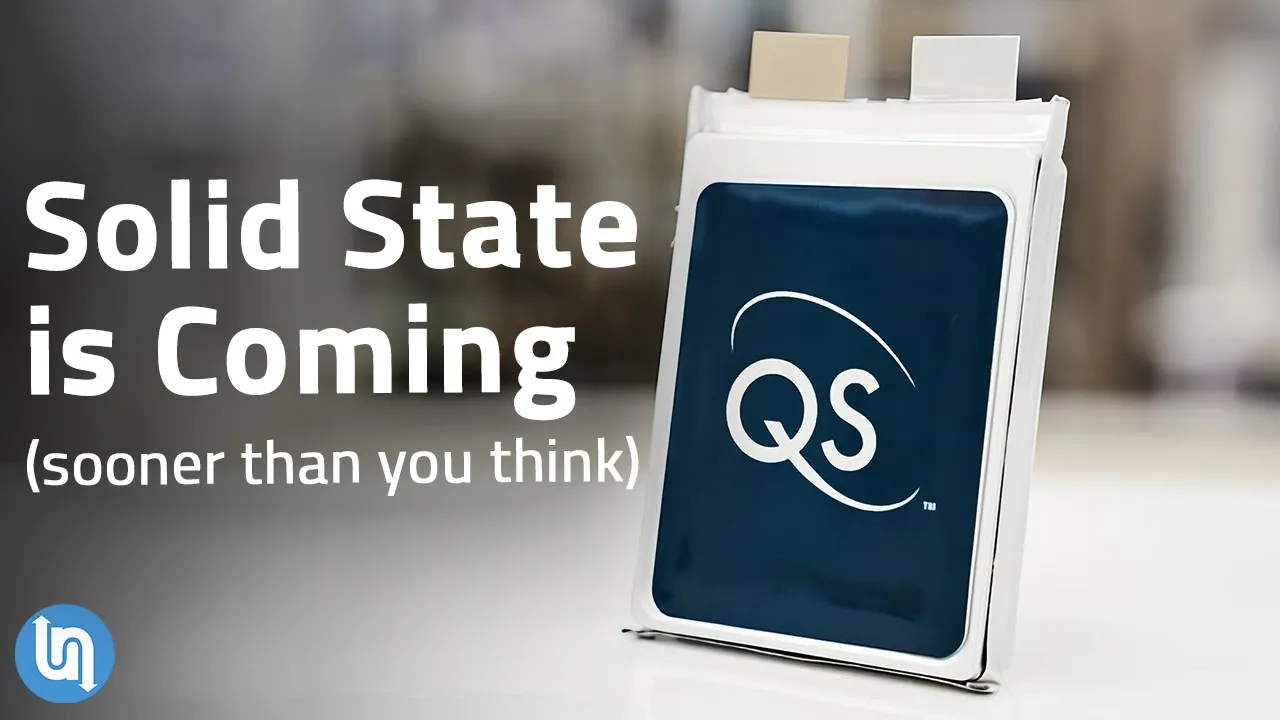
Let’s dive into QuantumScape first. It feels like every time we talk about SSBs, they seem to show up. Based in California, QuantumScape has spent years leading up to their first commercial product, the QSE-5 solid state battery. Previously, QuantumScape has said they were aiming for commercial battery production in 2024, and credit where it’s due, they’re pretty close to hitting that deadline.
One of QuantumScape’s core innovations is their anode-free battery, which sounds bananas. As I mentioned earlier all batteries have an anode and cathode. Normally a silicon or graphite anode stores the lithium atoms until they are ready to be discharged. Instead, they’re using a highly dendrite-resistant solid electrolyte separator. This allows the lithium metal itself to act as the anode. Ordinarily, the lithium has to diffuse through another anode material, which creates a bottleneck that slows charging speed. But Quantumscape’s method eliminates this bottleneck, so its battery is far more energy dense. The end result: shorter travel distance for ions and overall faster charging.
SSBs charge fast alright — that’s part of the draw. But by eliminating the anode bottleneck, QuantumScape’s battery can charge to full in less than 15 minutes. This is especially important for the world of electric vehicles (EVs). Along with range-anxiety, one of the remaining EV-adoption hurdles is charge time. As long as it’s faster to fill a gas tank than charge a battery, some people are going to have their doubts about EVs. That’s why QuantumScape is angling for the EV market.
Speaking of the market, that’s another benefit of the anode-less design: Quatumscape doesn’t need to spend money on making an anode. Considering that cost is one of the things holding back SSBs, every little bit helps. It also saves some space and weight, which again, are important considerations in the EV-world.
And there’s yet more benefits to QuantumScape’s design: it increases the batteries lifespan. The anode is where a lot of those nasty, life-shortening chemical reactions take place. Without that anode, QuantumScape claims their battery can go for 2,000+ cycles. Most lithium EV batteries can run for around 1,500 to 2,000 cycles, so QSE-5 isn’t lagging here.11
Another neat feature of the QSE-5 is its housing. Lithium-metal batteries like the QSE-5 have a tendency to balloon up if you fast-charge them. If you’re planning to stack a bunch of these batteries together, like for an EV battery pack, this can be difficult to engineer around. So QuantumScape has forgone the usual cylindrical battery frame, opting for a combo box-and-pouch they’re calling the FlexFrame.12. There’s a central pouch that’s built to swell, and when it does, it rises until it’s flush with the boxy frame. This little engineering trick ensures that the batteries have room to grow and shrink while remaining tightly stackable. Pretty clever when you’re trying to maximize the space, weight and energy density for an EV.13
Let’s turn now to Colorado-based Solid Power. Rather than changing up their architecture, they’ve got a novel battery formulation. The company has three batteries that are approaching commercialization, all with a sulfide-based solid electrolyte separator. We’ll focus on their Silicon EV battery though, because that’s the furthest along.14 Their solid sulfide separator offers the usual SSB benefits along with its own interesting perks.
Sulfides have great ionic conductivity, with some even close to liquid electrolytes. This means that lithium ions can travel through sulfide-based separators with less resistance, helping with faster charging times. They’re also flexible, so they can roll with punches instead of snapping like more common and brittle glass or ceramic SSB separators.15 These materials have shown remarkable heat resistance, which is great because batteries, even solid state ones, do tend to get pretty hot. And recent studies suggest sulfides can be moisture resistant when properly treated.161718 Considering how temperamental solid electrolytes can be around moisture, this has the potential to make manufacturing much easier.
Ease of manufacturing might be sulfide’s greatest strength. Sulfide SSBs can be produced with roll-to-roll battery manufacturing equipment, which is very common in the industry. And sulfides can be manufactured relatively cheaply from abundant materials too, helping them avoid many supply chain issues. All together, Solid Power claims they can manufacture its SSBs for cost savings of 15-35% less than their competitors. Seeing as the price is one of the major limiting factors of SSBs, that kind of cost saving is nothing to sneeze at.
Now that you have a handle on who we’re dealing with, let’s dive into the nitty-gritty stats. Which battery is better for an EV? Which will hit the market first? And what challenges still remain?
QuantumScape & Solid Power Pros & Cons
Rather than slow things down by listing off the stats one-by-one, we’ve got a graphic for you.

In addition to the QSE-5 and Solid Power’s EV battery, I’ve also added Solid Power’s other batteries. And for the sake of context, we compare these batteries with Tesla’s 4680 cylindrical cells, currently used in the popular Tesla Model Y, and now with the Cybertruck. If this looks intimidating, don’t worry. We’ll break it down.
Let’s look first at volumetric density. This is a measure of how much energy a battery can store within one liter of its volume. The denser the battery, the bigger the “tank,” so to speak. Tesla weighs in at around 622 Wh/L, the QSE-5 beats that by about 200 watt-hours, and that in turn is bested by Solid Power by around a hundred watt-hours and change.
There’s no definitive evidence or statement for how far a car with QSE-5 or Solid Power EV battery will go on a single charge. However, the less dense Tesla Model Ys are estimated to run for 300 to 330 miles (or 482 to 531 KM) on a single charge, so it’s likely the SSBs will rove for a fair bit further.
Next we have cycle life … and I’m not talking about e-bikes. This is the amount of times a battery can be fully charged and then fully discharged before its capacity starts to fall off significantly. You can see that Tesla clocks in between 1000-2000 cycles. Solid Power fits on the lower end while the QSE-5 leans toward the upper end.
Now let’s talk charge time. Tesla’s batteries can “supercharge” in 15 to 25 minutes, but it’s not recommended. Charging your car this fast on a daily basis can really shorten its lifespan. Tesla says you should go for a more casual home charging method that’ll give you a full charge in 8 to 12 hours. But solid state batteries? Both QSE-5 and Solid Power’s batteries can readily do charge times of 15 minutes with minimal side effects, though they achieve this through very different methods.
For Solid Power, sulfides’ softness is the solution (try saying that 10 times fast). Just like it’s easier to swim through water than Jell-O, it’s easier for ions to move through the softer sulfides than some other separators. Fast, smooth-sailing’ ions equals fast charge times. Meanwhile, QuantumScape is fast because their oxide separator can handle higher voltages. This is a clunky explanation, but a higher voltage means we can “force” more ions through the separator. In this case, more ions equals fast charge times. Higher voltages tend to speed up dendrite growth and cut into the battery’s lifespan, but the QSE-5 is tough enough to handle them.
Last, but far from least, there’s the release dates. Which battery is making it to the market first? Both companies are already capable of making small batches of their batteries. QuantumScape hasn’t issued an official commercialization timeline. The company is pleased with the small batches it can do right now and is preparing to introduce and scale-up their “Cobra” production system in 2025.
QuantumScape claims that this will allow them to mass-produce solid state batteries at the gigawatt scale. From there it shouldn’t be too much longer to full commercialization. Solid Power hasn’t issued an official mass market goal date either, though their CEO, John Van Scoter, told the Denver Post last September that he predicts 2028 will be the year that EVs are regularly powered by SSBs, Solid Power’s included. So while neither battery is hitting the market next year, these are significant milestones, and it’s looking like we truly have broken away from the “just another 5 years, please” catchphrase.
I do want to temper some of the excitement by drawing attention to the engineering problems that still remain for each style of SSB. For sulfides, their vulnerability to dendrites still needs to be addressed. We’ve found a few ways to tackle this issue but none of them are perfect. Running the sulfide battery extra hot fights dendrite growth, but it also means adding extra heat management devices. That cuts into the cost and weight. We could put the sulfide battery under pressure, but that’s tricky to do outside of the lab. Running the battery on low power could also work. Though, it’s a bummer to have a high performance battery and not let it perform highly.
QuantumScape’s oxides have their own issues. Most notably, it’s still challenging to mass produce them. This is because they must be sintered together at very high temperatures, an expensive and energy intensive process. Meanwhile, sulfides can be made relatively cheaply and easily with some common industry techniques like roll-to-roll processing.
Which is Better, Solid State Batteries or…?
So, which battery is better? There’s no clear cut answer. They’re at slightly different stages of maturity, with different strengths and weaknesses. As we often find with these sorts of things, neither is a silver bullet. I think each one will settle into its own niche.
I want to re-emphasize that the outlook for both batteries is promising, at least at the time of writing. Last year, QuantumScape deployed the very-cool sounding “Raptor,” a high speed throughput separator process that allowed them to efficiently produce some QSE-5 prototypes for its auto company partners like Volkswagen. It’s planning on shipping their A2 round of samples to its partners for further testing this year. But if you liked Raptor, you’re gonna love Cobra. We mentioned it a moment ago, but Cobra is the upgrade to Raptor, and should help QuantumScape affordably mass produce its oxide separator at triple the current speed. That said, the QuantumScape team does caution that the Cobra is a work in progress, so it’s not like the manufacturing challenges are done and dusted.
For their part, late last year Solid Power inked a deal with SK Group, the biggest company in Korea behind Samsung. This three-year contract gave Solid Power a $20 million boost40 on top of an earlier $130 million investment from Ford. Thanks to this kind of support, Solid Power is already capable of producing 1.1 million metric tons of their sulfide electrolyte per month! The company’s own A1 cells are already out the door, and it’s planning to have its A2 cells out soon.
With that in mind, I still want to be careful and not overhype SSBs and feed into the idea that they’re a holy grail and the thing to hold out hope for. SSBs are going to be huge when they hit, but they need a little more time. So if you’ve been waiting until SSBs are around to switch to EVs or install home energy storage, I’d quit waiting and get the product that fits your needs today.
Related Articles
What’s The Best Home Battery for a Net Zero House?
Gemini Hybrid Battery Breakthrough: Unleashing the Future