2.2 Million New Materials Discovered, But Will We Ever See The End of Building with Concrete, Glass, and Steel?
I asked a colleague who lives in Saudi Arabia today if she feels that the region will ever adopt sustainable building materials rather than concrete, glass, and steel – three very high users of energy in their production.
She didn’t answer my question, but sent me this video link instead. I also learnt last week that Google’s DeepMind’s GNoME has discovered over 2.2 million new materials in just 17 days – work that apparently would have taken us humans centuries to accomplish.
So when I consider that the building and construction industry is one of the slowest industries to adopt change, what’s the chances of us using more capable and more environmentally friendly materials in our buildings over the next couple of decades? I suspect the answer is very low, because not only do we have to learn about these new materials possible applications, we have to test them, then put them through some sort of compliance and certification programme, then we have to get the building code updated – and our Councils educated, to be able to permit their use. Then the industry has to actually adopt their use which is like herding cats.
So here’s the question – what good are all these new discoveries if it’s so hard and slow to make them commonplace? How many materials have we actually adopted into the supply chain over the last century that are regularly used in our building projects today? I have no idea, maybe LED lights? As I sit here at the end of a long day I can’t think of any others.
The Sobering Reality of Our Sustainable Building Materials Crisis
Here’s something that should make us all pause: the buildings and construction industry is responsible for 37% of the world’s greenhouse gas emissions. That’s more than a third. And every time we specify concrete, steel, glass, or aluminium, we’re making a climate choice whether we realise it or not.
Let me put this in perspective for you:
- Concrete alone accounts for 4-8% of all global CO2 emissions, with 900kg of CO2 released for every tonne of cement produced
- Steel pumps out about 1.8-3.0 tonnes of CO2 for every tonne made
- Material production creates 82-96% of all CO2 emissions during the construction phase
We’ve made decent progress on reducing the energy buildings use once they’re built – heating, cooling, lighting and such. But we’ve been absolutely rubbish at tackling the carbon embedded in the materials themselves. The irony is that sustainable building materials often perform better than traditional options, yet we continue avoiding them.
Why Sustainable Building Materials Discovery Matters (And Why It’s Frustrating)
What my colleague’s video showed me was fascinating – we’re living through what might be the biggest materials revolution in human history. AI systems have identified over 2.2 million new materials, and over 700 of them have already been created in labs and are being tested. Some of these include 528 new materials that could revolutionise batteries – so maybe that will help influence our renewable energy storage sooner rather than later.
But here’s what gets me: whilst AI can discover materials in days that would take us centuries, our industry will probably take decades to actually use them. It’s like having the cure for a disease but keeping it locked in a laboratory because the paperwork takes too long – or we just like the pills we already have.
So Why Are We So Slow to Adopt Sustainable Building Materials?
I’ve been thinking about this, and I know there are some uncomfortable truths we need to face about why our industry resists change, even when better alternatives exist:
We’re Operating on Razor-Thin Margins: Construction companies survive on profits of just 4-7%, compared to 20%+ in tech or banking. When you’re barely keeping the lights on, experimenting with sustainable building materials feels like a luxury you can’t afford – even if those materials might save you money long-term. And R&D grants from our governments are about as easy to find today as a reducing rates demand.
Nobody Wants to Be the Guinea Pig: The insurance companies don’t like new materials or building practices – so who’s going to be the first to specify a thoroughly tested new material for a hospital or school when traditional materials are just easier to specify?
The Regulatory Maze: Even when sustainable building materials prove they’re brilliant, getting through building codes and regulations can take years. Meanwhile, concrete and steel have decades of legal precedent backing them up.
Old Habits Die Hard: Many of our most experienced workers prefer methods they know inside out. Rinsing and repeating is the norm, it’s comfortable, it’s easy, it’s like that favourite jumper with holes in that you just can’t throw away.
What Sustainable Building Materials Nature’s Been Trying to Teach Us
The video featured Neri Oxman’s work, and it got me thinking – nature’s been perfecting materials for 3.8 billion years – and importantly it’s been influencing design, so maybe we can learn a thing or two if nothing else:
Neri’s shown us possibilities like:
- Structures that actually grow and adapt, then return to the earth when their job’s done
- Working with other species (her Silk Pavilion was created with 17,000 silkworms)
- Materials that respond to their environment – imagine concrete that changes properties based on the weather
- Building with materials that store carbon rather than release it
And we already have alternatives sitting right in front of us:
- Mass timber can cut carbon emissions by 39-51% compared to concrete, or up to 81-94% when you factor in how trees store carbon whilst they grow
- Bio-based composites made from agricultural waste, algae, and natural fibres
- Recycled materials – why throw away concrete when you can crush it for new uses?
So What Can We Actually Do to Promote Sustainable Building Materials?
I keep coming back to this: as designers and architects, we’re the ones specifying the building systems, products, and materials. We’re the ones who can push for change, so:
Start Small and Prove It Works: You don’t have to revolutionise everything at once. Try sustainable building materials for non-structural elements first. Build a case study that others can point to.
Demand Better Information: Ask for proper environmental reports on all materials. Make manufacturers justify their carbon footprint.
Build Alliances: Partner with other firms to share the risk and knowledge. Innovation shouldn’t be a solo journey. When multiple firms specify the same sustainable material, suppliers take notice.
Educate Everyone: Many clients don’t even know sustainable options exist. Make the business case – show them how these materials can save money over the building’s lifetime through lower maintenance, better performance, and future-proofing against regulations.
Work with the System: Partner with universities and researchers. Collaborate with councils and building control officers. Help them understand why sustainable building materials matter. Create student competitions that push these materials to their design limits.
The Economic Reality Check
Here’s something that might surprise you: sustainable building materials often deliver better value over a building’s lifetime. Yes, they might cost more upfront, but they typically offer:
- Lower maintenance costs
- Better indoor air quality (which reduces health costs)
- Higher resale values
- Protection against future carbon taxes and stricter regulations
Where This Leaves Us
The construction industry accounts for 37% of global emissions, yet our productivity has been declining since the 1990s. We’re the second least digitalised industry, only beaten by agriculture. The main barriers to adopting innovative materials are: lack of awareness, lack of education, lack of government support, poor research funding, unclear benefits, shortage of skilled people, and outdated building codes.
I don’t believe we can afford to wait for perfect conditions. Whilst other industries transformed themselves over decades, we’ve clung to tradition. The result? We’re responsible for nearly 40% of global emissions whilst operating on tiny profit margins because we’ve failed to innovate our way to efficiency. People say that we can’t build without concrete, but we actually can.
Think about the contradiction: we have AI discovering thousands of revolutionary materials, bio-based alternatives that often perform better than traditional materials, and a climate crisis demanding immediate action – yet we continue specifying the same carbon-heavy materials our great-grandfathers used.
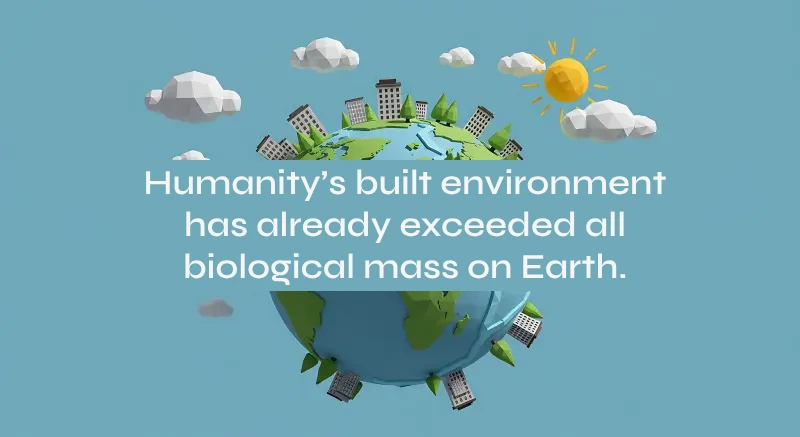
Here’s a statistic that should stop us in our tracks: humanity’s built environment has already exceeded all biological mass on Earth. Everything we’ve created – every building, road, bridge, and structure – now outweighs every tree, plant, animal, bacteria, fungi, and virus combined. This crossover moment demands that we fundamentally rethink our relationship with materials. We have the opportunity to design a future where buildings don’t just shelter us from nature, but actively participate in healing our planet.
So here’s my question for you: what good are all these new discoveries if we don’t have the courage to use them?
I challenge our governments around the world to make it easier to adopt better materials, products, and building systems. Every specification is a vote for the future we want to build. What future are you voting for?
Related
Building Prosperity Through Circular Strategies