
Foreword
by Ian Thompson, Editor at The Build Review
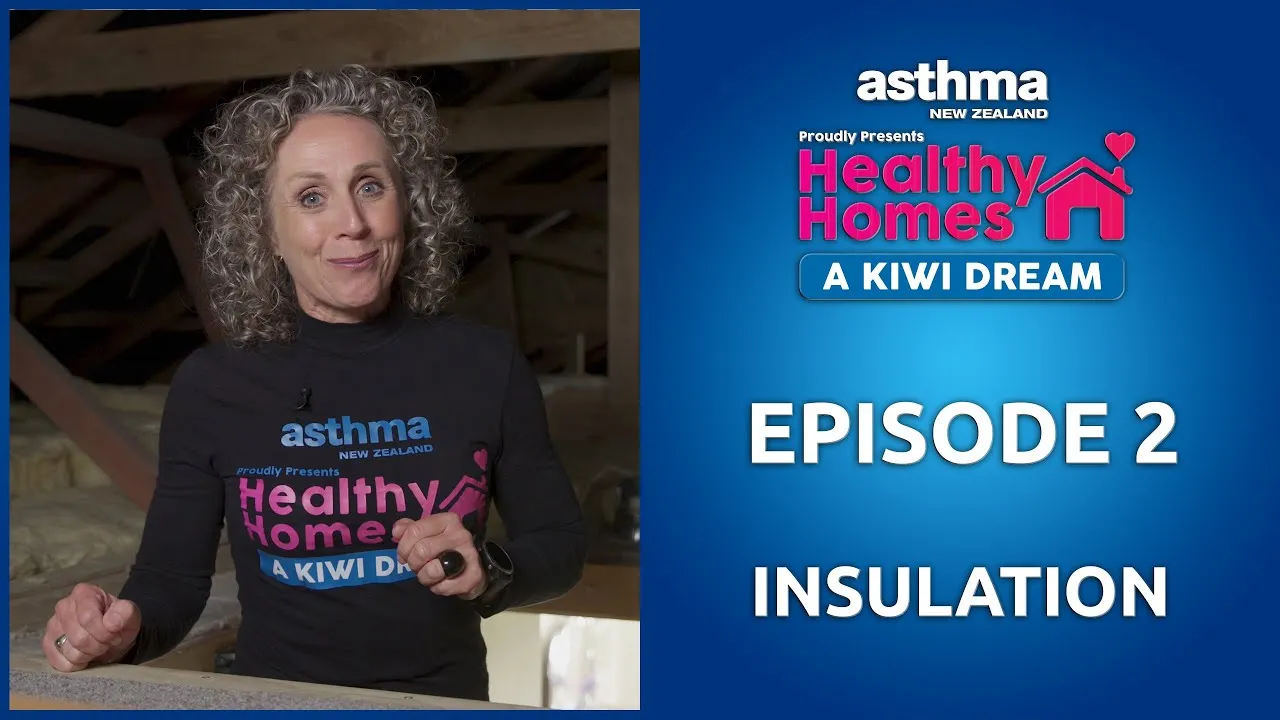
Today, in collaboration with Asthma New Zealand, we are releasing Episode 2 of the Healthy Homes series on The Build Review. This episode focuses on the crucial role of insulation in our homes and the consequences of poor installation or no insulation. Yes, still many homes in New Zealand have no insulation in their walls, under their floors, and roof spaces.
It’s important to highlight that even commonly used insulation products in New Zealand require special handling by installers due to their harmful toxins and particulates, which can negatively impact our health if not contained properly. While these products may meet the standards set by New Zealand’s building code, we must question their safety for both installers and the building’s occupants, especially if not sealed properly.
Our recommendation is to conduct thorough research before purchase. For my builds, I specify natural products that promote good health and sustainability. Additionally, exercise caution when selecting roof insulation, especially if you have a heat recovery system that draws air from your attic space. Let’s prioritize the well-being of our building’s occupants and the environment by choosing the appropriate products that safeguard our health.
Remember, if you design your new house to use high-performing insulation, good quality double or triple glazed joinery, and a good wall, floor, and roofing building system, you’ll reduce your heating and cooling requirements. This will mean that not only do you build a better quality house, but you’ll also save considerable sums in energy bills and maintenance. You’ll also be able to source a cheaper and smaller HVAC system, which will help offset any increased costs if your higher quality building products cost a little more.
Health is wealth, cutting corners may cost you more than money!
Asthma New Zealand Healthy Homes Series – Episode 2 – Insulation
Video Transcript:
Yeah, there’s a roof, there ain’t no insulation. Welcome to New Zealand.
I’m Catherine Lightning, the CEO of Asthma New Zealand, and I’m on a mission to help you understand what a healthy home is, but more importantly, how you and I can do little things to make our homes healthier so that we can protect our health. Because for far too long, we’ve been living in homes that aren’t doing the job they’re supposed to.
This week, we’re going to go speak to an expert to understand about insulation. Is all insulation equal? Why have we legislated insulation in New Zealand? Can you and I install our own insulation? Come with me, let’s find out.
Why is New Zealand got some of the worst performing houses in the world? So, the World Health Organization talks about this. The data shows that if you live in a mild climate, you’re more likely to die in winter. So, if you live in Canada, you build properly; otherwise, you do die. And if you live in a mild climate like we do, if you don’t build well, it’s uncomfortable. It’s cold, damp, moldy respiratory illness. But that doesn’t kill us tonight; that’s a slow burn. It seems absolutely bizarre then, why wouldn’t we build to keep us healthy?
Well, we changed the expectation of buildings. So, you know, something built in the 1940s, 50s, 60s, it wasn’t required to be insulated. When we started to want to be warm, that was when the problem started because insulation changes the way a building deals with moisture. We can have underfloor insulation and ceiling insulation; we’ve got grants for that. Is that not enough?
It’s not enough. You don’t go out in the winter naked except for socks and a hat. You don’t. You’re going to be called on the visual thinker. Thank goodness we don’t even. But what’s the difference? You’re putting on a little bit of insulation under your toes and a little bit above your head. Do you need to do that? Yes, and the walls need insulation. If we build new buildings with reasonable levels of insulation and double glazing and ideally thermally broken aluminum or better, we’ve got an environment, or at least a building enclosure, that is containing the warmth that we put in there with heaters.
You know, given the fact that we’ve got 1.8 million houses built in New Zealand and that a large number of those houses are not performing at a level that keeps the occupants healthy, is it even possible for us to start to improve those houses?
So, something I’ve been looking at, are kind of, I guess, exploring, is how do we incentivize people to keep their houses warmer and drier? We’ve had some for lower-income people for installation of above and below, but it really just focuses on insulation. I’d like to see those rebates expanded to include a lot more things. So, energy-efficient hot water heating, heaters, thermostats, heat pumps, windows. You know, all the things we know make homes better. We should be incentivizing people to do that to their houses. I’ve started to describe housing as Healthcare infrastructure. It’s really that first part, the first line of defense for a lot of people in providing health. And absolutely, if we start to look at that more holistically across portfolios, maybe the health sector and the housing sector need to get together and say, Actually, if we spent some more money in the housing sector incentivizing people to be warmer, we would have less demand on the Healthcare System until those two kind of come together, we’re going to be stuck where we are. So let’s say, you know, I want this house to be really warm. Is it just a case of rights whacking and a heck of a lot of insulation, putting, you know, some underground heating in and putting a massive heat pump in? No, there’s a lot more to it. I’m not a big fan of throwing in large heat pumps just to substitute for heating. It goes back to just the envelope. That’s the most important aspect. If you can get that part right, then you can minimize the amount of mechanical input, such as a heat pump. There are buildings now where it’s not properly done on the exterior, so the interior is quite cold, and a lot of people are getting massive heat pumps installed inside when all it’s really doing is just leaking out through the walls and roofs and windows. Focus on the structure, the envelope, and the performance of that, and then substitute with mechanical, like a heat pump.
Jenny, I’ve come to you as a building company, being like most Kiwis, I’m thinking, you know, a flash kitchen. What conversation would you have with me about investing in my asset? Okay, I’d ask you, probably, what is your most important asset right now? Your natural health. So as a result of that, I’d say, look at the structure of your home first. You can always spend the money now on the structure and worry about the sexy, very seductive nice kitchen at a later stage. And what matters is actually having a healthy environment, and your best ways to do that is having appropriate insulation. Like, obviously, if you’ve got no insulation under your floor, you can get into your roof space, you know, that’s going to make it a much more pleasant experience for you, particularly as we all know heat goes up. So that’s going to be your biggest loss of heat. And then if you don’t have any insulation on your walls doing that as well, they’re going to be your big-ticket items that will enable you to maintain a healthy temperature at a lower cost. Again, it’s not ideal, but it’ll be much healthier than where you are right now. There’s potentially investing into the things that I can’t see first in order to benefit the very thing that I will feel, and that’s my health. And not just my health, it’s the health of my family and the people that will live in that home afterward as well. Like, we do notice that actually, you know, allergy-wise and asthma-wise, that we have so fewer incidences of attacks, and we use a lot less antihistamine and all those other things that are familiar friends, I’m sure, to many New Zealanders. Yes, but yet, we only use them really now and when we used to live in the 1950s, aren’t you at home? Yeah, it was a regular routine, and now it’s become the exception rather than the norm. We’ve witnessed that with our own family. Insulation is starting to make a little bit of sense to me. So let’s go find out a little bit more about this stuff.
I’m in the attic of this beautiful old villa, one of the 700,000 homes in New Zealand that has no ceiling insulation. We’ve heard how important insulation is. I want to go find out, is all insulation equal? Simon, is all insulation equal? Catherine, there are many different types of insulation in the marketplace. You really have a choice if you’re looking at fibrous insulation, which is what we would suggest if you were going to put it between the timber frames. And you’ve got options of fiberglass or polyester or even a wool insulation. You know, I’m thinking about, you know, from fiberglass, now imagine breathing that in. Does that present challenges? Certainly. So I would make sure that when you install the insulation, that the person installing the insulation takes care to protect themselves. And once you’ve installed that insulation, the ideal is to protect it from both the outside and the inside with layers: air tightness and vapor control layers that will ensure that you store the insulation within that package so that you don’t have those fibers floating around. I would not know any of that stuff. Is the architect or the builder responsible for ensuring that stuff happens, or am I supposed to make sure that’s happening? I think it’s quite difficult for a consumer to understand how all these different products work. So as an architect or an architectural designer, that’s their job is to choose the right type of insulation for the specific building that they’re putting together. And then it’s also important to make sure that it’s installed correctly. So with insulation, if you have gaps in the insulation, it’s not going to perform well.
I’m curious, is there any other insulation other than synthetic available? We’re in Christchurch to go have a look at some natural fiber. Here I am standing surrounded by wool insulation. So you find sheep that are in the hot parts of the country and also the really cold parts of the country. You know, nature has perfected a fiber for keeping the body of the animal at the right temperature. And really all we have done is taken that fiber and applied it to a whole home so that we can manage the temperature and the humidity inside the home. And those are the two things that you really want to keep on top of if you want a healthy environment. And so what you’re saying is that wool is a natural fiber. If we think about how wool acts on a sheep, the wool keeps the sheep dry from the elements because the wool takes their moisture away from the heart of the animal. Water conducts thermal energy better than air. In fact, air is one of the best insulators. So what this fibrous insulation does is it makes these little pockets of air. Yeah. And if you keep that air dry, we get a better thermal result.
You know, the concern that’s going to exist for me if I’m looking at installing this in my house is going to come down to cost, of course. How would I justify the cost of this product versus synthetic product? We don’t hesitate to spend money on a new TV, new stereo system, the best, the shiniest, do we? We don’t hesitate for the cost of a TV. Leave that TV out. Invest in the envelope. So you’re saying to me that for the cost of a TV, I could put this natural product into my house? For an average home, yes, a few thousand dollars, you can have all insulation. It’s about where are you putting the money when you’re building the house? Are you willing to put the price of a TV on the price of your family’s health? There is no amount of money that you put on your family’s health.
“No idea that there was anything other than pink candy floss as an insulation product. And if it’s good enough for us as kids to grow up with wool jerseys and those stunning wall blankets, why would it not be good enough to put this product in our houses? Seems astounding that as a country we haven’t jumped on this as a product being natural and good for us.
Insulation, how complex is it to install the stuff? Can you and I do it? Let’s go find out. I’m out in the back blocks of Wellington on a freezing cold winter’s morning. I’ve come to the Building Research Association of New Zealand. If anybody’s going to know about this stuff, it’s going to be them. Ian’s going to help me understand just what can go wrong with installing insulation.
What are we looking at here? We’re looking at a demonstration of thermal imaging and how a thermal camera can pick up defects in the installation of insulation, how well it’s put in. Each one of these could represent a wall or the ceiling or the floor in my house. Yeah, well, the insulation part of it and its interaction with the framing.
How do you demonstrate the impact? We point the thermal camera at it. It shows the surface temperature on the panel, so from that, we can infer what the heat flow is. So, what am I looking at here, a thermal image? It’s an infrared image of the surface of these panels. The camera converts that to a temperature, and then that temperature is represented by a color. So, am I correct in thinking that the blue is real cold, being icy, and the red is hot, and the white is the hottest? Yep.
Why is the focus on getting the insulation installed correctly so important? Because it’s a system, and every little bit of the system has an impact on the rest of it. We’ve got four different setups here. What does R 2.8, R 2.6 mean? That’s the thermal resistance. It’s a resistance to heat flow. It’s a measure of watts per square meter per degree difference.
Okay, I think we should stop there, too. A value. The R-value is about resistance to heat transfer. Hot water in this glass is going to transfer to my hand a lot faster than hot water in this mug. The R-value or the higher the R-value, the slower the heat transfers. I want to see if I can take a guess at the size of a face gap. I’m picking that we’re probably going to see a gap of about that much. Yes, a lot less. I’m prepared to put 20 on this. Let’s have a look. That is remarkable. If you’ve got a gap on this side, a gap on the other side, and you’ve got gaps at the top, the heat can convect around, completely undermines the insulation. Our measurements showed gaps of two millimeters, both faces, top and bottom, can be half the R-value. Okay, I’ve just lost twenty dollars here. This could get an expensive exercise in terms of front tuck. I’m picking that it’s probably going to be there’s going to be a size about that big. As we push the product in, it can naturally tuck and so you get it flush on the surface. But what’s hidden is the tuck on the other side. Yes, absolutely. And so, in terms of a fold, that’s when there’s a fold in the insulation. Yeah, when the segment is too big for the space you’re trying to fit it in. Okay, I’m picking that there’s a fold of about that much. It’s more like that, battling the full width of the product. That fold there is causing extra heat transfer, heat loss through the wall. Now I’ve got to see this R 2.8, 2.6. Am I going to see any difference with this? No, look exactly the same. So unless you’ve got the bag, how do you know which is which?
Well, you wouldn’t. I wouldn’t know. I probably would go and just want insulation, and I’d see two products that look identical, but one’s more expensive than the other. But it would have an R-value on it, but that wouldn’t mean anything necessarily to me until now because I haven’t been aware of that. And I wonder how many DIY and insulation installers are actually aware of it themselves.
When it comes to insulation, a ground vapor barrier, something that you and I could do this weekend, it’s actually not that complicated. So, I’m under this house because I wanted to understand what this thing called a ground vapor barrier is. It’s now just been mandated for all rentals. So what is it, and what does it do? In effect, a ground vapor barrier is basically polythene laid down under the house, pigdon, so that it stops the moisture from the earth coming up into the floor. Now, if I was to pay somebody to do this professionally, it’s probably going to cost me about a thousand dollars. But I could go to my local DIY store, buy some polythene, get some electrical tape so that I can make sure that all around the piles are well sealed, definitely a set of blue overalls. They go with it, and I could lay it myself.
You can see, if we were to lift this up, there’s moisture. Now, if this moisture wasn’t being trapped by this polythene, it’s got to go somewhere. And so, it’s going to come up into the insulation. Depending on how moist it is, it could start impacting on the internal environment. And I’ll tell you how much moisture it is. It’s about 40 liters a day. 40 liters a day from an average-sized house evaporates up without this ground vapor barrier. That 40 liters has got to go somewhere.
Okay, I’m under another house here, and this does not have a ground vapor barrier. What is so interesting is actually having a look at the moisture here. And I can see the dirt here is clay. It’s wet. Over here, you can see all of the moisture droplets under here, of water. What’s remarkable is I can actually see water droplets. It’s affixed itself onto the insulation, you know. So if anybody’s in doubt about the value of a ground vapor barrier, the amount of moisture it’s got to go somewhere, yeah, it will seep up into the internal environment.
You know, it’s funny because I recently was driving, and beside me were three vans of young men, all full of insulation. And I looked at them, and I thought to myself, if only you understood that you’re a healthcare worker. Yeah, you’re actually going to install insulation into a house that will make a difference. We need to start thinking more holistically. Everything we do has an impact, and is that impact going to be something that we’re going to be proud to pass on? Is that going to be a baton that our future generations will pick up and say, ‘Thank you, you’re giving us an asset,’ versus leaving us with a liability? Builders like being in the building industry because they like to leave something good behind. The challenge at the moment is, are you leaving something good behind? And if we can provide information as people learn how to build and for designers as they learn how to design, they know they’re going to be leaving something good behind.
I think that is a really powerful message, and we’ve got to think from that perspective. I now know so much more about insulation. You know, I didn’t realize that there were so many different types of products available. And I think probably the most surprising is how important correctly installed insulation is. Now, of course, insulation only stops a heat transfer. We’ve got to go and continue to understand what makes up the system that keeps our homes healthy. So join me next time as we look into ventilation and understand the role that it plays in keeping our internal environment healthy for us.
Related posts:
External Youtube post: Healthy Homes – Episode 1 – The Problem