Foreword by Ian Thompson, Editor
The circular economy champions a solid principle: locally source all our building products, recycle them after their lifespan, and repurpose them for new uses. This philosophy is undoubtedly appealing, but its feasibility, particularly in countries with a less developed manufacturing sector, is debatable.
Numerous countries have implemented recycling programmes to handle items like food and drink packaging. However, how much of it is genuinely and effectively recycled and reused? Some countries perceived as environmentally-friendly actually pay for their recycling to be shipped and processed overseas. When considering the carbon footprint of this versus landfill disposal, which is more sustainable?
Another question we must ask is: ‘What exactly are we manufacturing?’ Is it sustainable? Can it be recycled and repurposed?
While these ideologies are commendable and ones I fully support, they cannot fully materialise until significant investments are made in our manufacturing capabilities for sustainable building products.
If you were to ask 100 random people about the circular economy, it’s likely that a significant portion might not fully understand it. Considering the current lack of investment in our manufacturing capabilities and sustainability initiatives, how feasible is it for the circular economy to become mainstream, outside of the most progressive and proactive countries? This is a thought-provoking debate, one that extends my thinking in various directions.
I’m a strong advocate for international procurement, which enables us to source more efficient, affordable, high-performing, and sustainable products and materials. However, this position seems to starkly contrast with the core tenets of the circular economy. Consequently, the need for balance is crucial. We shouldn’t exclusively purchase expensive, underperforming, and unhealthy products locally just to satisfy the principles of the circular economy. Instead, we should shop wisely, responsibly, and conscientiously.
I’m committed to considering the circular economy in all my designs, but I also recognise the need for balance and the importance of making small, measured steps in the right direction.
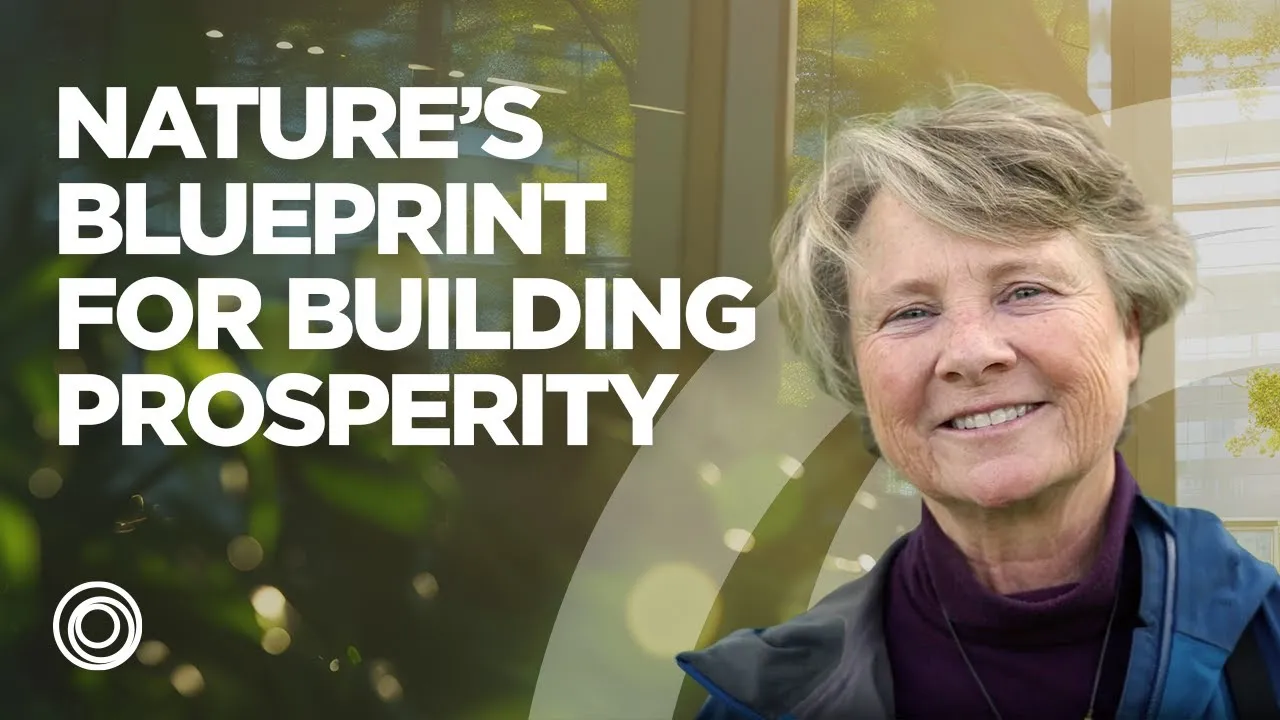
There are no landfills in nature.” Janine Benyus, Founder of Biomimicry 3.8, tells us how our cities and urban landscapes can function just like the wild land next door. By looking to the natural world for our models of how to design and innovate, we can create nature-positive, circular cities, where people and biodiversity thrive together.
This video hosted by the Ellen MacArthur Foundation is a quick and interesting watch, that I’m sure everyone watching will have something new to consider in their building projects, and lives.
Nature’s blueprint for building prosperity
We want healthy places where local materials are reused over and over again in a circular way. Part of being circular is that you move to a place of regeneration where, just by you being there year after year, the place gets better. The best place to look for a circular and a regenerative model is in healthy ecosystems.
I’m Janine Benyus and I’m the co-founder of Biomimicry 3.8, which is our consultancy, and The Biomimicry Institute, which is our nonprofit. Right now, we take things and just put them in a landfill. We extract raw material, make something out of it, and then we put it into a landfill. That’s the take-make-waste linear economy.
So how do we eliminate the landfill? There are no landfills in nature. Biomimicry is looking to the natural world for your models of how to design and invent things, but also for your measure in this case of what health is and what it takes to be healthy.
If we get this right, we’re going to come to a point where our cities, our working landscapes, and our living landscapes function just like the wildland next door. Can we build in such a way that we actually enhance the watershed, the ecosystem where we are? Is there a moment when the watershed is thankful that we’re there because our cities clean the air, they clean the water, they provide habitat for wildlife, they build soil, they slow floods, they store water to avoid drought? In the way we build, we can mimic the ecosystem services, as they’re called, that these organisms provide and that these systems provide.
Trees have the same need that we have, which is to get electricity and water to each cell. For a building, it’s electricity and water to each room. The way we do it is not at all the way these trees do it. At the same time as they’re trying to reach the sun, they’re thinking about the plumbing system and making it as friction-free and efficient as possible to move that water along. You’ll notice that there’s no 90° curves, as that would be too much friction. So, it’s always usually a Y formation and then another Y formation and another Y formation. Those branches have a design, and it is to reduce friction in distributing fluids.
One of the ways an organism reduces energy uses is by lightweighting. All the birds that are flying all around here, they have very lightweight but strong bones. That lightweighting is something, if we were to lightweight all of our building materials, say that they would have the same strength because the structure is strong, but you would reduce the amount of material needed. Then you reduce material use, you dematerialize, but then it’s also less energy to transport. That’s why the bird does it, it’s less energy to transport.
Your yard, your campus, your corporate campus would, by design, be part of a place that wildlife could move through as well as people. So that you would actually think about your surrounding areas and say, “How can we put the pieces of a fragmented city back together?” That was once an ecological corridor, can we recreate that corridor? Many of the streams in cities are put into channels or pipes underground and the first thing we can do is bring those to the surface, get rid of those pipes, take them out of the pipes, put the stream back on the surface. It’s an incredible magnet for wildlife and for people. Who wouldn’t want to picnic next to this?
We’re evolving, and what we used to think of as a sustainable building is tight and energy efficient. That’s it. We’re asking more of our designs these days. With this circular and nature-positive methodology, we’re actually able to do it through measurements with nature’s benchmarks. That makes it different than other things because it’s local, it’s place-based, but it’s also science-based and database-driven. You get a goal of how many of these ecosystem services you should meet per acre or per hectare of your land, and then you start to design into that goal.
We come back and we say, “Well, at your campus, or at your building, or your development in your city district, this is how much water you should store each year. This is how much water this stores each year and you’re right next door. This is how much carbon it should store. This is how much soil it should build. This is how much habitat support it should provide. This is how much cooling it should do. How much noise abatement it should do.”
There are no other alternatives than living as a beneficial participant on the planet. We can regenerate places that have been scarred. It’s in our DNA to do so. I think we just need to ask our designs to do that, to regenerate, to be circular, to create ecological benefits that go beyond the borders of a property.
Related
Ellen MacArthur Foundation Website
Circular Economy Principles for Achieving Net Zero in the Built Environment
Explaining the Circular Economy and How Society Can Re-think Progress