
Foreword by Ian Thompson, Editor
Today, we’re diving into a topic that’s sparked quite a bit of debate in the world of construction and home improvement – closed-cell spray foam insulation. Now, you might have heard about it, you might even be considering it for your next building project. But the question is, is it the right choice for you?
This closed-cell spray foam insulation is known for its high R-value per inch, moisture resistance, and ability to strengthen the structure (frame) of your home. In terms of energy efficiency and protection against mold and pests it’s a high performer. Sounds perfect, right?
Well, not quite. No insulation is perfect, and as they say, “every rose has its thorns”. While closed-cell spray foam insulation brings a lot to the table, it also comes with a few drawbacks. It’s more expensive, needs professional installation (Not a DIY Product), and there are environmental and health considerations that we should really take into account.
So, is it worth it? Well, we’re about to find out. In this video, we’re revisiting an old video where Matt’s taking us on an in-depth look at closed-cell spray foam insulation, weighing up its pros and cons, and helping you decide whether it’s the best solution for your project. Remember, the best decisions are always well-informed ones!
Closed-Cell Spray Foam Insulation: Is it the Right Choice for Your Build?
Video Transcript
On the Build Show today, we’re talking about an insulation strategy that’s going to add both strength and resilience, so this house can handle the worst that Mother Nature might throw at it. On the Build Show today, we’re talking about an insulation strategy that’s going to provide both strength and resiliency to this house. Now, I’m building in Austin, Texas. This is not necessarily a hurricane zone, but I’m building for a client who wanted to build traditionally using traditional methods with basically framing. But he wanted to build a house that could withstand the worst that Mother Nature could hit us because, of course, he’s going to live here for a long time, and we’re trying to build our houses for generations, not just for a couple of decades. So let’s get going.
We’re talking specifically today about the benefits that this closed-cell spray polyurethane foam is bringing to the house. Now, if you’re not familiar with closed-cell foam, there are two typical types of spray polyurethane foam: open-cell foam and closed-cell foam. This foam, because it’s a closed-cell foam, is very, very rigid. If you see my finger trying to poke in there, gosh, it’s got a lot of strength. It feels like you sprayed a rock into that cavity. This is kind of the same foam that they’re using when you build a Yeti cooler, very, very strong. But it also has a couple of other properties that are really helping us on this house in particular.
When we think about strength, this foam is basically the same type of chemistry as a polyurethane glue. So if you’re a woodworker and you’ve used, let’s say, Gorilla Glue, that polyurethane glue, you know that’s the strongest type of glue you can find. We’ve got a sister or a brother in the chemistry here, where it is actually locking everything together. So when they spray this foam into the cavity, it’s a two-component foam, meaning there’s a Part A and a Part B. It mixes in a hose at a high temperature, about a hundred and thirty degrees when it leaves the gun, and then it actually expands. Now, the open-cell foam expands a ton, just a huge amount of expansion. The closed-cell foam, there’s a little bit more density to it. This is actually what’s referred to as two-pound foam, and that’s a glue that’s going to lock everything together.
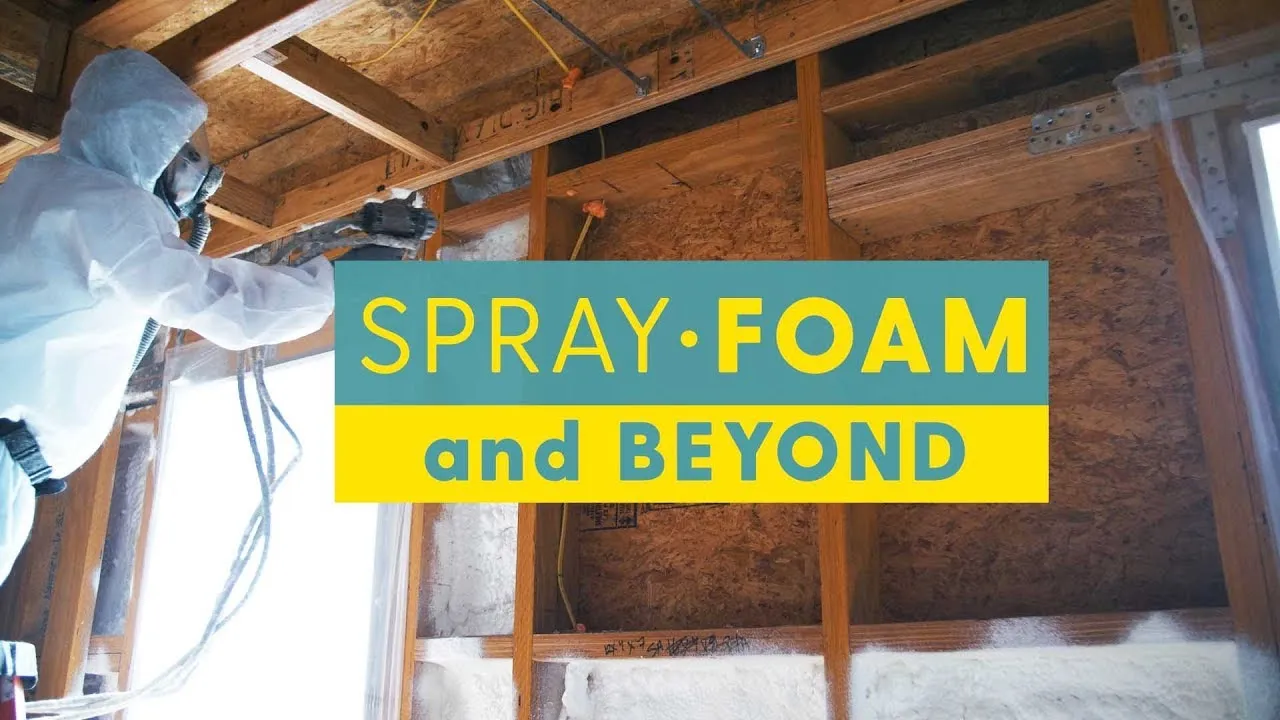
Now, as a result of that, you’re also going to be really careful when you’re spraying this. You’ll notice in the video, the guys that are spraying this have a lot of personal protection on. They’ve got all their clothes covered, they’ve got a face mask, and they’re actually bringing outside air into that face mask. Be careful if you’re a builder or a homeowner watching them spray the foam in your house. That airborne foam is basically like an airborne glue, and anything it’s going to land on, it’s going to stick to, and it’s not coming off. We’ve actually ruined a camera and a pair of sunglasses before because of being back there taking some pictures when the guys were spraying.
But what’s happening is when we spray that into the cavity, that foam is physically adhering and gluing to the sheathing. We’ve got that Advantech sheathing on the outside of this house. And then you’ll notice, this house is framed traditionally, but these studs look a little different. These studs are actually an LVL stud, so this is a 2 by 6 standard dimensions from a typical stud, except instead of an inch and a half, we’ve got an inch and 3/4 wide. But we framed.
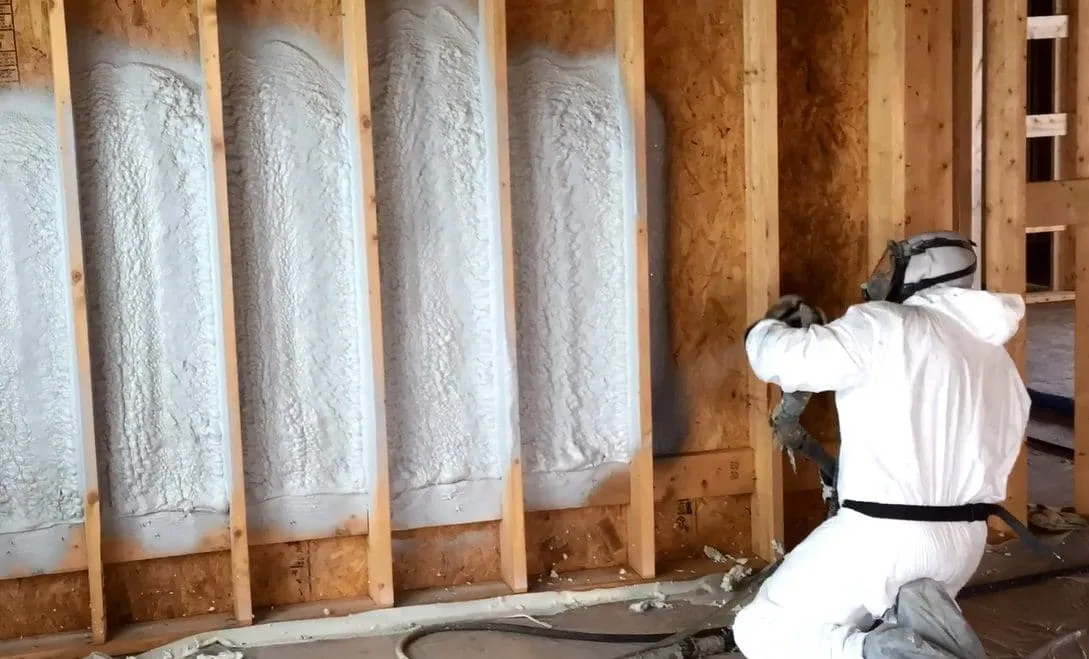
It’s adhering to the Advantech. It’s adhering to the sides of the studs, and it’s going to bring anywhere from 75 to 200% more racking strength to the house. Now, we framed with LVL studs because we were looking for extreme strength in the house. But the other thing you’ll notice is we’ve got some really beefy engineering on this house, especially the hold downs. Let’s start at the foundation level.
So, at the foundation, we’ve locked the framing down with some really big hardware that’s been bolted to the foundation. And then we’ve got multiple screws into the framing. And as we move up the levels, you’ll notice that the framing also has a lot of strapping. And we’ve got a door or a window opening, everything’s been strapped together with some straps. And as we get up to the roofline, we’ve got a couple of things going on there.
We’ve got some rafter ties, that’s that metal rafter tie you’ve seen a lot in construction. We’ve also got a timber lock screw going up through the double top plate into the rafters. But this is the place where that closed-cell foam is adding a ton of strength and uplift resistance to the house. That closed-cell foam is going to attach to the top plate, to the rafters, and that decking up there. And if we had a terrible uplift in a windstorm with 100 mile-an-hour winds, it’s going to help lock everything together.
Read More
Now, the engineers designed it with hardware to do that. But again, by using the closed-cell foam, we’ve just made those numbers that much higher. We’ve really got a very fortified house against some serious elements outside. Now, if you didn’t have the money for a full spray foam job in the whole house like we did here, we’ve got two inches basically on the walls and the roof everywhere. Another option might be to actually picture frame things.
I had the guys do one rafter bay for me like this, where basically they sprayed with the gun at a 45-degree angle in between the rafter and the decking. So that that spray foam would, again, glue that rafter and that decking together so we wouldn’t have decking blow off. And they sprayed the seams on the roof as well. So where you’ve got your H clips holding that plywood, or pardon me, the Advantech roof sheeting here, apart from each other, that’s where our expansion and contraction… They’ve sprayed that seam as well.
So now, if the worst of weather came and somehow some part of our roof blew off, we wouldn’t have all that water intake on the house because that closed-cell foam is going to lock it all together. Now, I’ve had people in the past say they don’t like to use closed-cell foam in the roofline because they’re worried if they got a leak, they’d never see it and you’d rot out your framing. I would say there’s probably some truth to that, but here’s what I do:
I always go in with an ice and water shield-type membrane on top of my roof. And that way, I know I’ve really got the best protection from the elements. And because it’s a fully adhered membrane, it’s not going to blow off, even if I had some roofing blow off. Another option would be to use something like a zip sheathing on the roof that has a taped seam. Because then, if your underlayment blew off, let’s say if you had a 15-pound tar paper, you’d still have those zip panels and that tape at the seams, which would help you with water intake.
Okay, next let’s talk about our value and perm rating. As I mentioned, this closed-cell foam has a very high R-value, nearly R7 per inch. We’ve got two inches here. Check out my other video on what we did on the outside. We actually used Comfortboard from Rockwool on the outside. So, we’ve got an R8 continuous on the outside. And then, because we’ve got two inches here, we actually have room inside the cavity for a batt.
This is what’s called a flash and bat system. We flashed two inches of closed-cell foam on the inside. And then, we’re going to finish the cavity with a batt. We’re going to be using Rockwool batts that are R-15. So, we’re just shy of our R-40 in the walls. And then, in the roofline, we use that two inches of closed-cell foam to lock everything together and to get that structural strength. But we wanted to save a little bit of money. So, we actually came in, we’re going to come in with open-cell foam after that closed-cell. And then, we’ll put that to a depth so we can achieve a total R-value in the roof system of R-40.
Now, we’ve got a conditioned attic in this case because we’ve got a lot of ducts up there. And that closed-cell foam, the other big benefit of it is, as long as you go an inch thick, it’s a really excellent air barrier. So, we’re not going to have infiltration, exfiltration. This house is going to be very tight. If you do this on your house, be sure you talk to your mechanical designer because most likely, you’re going to drop the tonnage on your house. And that’s something you could think about.
This is not inexpensive to do this on this house. But we were able to consider that as we thought about air infiltration rates and the excellent amount of insulation on the outside of this house. We’re basically building it like a Yeti cooler. And as a result, I’ve been able to reduce the mechanicals. We’re somewhere around 1,200 square feet per ton of air conditioning on this house. And compare that to a traditional house in Texas that maybe is five or six or seven hundred square feet to the ton. That’s some big savings overall, not only in energy use but in equipment costs.
Another property about closed-cell foam that you want to know about is it’s going to give you a vapor barrier. As long as you spray it an inch thick. So, that’s why you often see the flash and bat method. It’s not going to allow water vapor to condense on the back of your sheathing because the vapor will not permeate through the closed-cell foam as long as it’s an inch thick. We talked about how the closed-cell foam gives us racking strength and uplift resistance in the roofline.
One other thing I wanted to mention when we talk about strength, I’ve got a builder friend of mine, Foster, in New York City, who actually uses closed-cell spray foam underneath his stairs. I’ve not seen that before, but I think I’m going to start doing that where he’s actually spraying the bottom side of his wood stairs to lock everything together. It’s that extra squeak protection and glue, so those stairs are super solid. What a great idea!
Big thanks to Foster. Thanks for joining me, guys, as we talked about the huge strength and resiliency benefits of closed-cell spray polyurethane foam. Big thanks to my sponsor on this video, Accella. They’re the manufacturer that actually makes this spray foam. And also to Best Insulation, that’s my contractor here in Austin that actually has several locations around Texas. I’ll link to both the manufacturer and my applicator in the description below.
And lastly, I want to say thanks to DryDuck. We got a great load of Build Low Goat clothing from DryDuck. They make some awesome workwear. And I’ve actually got a coupon code link in the description below. So, if you’re interested in checking out some DryDuck apparel for you, you’ve got a discount just by being a Build Show watcher. Follow me on Twitter, Instagram. Otherwise, we’ll see you next time on the Build Show.
Related insulation links:
Closed Cell Foam – Does it add strength? Let’s Test!
Denim vs Cellulose Insulation | Everything you need to know! by Belinda Carr