Foreword by Ian Thompson, Editor
I think cork could be the perfect cladding and insulation on my next house. It’s natural, waterproof and very easy to work with. It natural and sustainable, and it’s healthy. No extra glues needed to bind the product and it can be recycled and reused. Is there a more natural and better product on the market that’s this easy to install? I even like the texture and finished look, and it’s carbon negative, a big plus for the planet.
I’ve walked on cork flooring and besides carpet I don’t think there’s a more comfortable surface to walk on. But I have not used or even seen cork used as a cladding on houses before.
Not only is cork insulation an excellent thermal insulator, but it is also a natural sound absorber, making it an ideal choice for reducing noise pollution in homes. In addition, cork is highly resistant to moisture and mold, which can help improve indoor air quality and prevent costly damage to your home.
But the benefits of cork insulation don’t stop there. It is also a renewable resource, as cork is harvested from the bark of cork oak trees without causing any harm to the tree itself. This makes it a highly sustainable option for those who are looking to reduce their environmental impact.
At a time when energy efficiency and sustainability are top of mind for many homeowners, cork insulation offers a practical and effective solution. So, whether you are building a new home or renovating an existing one, cork insulation should be an option to consider if it’s readily available in your country.
Over to Matt Risinger and his site visit to the cork clad house.
Cork Insulation and Siding – I’ve never seen this!
Introduction
Welcome to The Build Show! Today’s episode is all about cork insulation, a fascinating and innovative product that provides insulation using natural cork. This building behind me is entirely insulated with cork, and we’re here to explore its unique features and benefits. Cork insulation is not only an environmentally friendly choice but also one of the oldest insulation materials in the US. Its natural binder, subarin, acts as a glue to hold the solid cork panels together. This heavy yet versatile material cuts like wood and has a beautiful stone-like texture when finished. With its carbon-storing properties and remarkable thermal diffusivity, cork insulation offers a compelling alternative to traditional options. Join us as we dive deeper into this sustainable and high-performance insulation solution. Let’s get started!
Video Transcript:
The Build Show today features cork insulation. That’s right, this big insulation panel is made from natural cork. The building behind me is entirely insulated with cork. We’re going to get into all the interesting features and benefits of this insulation I’d frankly never seen before. Let’s get going.
Alright, guys, let me introduce you to Greg. Greg is the builder on this project, and his supply company has supplied all of this. What are we looking at, Greg? What is this?
So, we’re looking at two inches of solid 100% natural cork insulation. Yeah, this might seem like a really crazy new product, but it’s actually one of the oldest insulation products in the US. The same kind of cork is like a wine bottle that you pop the cork out of. The same material.
Yeah, so it’s the same stuff. When you take a cork bark out, you’re popping that out of a thick layer of cork bark, and then you’ve got all these leftover granules. And then you’re able to steam heat them. So when you steam heat these granules, they expand, and then the natural binder in the cork, subarin, releases. So it’s acting as this natural glue to hold this whole thing together.
Wow, so then you get the solid panels that can act as continuous insulation and a final cut adding for your house. Acting just like cork bark does in nature. Wild.
And so these are like two-foot by four-foot panels that come in a bundle. It’s actually pretty heavy. What’d you say this bundle is, Greg? What’s this bundle’s weight?
Yeah, it’s like 45 pounds. It’s pretty dense stuff. Cork is just this really wild material where it insulates like foam. It’s about R4 an inch. Pretty heavy. But it cuts like wood, and then when it silvers out, it kind of has this sort of stone-like quality to the texture.
So, you’ve got a rain screen and a siding going on here, or what’s happening?
Continue Reading
This is a very simple wall assembly, actually. And that was one of the things that really attracted me to it. You have two main things happening here. One, it’s working with carbon storing or carbon capturing plant-based materials. So this is a three-component wall assembly. On the inside, we’ve got about four inches of cross-laminated timber from sustainably harvested Doug fir and spruce in the case of this house. And then we’ve got our self-adhered control layer, Evapor Shield Wrap Shield SA. Okay, so that’s acting as a vapor-open air and water control layer. And then on top of that, we have these two inches of cork, and the cork is just adhered right onto that.
Is it glued on, or how did you attach it?
It’s screwed actually. It’s screwed through the ship lap. So when you’re working with cork, I mean, you’re able to hold the cork down here and be like, “Alright, we’re gonna put this through here.” You can usually just get it going on the ground and then screw it home.
So, you’ve just got a waffle head or a bigger washer head as well?
Yeah, this is a Fast Cap power head screw. Just a nice cabinet hanger screw. You could probably do it with something that doesn’t have quite as big of a head, but this gives you kind of a nice grip on the ship lap of the cork. That’s pretty sweet.
Yeah, you’re able to put this up, and it’s got a four-sided lap. So, this is what you’re seeing here with all the seams. You’ve got another one over here that’s covering over that. The screw’s hidden back here. The next panel comes in and it’s hidden behind there. Next panel comes in and covers it.
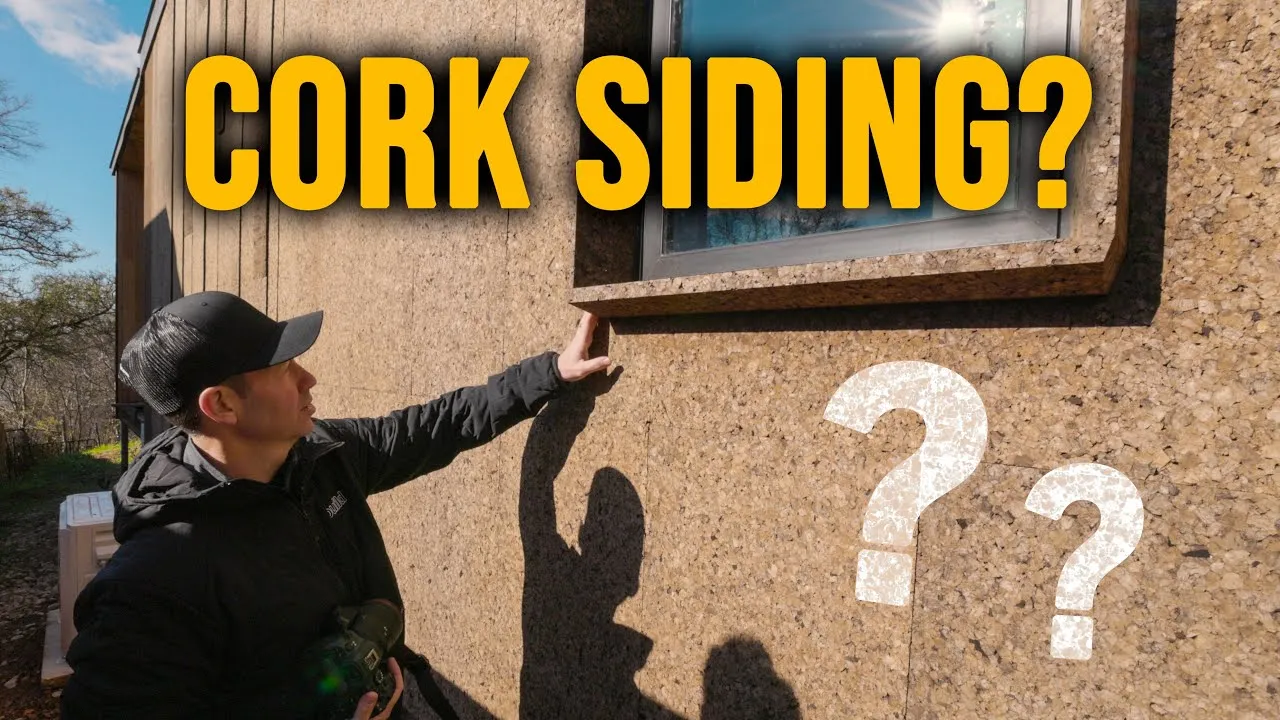
Also interesting to see, now you can see a little bit of this weathering. So, what you’re actually seeing here on this house is your final finish, this stucco. It’s going to be a cork-finished house, a cork exterior. I mean, what are they like? It’s basically tree bark for your house. But cork just has very unusual properties, which is the reason that people have used cork for wine, whiskey, etc., for hundreds of years. It is a natural, technical material. They’ve actually used cork on space shuttles, and they still use cork on space shuttles because it’s able to insulate and provide critical insulation for shuttle launches. And when it burns, because this kind of booster rocket is burning off, it burns at a steady, predictable rate. Wow. So, it does something that comes in handy in engineering scenarios. But this is literally 100% cork. It’s only its natural binder holding it together. It’s wild.
Um, yeah, it’s pretty much leftover pieces of this. Would break down if you put them in a landfill or your garden mulch bed too, right?
Correct. Yeah, it’s still totally a natural material, so it’s biodegradable, compostable, the whole bit. And ultimately, this will silver out and probably stay that silver finish and not have to do any maintenance to it, I’m assuming.
Exactly. That’s pretty wild. Yeah, and actually, if you hit it with an orbital sander, we did this, you know, we did this once. It’s only this outer very, very thin layer that is silvered. It comes back to that chocolate color just with about, like, five seconds with an orbital sander.
That’s pretty wild. It’s, yeah, it’s pretty crazy. And part of the reason is it’s a hydrophobic material. So, like, you know, we were talking about this. Like, the cork itself has a cellular structure. So, you think about wood having a porous kind of fiber structure where these little tubes where water can kind of flow through it because that’s what, you know, the wood is doing for a tree in its natural setting. The cork has a cellular structure. It’s like a closed cell sort of like foam type structure where it’s hydrophobic. It is not wanting to accept water into basically into the material. It’s like holding the wine into the wine bottle for the next 30 years as the wine ages.
Same thing.
The wine’s not leaking out.
Exactly. Even though the bottle’s on its side.
That’s pretty wild. Yeah. Now, talk to me about cutting it and handling it. And in fact, let’s use this pop-out as an example because I think this kind of shows what you can do with it. How do you cut it?
So, you can cut it with all your typical carpentry tools. So, we’ve used table saws, track saws, skill saws, jigsaws, routers. Yeah, we’ve used all those. Like, I think like this little piece, we probably did with the fine saw. I think that got cut with the track saw. This got cut to width with the table saw.
That’s so cool. Yeah. Those curves up there, we cut with the track saw. So, on this bevel cut right here, I would have thought that as the saw blade was wrong, this would pop out and you’d see a bunch of pockmarks. But, in fact, it looks to me like it’s really intact.
It also honestly feels pretty durable. It’s soft to the touch, but it’s not soft to the squeeze. Like, when you really got to get in there, it’s a nine-pound per cubic foot material. So, you think like foam, like typical spray foams, like two pounds per cubic foot. Wood’s about three to three and a half pounds per cubic foot, 30 to 40, depending on the species. So, it’s this really nice in-between where, yeah, it’s hard enough so that you can cut it. You don’t have to worry about being ultra delicate with it when you’re running it through the blade. But then it’s also light enough that it’s a ton of fun to work with. I bet. So, it’s not like trying to lug something that’s like 80 pounds up a lot or anything. It’s like the panels are going to be maxing out at about five pounds each.
And speaking of which, man, you guys had some fun over here. I didn’t introduce Greg fully at the beginning, but Greg is also the founder of a really well-regarded design-build firm here in Austin, Texas called Moon Tower. And, man, you got to show your design chops on this. Check this out. This projection on this Marvin window you’ve got here is all cork. Talk to me about what you did here.
Yeah, so this is, you know, this whole wall is what we called, like, the experiment wall. So basically, we were looking for opportunities to use the cork in interesting ways. So what we did here is, kind of starting at the head, we actually created a cork projection that sloped on the top and then has a kerf at the underside, basically, for a drip line. So it’s essentially kind of like a cork head flashing.
So cool.
Yeah. And then we kind of kept those bevels and angles coming around, you know, coming around the jam. And then put a little bit of a slope on the sill and then another curve cut at the back. Yeah, just to do something, like in this case, that has a little bit more of a modern, kind of contemporary look. It creates an interesting sort of shadow feature. It’s also, like, deep enough that you can see it from the interior. So, like, when you’re coming up to this window, you actually start to see the cork from the interior.
So cool.
Yeah. And it’s something that you don’t usually, you know, like, you talk plenty about insulation, but it’s like, you don’t usually get to expose the insulation with the final product. So it’s like, it’s like, okay, yeah, this is, you know, this is cork. This is the thing that’s keeping your house warm or keeping your house cool. But it’s also something that has this really interesting, like, kind of natural story, like a sustainability story. And that’s something that we want to really celebrate with the architecture of this building.
Talk to me about fire resistance. What happens if, you know, something happens and this would catch fire? Would this catch fire?
It’s a Class B kind of fire resistant, so that falls into the same category as, like, solid sawn timber.
Okay.
So, you’re not like a Class A.
But yeah, it’s like, the cork can burn, but it’s, it’s like a lot of these materials where, like, we saw with the charred timber, like, it’ll burn if the point of ignition, like, if you’re holding a lighter, like, it’s right there. But if you remove that, like, it doesn’t stay. It’ll char and then, yeah, kind of, yeah, makes sense.
Exactly.
And you also used it in some pretty cool ways here where you kind of vary the width and the depth to get that shadow line, which I bet architects would absolutely flip for.
Yeah. So, here we tried using different thicknesses, some, like, inch thickness and then some 3/8-inch thickness to create some different, yeah, different patterns and different reveals with it. We even used some, like, standard-grade cork to vary up the texture a little bit. Yeah, and it creates some interesting, you know, interesting shadows. And, yeah, it’s just a fun feature that we wanted to experiment with.
Pretty awesome. Now, what happens if there’s a job site accident or, you know, something hits the house or scrapes it? Is there any way to repair or fix or do anything like that?
Yeah, I mean, we can take a look at a big boo-boo on the front of the house. But for small stuff, like, one, like, you can see, like, here, like, this is what would be like a small sort of defect, and like the pattern of the cork, there’s so much happening with it that a lot of these things just don’t pop out.
Yeah, it disappears.
And then you can also take a little granule on your finger, dab a little type on three, the exterior type on, on it, and just stick it in there. Oh yeah, we’ve done that. We’ve done that on a couple of places in the house, and it works great.
But the big boo-boos up here, sir, tell me the story. What happened?
Our plumber, who’s wonderful, he was backfilling our drain line over here. He got a little too close to the corner of the house without even realizing it with the Kubota mini excavator. We’ve got a picture of one of these things.
Oh yeah, and so he hit it with the bucket. So, I came back and saw this, and I’ve got some pictures of this. You know, I saw this chunk that had come out of the cork that was about the size of my hand. But I was like, first, I was like, “Oh, that’s not great.” But then I was like, “Wow, it actually came out in one clean chunk. The wrap shield, the vapor shield, the WRB behind it wasn’t damaged at all because it didn’t get back to it. Because this two-inch cork was too thick for it to get damaged. The CLT, everything behind was totally fine. And then I looked down on the ground, and there were four big chunks, including this big corner chunk here, that were just down on the ground. So, I was able to puzzle them back together, and then I took a bunch of cork dust that we’ve got saved and mixed that with type on three, and then was able to fill that in and just put it up in there. A little wabi-sabi, as the architects call it.
Yeah, imperfection. I love that you don’t hide it. And there’s a great story to be told there.
Yeah, it’s pretty cool. I think it’s more, you know, being a builder for over a decade at this point, I’m sure you’d sympathize. It’s like, you know, damage, wear and tear to the house is something that’s gonna happen. Things happen.
Yeah, it’s not, you know, and sometimes it’s something where it’s like, “Oh yeah, like, it’s part of the story of the house.”
Um, but yeah, if you wanted to do this, like really cleanly, it’s like, yeah, it’s like we could come in with a fine saw and just like cut out a really nice rectangle and stick something in there. It would also disappear.
That’s wild. So, compare this now to, you know, a thermoplastic type insulation on the outside of the house. What are the pros and cons of using cork versus a more, you know, kind of normal insulation?
Yeah, so I mean, where I kind of first really came across the cork was, you know, at a big picture was reading a couple books, like “A New Carbon Architecture” and “Build Beyond Zero.” And both those books talk a lot about the potential for plant-based materials to sequester carbon, to actually capture carbon while that tree is growing. You know, this is just the bark of a tree, and then actually harvest it and then kind of store that carbon in a building for, you know, for the long term.
Yeah, so compared to, like, thermoplastics, this cork is actually a carbon-negative material. Like, there’s more carbon stored in this cork than it actually took to produce the cork.
Cool.
Um, so, um, that was a big selling point for me. Um, then when you get into sort of performance from an R-value perspective, as I mentioned, this is about R4, you know, R4 per inch. Your foams are going to vary between R5 to R8, depending on the type of foam. But cork actually has a really interesting property called thermal diffusivity or also sometimes called thermal lag.
Okay.
Where, like, um, foam, like we mentioned earlier, is usually between two to four pounds per cubic foot, okay, in terms of its density. And it also has a really low specific heat.
Okay.
So, um, and the specific heat is basically a measure of, like, okay, how much energy, how many BTUs, how many joules do I need to put into a material to raise it one degree?
Okay.
So, cork has a high specific heat and also has a higher density relative to a foam.
How many pounds per cubic foot?
This is nine pounds per cubic foot, okay? So, you’re, you know, working with something that’s, like, two to three times the density of, you know, two to three times the density of your foam, and, um, and has a higher specific heat. So, what happens with this is when you have a lot of heat gain that’s kind of hitting the cork, it diffuses, this thermal diffusivity, it kind of diffusivity, the cork actually acts as, like, kind of a sponge for heat, and it absorbs into the cork and keeps absorbing until it kind of hits the capacity, the sponge capacity, that kind of, like, thermal battery of the cork.
So, like, the dry sponge on your kitchen countertop, you drop BTUs as the sun hits it and it absorbs that before it soaks through the other side, so to speak.
Yeah, and that’s, like, the kind of thermal lag part of the concept, where it’s, like, until this thing is kind of, like, at its thermal capacity, that heat is not going to start moving through, you know, to the other side.
That’s awesome. Um, yeah, so, like, RDH Building Science actually did a test on some on cork versus polyiso at, like, similar, comparable R-values. So, I think there’s, like, six inches of cork and then four and a half inches of polyiso. And so, they applied heat, like, in kind of one of these R-value tests. They applied heat on one side, and then they were measuring the temperature on the other side. And it took six and a half hours for the same kind of heat input to travel through six inches of cork, and it only took an hour and a half for that same heat input to travel through four and a half inches of polyiso, but the R-values are the same.
That’s wild. So, yeah, there’s not just R-value, in other words. It is not just… It is something to this mass. There’s some… In this kind of thermal sink, so to speak.
Exactly. That’s pretty wild.
Yeah, it’s pretty cool.
All right, the million-dollar question, which I know people are going to ask. Can you talk to us about cost at all? Sure. I know this is not for everybody.
Yeah, and I want to preface this by saying, you know, it’s interesting to see here where, when you first walk up, you think, “Oh, the house is under construction,” and, uh, you know, “I’m looking, I wonder what the siding is going to be.” But no, this is rain screen insulation and siding all in one. So, there are some other additional benefits with this, as long as you like the style. Right? You have to like this look, but if you like this look, what are we talking about?
Yeah, so, like, this… This material, so I like this at a two-inch thickness. Um, so I, uh, I’m stocking, or we will be stocking, in basically an inch-and-a-half version, like a slightly thinner version. So, that’s going to end up being about an R-5.5, uh, rather than this being about an R-7, okay? Uh, and that, uh, here will be about seven dollars and ten cents a square foot. Yeah.
Uh, freight can be a big part of, like, the, you know, kind of, like, cost of insulation because basically insulation is, you know, generally, like, a relatively low weight but high-volume sort of material. So, like, freight is a huge deal when it comes to the installation world.
Big deal.
Uh, but that’s one of the reasons, uh, that we started Cross Cabin Building Supplies, like, to try to help close that, like, availability gap for using materials that have a better, you know, have a, you know, our carbon-storing, have a much better, uh, kind of environmental footprint. So, yeah, like, seven dollars and ten cents a square foot for, uh, this kind of, like, four-sided lap cork, um, and then this material in an inch is about half that, like, 350 a square foot, okay?
Uh, and then the insulation-grade cork is even kind of less than that a square foot. So, in a, about a three-quarter inch sheet, it’s about, I think, you know, two to fifty.
So, you could even potentially use this as strictly just a facade material, like, cladding, if you wanted to. You could buy the thinner grades just for that, even if you didn’t want it for exterior insulation purposes.
Correct. Yeah. I mean, so if you just use this in, you know, kind of an inch or, like, three-quarter inch facade, you can glue it on there. It’s going to help out with your insulation value a little bit, like, it’s about an R, you know, about an R3.
Yeah. Um, so that’s,an option as well. In this case, with this being a solid cross-laminated timber home, the cork is my primary thermal control layer with this project.
So cool, man. I really, really like it. Greg, how can people get a hold of you if they’re interested in this? And what else do you guys do?
Sure. Cross Cabin Building Supply, we’re supplying cork, hempwood, hemp wool, and then also some critical components for cross-laminated timber assemblies. Like, we supply vapor shield, and then we also supply Simpson Strong-Tie’s mass timber connectors.
Okay.
Simpson Strong-Tie, the last few years, have been kind of rolling those out. So we do the supply side, but then we also offer a pilot program for these types of prototype projects because, obviously, like, this is… I’d never seen a house like this before we started building it.
Yeah, so, um, but we’re… You know, the mission of Cross Cabin Building Supply is really to make a plant-based, zero-carbon building mainstream in Austin, Texas, and beyond.
That’s cool. Um, so one of the things we want to… You know, one of the things we’re doing in partnership with Moon Tower Design Build is building these pilot projects, so you can have your own cross-laminated timber and cork, hempwood, fiber, you know, house, and we can do the full design-build package for you.
That’s wild. Yeah, super cool, man. I really appreciate having me out today. I’ll tell you what, we need to make another video on this house, though, because there’s so much of a story to be told here beyond just the insulation and the cork and the cool factor here. How about we come back and give these guys a tour of your house for the next video?
I’d love it.
All right, guys, thanks for joining us. We’ll put full contact info for Greg and Cross Cabin in the description below. But if you’re not currently a subscriber, hit that subscribe button. You know the drill. We do this kind of stuff all the time. We’re gonna have some fun with this. Greg’s gonna take us on a tour of this whole thing. It’s a prototype. We’re gonna get into a lot of the details of how the home was built, not just the materials used. So, we’ll see you on the next one.