Foreword by Ian Thompson, Editor
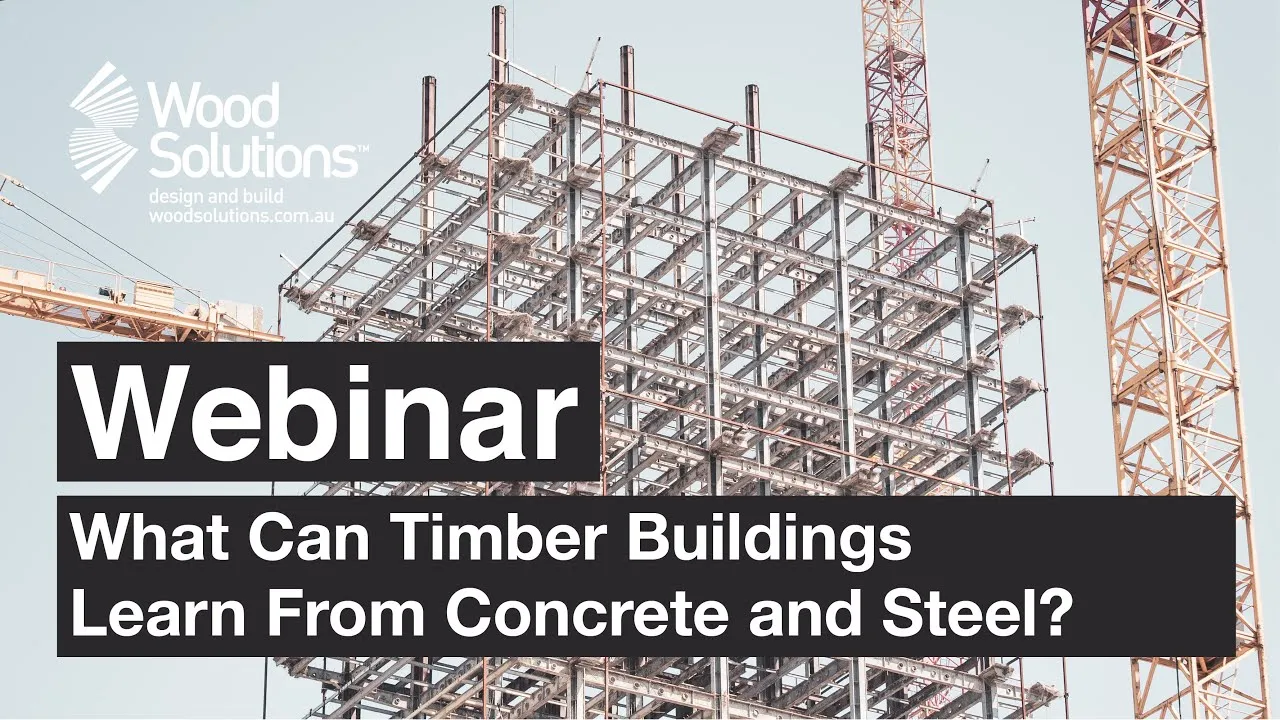
In this webinar Karl-Heinz Weiss presents his thoughts on the future of timber construction and in particular what can mass timber learn from the steel and concrete construction – Turning challenges into innovation opportunities.
Head of R&D and Technical Director DfMA with Lendlease Digital, Karl-Heinz is globally recognised for his work in delivering landmark commercial projects utilising engineered solid timber in their construction – including “Stadthaus Murray Grove” in London, and many others across the UK. Also ground-breaking timber projects in Australia including the first Australian CLT building ‘Forte’ in Melbourne, ‘Library at the Dock’, ‘25 King Street’, Brisbane and ‘International House’ & ‘Daramu House’ at Barangaroo in Sydney.
Karl-Heinz clearly understands the importance of research to challenge assumptions, reduce risk and catalyse opportunities for the construction industry – and more importantly to deliver innovation which is commercially exciting and market ready.
Collaboration within the timber industry and with other sectors is a key takeaway. Learning from the global steel and concrete industries, which have developed robust sharing cultures and collaborative practices, can help the timber industry address challenges such as fire and water resistance, raw material constraints, and market volatility more effectively.
The discussion also touches on sustainability and underscores the potential for timber to contribute to a more sustainable built environment, particularly through innovations in design for disassembly and circular economy principles.
What Can Mass Timber Learn from Steel and Concrete Construction?
Video Transcript
Before, before we start, I just wonder, um, say I’m dialling in from the land of the garlic and people, and I do show another state in the acknowledgment of country and pay my respect to the, as this past, present and emerging.
So the title I’ve chosen for this, for this webinar, uh, is about what wood could learn from steel and concrete. And one of the reasons why I’ve chosen this, this topic is um, skiing over the last 20 years, specifically in the mass Timber industry, actually lots of assumptions and lots of gut feelings uh, driving decisions.
So going back, just a quick introduction of myself and a bit of my journey where and to explain as well why I got to, to this uh, title of the the webinar. So over the last 20 years, I have been involved in more than 150 engineered and mass Timber projects. And this is a snapshot out of the work we have been doing back then in the UK.
Um, and whilst being really in love with Timber, um, and I started my career as a cabinetmaker actually and then turned into a master Craftsman and uh studied industrial design and team engineering. Um, so there is there is certainly a very strong Affinity to to material but whilst doing all these beautiful Timber buildings and being exposed to that environment, I have been actually living there.
Read More
This is the Barbican, the barbecue London, uh, built around the 70s, started off 1968 and took about 10 years to complete with 5,000 people are leaving. And I had the pleasure to live and I moved around a bit in the Barbican in this kind of you know we’d call it concrete brutalist structure.
I had an apartment here and later on I moved up there. Um, and it was beautiful, it was beautiful because the space was right, the space, the cross ventilation, the kind of the layout was perfect. So it’s actually not that much materials driven.
Later on, I I was watching quite a few, few movies and I came across the style house. That’s another house I would love to live in at some point and experience. And style house, it’s a funny funny name, it’s actually named after the family style, um, where I’d be building that house in, in the 1960s just above Los Angeles. It’s a steel frame structure.
And that’s your friend structure gives you not only that incredible view, it gives you the cat, the big cantilevers. Etc. And in translating the family name style, which sounds very German into English, means Steel. So the style house had been building, the style family have been building a steel house.
At the same time, I find myself over and over again in very intriguing Timber structures. And again, the space is right and despise talks to you. And yes, the material is supporting that. In this case, it’s the kengo kuma and Jeff knees Botanical problem, which was EX on display in the NTV in Melbourne for quite a while, interesting to experience.
So, if I look into that and recap my personal history over the 40 years I have been into in that space, uh, I actually have to admit, I love the Beauty and the haptic experience of Timber. I love the Elegance of Steel. And very early on in my industrial design practice and experience,
I really loved the CNC driven cutting, punching, laser cutting, water check cutting, and seeing CNC is really folding of sheet metal. And I do love concrete bench tops I have to admit. And with all of that comes always a very kind of specific smell of species materials process.
And I’m still wondering, “What would would do if it could?” And that kind of relates a bit to certain certain limitations, uh, I see a kind of emerging more and more, the more we do, the more we learn in in that space. And if what could we would, what if what would he would like it, it would provide us raw material in abundance and the material which is stronger than steel.
I would provide environment for everybody to work with easy to install, no discussion around sequestration, always ready for kind of disassembly because everything is a kit of Parts, having a longevity of 400 years no sweat, uh, and companies would collaborate globally, and systems would be easy in terms of their connectivity and interoperability. Fire wouldn’t be a problem, water wouldn’t be a challenge, and uh, it would be affordable.
So that’s what would would do if it could. Today we obviously facing a slightly different situation. We have got raw material constraints and a a volatile Market, extremely volatile. We still see there’s a costum costum premium because we don’t seem to be tapping into the potential of really time saving and efficiency. And there’s a big question mark around, you know, what are we going to do with Timber structures after end of their lives, uh?
And I I have to blame myself for that and guilty guilty of uh preaching the same story about 10, 10, 15 years ago, saying after its life you can turn it into biomass. But meanwhile, with the whole carbon conversation, turning Timber into biomass and burning it is probably not the best, the best way forward, especially if we look into the material constraints we’re facing. It’s a similar, a similar challenge.
And the fullest one which we see, uh, is basically in the steel industry, in the concrete industry, a concrete industry, the collaboration and there’s a there’s a global scale and a sharing culture at a global scale has been developed, uh, way ahead of where the timber industry is to date. And yes, there is a lot of work to be done in the building physics space, fire and water, just to name two of them.
In the following slides I will probably only cover and touch on four of these aspects because building physics on their own will require a number, a serious, uh, of the webinars. And happy to come back and happy to quantity a bit further.
So that’s a bit of a summary about to expect from the following slides. So if we look into the the argument we bring forward on a regular basis, “Timber, Timber in abundance.” If I just take a snapshot and this is looking into global, global demand and is looking into the German uh consumption or the consumption in Germany.
So if you see the the lumber, the lumba, um, demand has been kind of increasing significantly. And unfortunately this graph stops at the year 2020, it would be an interesting one to see how they curve actually has been developing in 2021.
The the diagrams are coming from the WWF, uh, and have been published in 2021. So these are, you see there’s quite a bit of consumption, um, in millimeter cubes and that’s with our bark, so it goes back to the the tree trunk with our back for for lumber, for Timber Products, and for Pub and paper.
If I look into a German consumption, it’s about close to three times as much as the the global average. And if we again bring it down to the German, German market and the availability of material, it’s actually more than it’s growing, uh, in Germany, so it’s a heavily heavy Reliance on importation, um. So just a bear this in mind, uh, if we design Timber structures, where’s the material coming from, how is it sourced, are we really using it efficiently?
And talking about efficiencies, uh, in a way, um, just put up three lines here. Look into the typical lumbar or saw milling process. And um, we know the process is, process edis not a very highly efficient process, whilst it’s being very sophisticated and I understand. If we talk about here a conversion of 50 to 55 percent into a, into a lumber, the residual is still of value because it goes into other processes. At the same time, the residue potentially represents structural properties. So is there something we can look into slightly differently?
LVL has got a a slightly higher conversion and the conversion could be increased to always depending on the diameter of of the core, typically the diamond of a core is still about 130 millimeters, 140 millimeters. If that core can be reduced until 40 millimeters, then suddenly the uh conversion rate is increasing. And if we look into CLT as such, which product we like and it’s not that dissimilar to to glulam, the conversion rate from a tree triangle from a log to the product is actually very low.
So obviously we have got the saw milling process before and there’s a additional process in terms of planning and finger jointing and cutting and writing. Etc. So that’s something to bear in mind. The other the other one, from in terms of efficiency,
I’m coming across over now again and people working with me, uh, know exactly where I’m coming from. Say are we actually using standard section sizes? Where we often, we design towards a performance requirement and we’re not looking into what’s the, what’s the available at the market?
So 240 is a great width of a glue and beam and then 40 millimeters in incremental. In terms of height is a great starting point but if it then suddenly apply what we all uh do on a regular base from a performance and fire performance perspective allow uh apply a jar layer, then obviously our effective residual section is decreasing and depending on the section size. If we do the math how much Timber we putting in as sacrificial layers is actually quite significant.
So if you’ve got smaller section size and still want to achieve 90 minutes. I’ve got a twice the amount of Timber I need to put in. If I take for example a 480 by 480c olumn with an effective section size of 400 by 400 to allow for that jar, that means I’m adding 44 more Timber to allow for John. So certainly something we should look into and should should do more work.
So I have been using the word efficiency or effective or Effectiveness multiple times but uh here we have got a good understanding because sometimes I’ve Got a Feeling we mix up effective ore fficiency with productivity. So I think that’s kind of simplify that efficiency is getting more out of the resources.
It’s doing the same as an alternative description doing the same or more in less time. So efficiency is all about input and resource focused and using here another example of umit’s kind of the way how markets are responding and materials material suppliers are responding.
Obviously putting a lot of concrete uh into its Labs is not very effective. We’re not using the material in the most efficient way. The bubble break is one example. Bubble dicks reduced or call it voidf ormers reduced amount of concrete without actually compromising the structural integrity significantly. So the amount of concrete reduction is very beneficial, even if you look into the whole carbon carbon disc discussion.
On the other hand, we all like the CLT product. The CLT product used the timber as the void formers, so it is a solid piece of piece of Timber.
And very often, you kind of, you know, we did post-mortem analysis and looked into start house Mardi Gras, for example, the first hole structure. Back then we didn’t know what we, what we’re doing, so we took a very conservative approach. But the utilization of CLT as walls in certain areas, we had the utilizations less than 10 percent from the structural performance perspective, and less than 10 percent means I’ve got 90 percent of excess material in a structure which could be used differently, um.
So they are products emerging in the markets, and some of them haven’t found their way to Australia as yet. We still have to find a ways across Europe. I just want to want to show here a couple of them. One of the products is keto steak product, which is quite interesting because it uses Timber, uh, in the wide space. It’s creating that distance between the top and bottom chords, um, and it’s actually providing stability as well, um, in a horizontal, um, situation. So it’s an interesting product, and it can achieve quite significant spans.
The other one on the right hand side is the ligno tour, uh, more kind of set system, but it’s made out of solid Timber pieces which I’ve just glued together. And what you can do in this case, and this is a section at the bottom, is you can utilize the void ance base for services distribution for adding insulation for better acoustic performance etc etc, certainly a product to look into.
The other one the industry always kind of faces as a as a a stronger or a growing competitive, growing competitor is that the light gets the offering. And there’s certain certain interesting advantages are like HDL frame. It’s a cold rather process, so it can be very material efficient. So if you look into the section I referred to earlier, the fascination about folding metal, um, which creates stability, so these section sizes are using very little method.
At the same time, I came across a while ago 3rt coming out of a Monash research project, now a company on its own. And 3rt kind of embarked on the journey, um, originally kind of manufacturing decorative Timber Products in a more efficient way. But I think in that why, how the product is manufactured is actually an interesting aspect.
So I’m going to highlight, uh, here with the continue to, uh, lines going going through the that log of timber, because 3rt is using layers of one year and compressing the veneer walls from one side whilst is already constrained on the other side, and there suddenly you achieve that kind of folding structure.
Unfolded Timber as such will have got actually different properties in terms of the store torsional and and the bending aspect, right? Not that is similar what you do with folding metal.
So just to give you a bit of an idea what’s what’s actually happening in the industry and what where opportunities lie, as Alistair mentioned before, we have been looking very closely in terms of how we work with the building 4.0 CRC, what are the research projects are we doing?
And I just want to refer and touch on one, it’s called a long-span low carbon floor system. And we have been working here with swimming Tacoma Forestry with the building 4.0, with Monash University, the University of Melbourne, and the whole research program was led by the future building initiative which sits within Monash. And just name here Dr. Ivana Guzmanovsky, Duncan Maxwell, Victor
Banster. Victor has been looking very much in the low carbon aspect and Dr Angela, she’s af ire expert. So looking into long-spend low carbon floor system not from a product development perspective but from a benchmarking perspective. What is out there? what is out there globally and uh how relevant can these these products before what we try to do normally perspective across all our regions?
So we looked into again initially say timber-based product must be must have a good carbon story and we looked into Timber concrete and Timber Steel structures as well. And that’s kind of the summary finding of the different systems and then we broke it down say let’s select certain certain uh products and uh here are the the nine products we selected and as this was a benchmarking exercise.
We used uh obviously a building which landlines have been delivering their muhas it’s a 9×9 grid and uh we use the stories of CLT open rip. We used to kill stake product use. lignito tour as a product Astora Enzolvial close rape and the foreign and then we looked into a Timber concrete composites and they uh one of the criteria as was.
Is that product available available to the market. And uh so having Timber Concrete in situ, we didn’t we didn’t look into that because we uh thought about pouring concrete on side, will actually slow down the whole process from an installed perspective. So there’s an acceleration
The requirement in which product are we gonna, we’re gonna choose info further research. Three and pretty sure many people heard about the Cree system. I know we looked into a tech slab, um cassette, and in order to get a good view on benchmarking, we looked into what are actually the different, the different criterias. And even that process, defining criterias and then looking into the weighing of the different criterias in the outcome of of the research.
So we looked into structure, vibration, carbon, fire, and we looked into production, availability. We looked in a design, uh, and within production there is an element of Transportation. Uh, we did a bit of a DFMA analysis, so how many panels can you put on a truck? What does it mean on the assembly, assembly perspective? And what are the alignment mechanisms, um? And then yeah, there are certainly aspects of aesthetical potential. Etc.
So even just going through having these benchmarking criterias clearly mapped out and agreed was already worthwhile the process. And to no surprise, uh, obviously we didn’t find the best in class, uh, best thing class would have been, you know, number 102, uh, in every of every single criteria.
But we saw was the structural criteria, different uh Front Runners, fire, vibration, carbon. Uh, the whole carbon investigation was, was coming up with a big Challenge. And seeing how much sequestration of Timber can you allow? So we went through both scenarios, with and without the constipation.
And obviously, if you look into uh, um, vibration, in the concrete products, typically come come out as a as a front runner. In this case, we looked into our, uh, without, uh, that’s where you see the Ligna Tour and the LVL, the Kia steak listed as the top three, because we have looked just from a Timber perspective in this case.
Uh, so that is just a snapshot and that, um, that how a report, um, and and the workings we have been doing, um, with the researchers. I think we’re gonna make it uh available over the coming, coming uh weeks and months, um.
So we looked into, you know, what’s the structural depth and you have seen nothing already in in the previous slide deck here. That’s actually a huge variation in terms of uh structural depth. We looked into stiffness of a mass, uh, and no surprise, obviously concrete, uh, because it’s adding a significant amount of mass, comes comes out I call it last, um. If we look into the fire performance, there’s a completely different story from a carbon perspective.
And you see already there’s some some, some differences in the left-hand side is actually with carbon sequestion and the right hand side without carbon supervisatio.
So Timber still seems to be a bit of a, be ahead of of other systems. But within the timber systems is only fine, once you go really solid, um, then from a, the Reliance on sequestration is actually very high. So product with a lot of Timber, uh, per meter Square, um, really are reliant on the alliance of sacred station in the carbon coagulation.
And what we found as well, if you do a proper LCA, the requirement meanwhile is to allow for sequestration in your in your LCI, you have to guarantee a hundred years years of the product, because we now, once a Timber product goes back into, uh, the recycling or the the process of being potentially, um, transformed into biomass can be counterproductive.
So we looked previously into efficiency. Now let’s talk about productivity briefly. So productivity in simple terms is doing more in the same time frame. So it’s very much output focused. And I’ve got a couple of case studies here, most of you are well well across projects like 25 King Street. And uh, we used research for on another research project and, where we dissected ac, 25 King Street a little bit further.
However, this is one, one of my favorite slides of 25 King Street, because what is here still working in progress from an installed perspective? There’s the vertical structure still going up, columns and beams, um, the floors going in. And interestingly enough, the facade, it’s actually one level below the superstructure, the facade in this case, the facade has been chasing the superstructure, which is you know, a great outcome.
But if we look very closely, in then the subsequent, uh, success of the of the project is, we left the DFMI approach and that interaction between facade and structure with facile instruction. As soon as he came down to the services, the services trade, we did everything traditionally in a traditional way. So the one of the questions back to researchers was, is there a critical mass required to really achieve time and program savings?
And if we look into the very high level across structure of construction, let’s see, superstructure it’s probably somewhere around 15, facade somewhere around 20, Services is around 25 percent.
So the conclusion here is actually to really achieve program savings, it needs to be one more than one or two trades driving prefabrication, you have to have, have to look uh into the whole, uh, Project Life Cycle, you have to look into the whole value chain, um, of a of a built build a project.
So bringing services in into our creation for commercial buildings absolutely essential to drive program savings and therefore cost savings, uh, to offset slightly higher cost of the superstructure. The other project, many people of you have seen, and you in this case the student accommodation building, uh, be the N architects, um, very similar situation. And some interesting learning here as well.
I would like to share, what we see, obviously great great outcome, your CLT superstructure going up very fast. And it’s actually in this case, the facade system has been a bit slower. But on the other hand, uh, one of the big learnings out of this project is the facade installer, was not a different company to the superstructure installer, it was actually the same.
So integrating trades from an in-store perspective or assembly perspective, uh, was absolutely crucial. The other interesting learning out of this project is, and I kind of highlighted uh three of these building blocks, that’s a top writing corner, you see the whole Precinct, these have been Timber selections, obviously based on a concrete, concrete basement, concrete commercial ground floor as you can see in the diagram here.
For the student accommodation, the B155 is a is a teaching a learning building, um, out of Timber. For the business, the only chance to deliver this project in a very tight time frame, what’s actually diversifying The Building Systems.
So by not having everything building concrete but having some of the buildings as a concrete structure, concrete steel structure, and some of the buildings in Timber construction, there’s diversification of the systems made that possible, because suddenly I’ve got access to, other trades to more trades, you can bring bring in and you’re not having that bottleneck of a concrete supplier, a form worker, um, reinforcement Supply which will be at a project of that scale will be heavily uh, heavily burdened.
And the other one I mentioned before, actually the install of superstructure is the facade installer at the same time.
So that’s a very good, a good observation out of this project. And that gave us the possibility to meet both time and then cost uh requirements. So just in in other in other words what I described and we went through a bit of that journey of what is the efficiency, what is productivity, and how they actually interlinked, um.
I’m referring here to a little law, uh, goes back, uh, not a little John, but John, John little, um, who came up with that kind of, you know, a slightly stimulified simplified diagram. We look into input and output.
And very often we kind of try to push more and more through the call it the, side or the work in progress to get more output. But actually that’s not not not a way how we can increase output, because we are at risk to to Really uh jam-pack the the work in progress and we’ll block the pipeline.
So to look into, how can we improve output is actually, you have to look into what’s in work in progress and what’s happening there, and can we reduce the cycle time? And the reduction of side of town will mean we get more output and therefore we can pull more input.
So that’s, um, a bit a bit of a, kind of summary that which run wraps up that, do we understand efficiency, productivity, how do we get to more and better output? Is actually we have to look into the throughput and the the relevant cycle time aspect.
And coming to cycle times, connections and connectivity is actually an important part and I’m going to show you a very quick video here. And our video is um, coming out of Germany and sorry about the German text, it talks about the the, hcw connected which has been developed in collaboration between both
Ritz and Timber Frame companies or house builders and and Hilti in Europe. And what that shows uh here is actually the connector has got such an important role in the efficiency and subsequential productivity. We’ll call it according to a little slow the throughput on on the building side, um because it takes takes out about 30 percent of labor and it’s accelerating the setting. The setting out by utilizing the relevant tools and no surprise and pretty sure other companies will follow.
So there’s a direct relationship between the connector the the design model, the fabrication, how the setting out and the tools uh for the applying the connectors. All of that is completely interlinked and these connectors work from Timber to Timber concrete to Timber and for me it’s very interesting to see actually the company uh coming out of originally creating tools to drill holes into concrete and then becoming a world leader in uh in Fasteners into and concrete anchors Fasteners into concrete.
Now I’m kind of embarking on a journey towards um sorry, towards applying their knowledge in in a Timber world. So again that’s a snapshot of that specific connector. There is um another reason why I kind of showed that video. I think that specific connector we have seen the hcw I think is relevant for everything we do here in Australia as well from a from a house building perspective.
I think he has got it, it’s, it’s placed in the low to mid-rise. But if we look into the mass Market, we have been looking into how can we improve our throughput on building science, how can we shorten the install time. And we always talk about hook time, in in this case, and the hook time being the bottleneck.
So if you put up structures, if you put up a column, you put up the column and any of the temporary price the column before you can actually release the hook again. So can we develop a self-propping column, a self probing connector for columns? And the same is then the connector for beams meeting meeting columns.
And this is a collaboration between Lendlease and Holmes, and subsequently HomeSolutions out of New Zealand. And subsequently we engage with Hilti, ers being the manufacturer and the distributor of the product, um. So that self-propping connector is kind of allowing us a five to ten times faster install time on site. And that’s significant, and that’s increasing again what we saw earlier, throughput significantly. So I covered, covered that briefly already, connect, connection, connectivity.
And again looking into how that connectivity will play a role and where technology will play a role in the future from a digital platform perspective. I’m not going into too much detail, because digital platforms could be another another topic for for webinar.
But it’s all about bringing the decision points, and a lot of us talking about early, early engagement. But let’s bring the knowledge and and Clarity around when do we have to make which decision right up front into the process. And that’s what our platforms uh will enable us to do.
Other topic which will come, will be coming second fast circular economy, uh, the ReUse of products, um. The other big big topic, ESG, environmental social and governance. And if you look into some just of the line items, looks into materials, looks into resources, looks into resource efficiency, Waste Management, water consumption, Etc.
And covers all the aspects of Supply Chain management, procurement, diversity, quality and ethics. So it’s, it’s the first time I see in in my life that actually, call it the original intentional sustainability, uh, is now driven by an incentive and not perceived as the cost per, because the incentive through ESG comes through the capital markets, once he is she compliant or your outperformed ESG requirements, the access to Capital will be much easier.
And that’s certainly something to keep an eye on, uh, in in the very near future. This is coming for the Australian Market, taking fast. I think it has arrived already in Europe, and there’s, there’s more to be expected. And just to close out, uh, I haven’t seen many buildings which have been actually designed for disassembling.
And that’s a, that’s a good example. And uh, Courtney Stones architectural practice out of Holland, have been my early Heroes into that space. They have been building that little parasite on top of a warehouse, and that was already with the intention, it will move on, that’s a CLT uh structure.
The other one, um, again it’s more of contemporary nature and temporary nature drives thinking around disassembly, the MK40 tower by DRMM architects, where we have been challenging ourselves there, we can’t anchor things in the ground.
So how can we make sure once people are going up and down and there’s wind, uh, that that Tower is not falling over? So that’s how it was kind of in place for a year, was this, this mantle was put up another place was dismantled. And I think it hard, it found its final, harm, uh, in the meantime, very similar to parasite, uh, reused over and over again.
And by closing, um, just we’re putting ourselves as a Slendlease, actually under a significant pressure, because we came up with our our mission zero and then the embedded carbon targets by 2025, Net Zero, a net zero here looks into scope one and two. It looks into what kind of energy we’re using, are we still burning diesel, uh, and burning gas, um.
But from 2040 onwards, we’re going to mesh ourselves differently because it will be saying, we will be saying absolute sterile, not Net Zero, absolute zero for scope one and two and three, which actually looks very deeply into a materials and materiality, with material coming from, housing used, can it be reused, etc. etc. So I’m coming toward the end, uh.
So to leave a bit of time for discussion and questions, are just a snapshot and a reminder, once people haven’t heard much of Lendlies in the last couple of years about Timber structures. Dara muhaus with alexan’s architect, I think it’s still an outstanding building and full of Lessons Learned. And it’s a great environment to work in.
And if we recap then Lisa’s Journey over the last 10 years, because if we go back, 2012, we started with the Forte building done in Melbourne, uh. We now have delivered today, at about 20, not the bug, we have delivered 20 engineered Timber buildings across three regions.
And those regions we operate in America, America’s, United Kingdom and Australia. And we’re still learning, so that’s some something we certainly, um, to take on board.
There’s so much work to be done, and there’s so much work to be done, we can’t do in isolation. I know 10 years ago we have been doing this quietly, uh, before we have been delivering, uh, the Forte building down in Melbourne, where we can’t do it on an hour. So we have to tap into research, we have to tap into collaborations.
And uh, the building 4.0 is is a great chance for collaboration. We uh, have been now embarking on a number of research projects with Partners, just to name, Sumitomo Forestry, again, uh, or IG combs in the services space, Etc. So we still, we’re still on the learning curve and uh, looking forward to more to come. Thank you.
Thanks Carol Hanzo is an absolutely amazing presentation. So um, everyone out there, if you’ve got some questions, please um, stick them into the Q a, um. Just to start them off, Carl hands up, I was really interested in your slide there near the end about Len Lisa’s Mission zero. That is a pretty challenging, uh, um, that sort of uh, sort of benchmarks they put out there, how how much would Lindley’s see Timber buildings in sort of assisting to achieve some of that?
A good good question Alistair, uh, we kind of openly admitted, uh, 12 months ago when we put out these targets that we actually don’t know how we get there, uh. Since then we’re working a lot, uh, on really getting a good understanding of, uh, not only life cycle assessments but the whole world of carbon cooperation and carbon accounting. I think we’re very confident about the 2025 goal, uh, with being Net Zero cup.
Then there’s still a lot of kind of you know, offsetting, uh, which which can be done to get to the 2040, uh, go. It’s very clear we have to take, not only have to take, we have to go on a journey together with the supply chain. And we’re running different scenarios, so if we’re not doing anything we never get there. If we look into how much of our pipeline, uh, could we, uh, utilize for mass infrastructures or engineered infrastructures, looking into 20, 40 percent, we look into a 40% allocation.
And making sure at the same time, we’re really working with the steel and concrete industry and the supply chain, uh, looking into where’s the aluminum coming from, uh, you know how is highest hydrogen playing a role in all of that, um.
That’s going to be essential. So the scenario we have been building at this moment is certainly a, it’s quite a portion of the purple line needs to be, needs to be allocated, uh, with with a little disclaimer, we have relied on this case on the secret station, right? Which in its own is a big challenge.
Well one of the attendees actually sort of asked a similar question there in terms of your absolute zero, uh, how do you see concrete playing a part in the business and how would that look, because it’s a challenge for concrete. I mean physically you’re going to produce a lot of CO2 just from the production of, uh, cement, the the.
Again, if we look into concrete, it’s a, it’s a very similar scenario. So we we’re obviously working with the supply chain and with the industries, we’re looking into our green concrete, um, um, we’re looking into what’s going into the concrete, um. So Melbourne University is doing great great work in that space, uh, uh, and it’s not always about replacing uh material, but making
sure we find a good a good pathway. So uh looking into where’s the energy coming from for the concrete production for example. That’s that’s the big the big challenge. It’s a very similar in the steel worldu m we’re learning a lot in terms of how often can you actually recycle steel. How much how often can you get a steel beam back into the into the process.
I think there are limitations there as well um and the industry seems to be both steel and concrete seems to be well setup and pushing hard on a carbon carbon strategies. In the timber in the timber world um I do not want to be be to to negative at all. But sometimes I’ve Got a Feeling we we just reliant on it’s it’s kind of you know it’s given to us by Nature.
It’s it’s a growing material so we kind of automatically go into uh so it must be good. But I think uh you might recall the question I have been putting out at the Timber of site construction uh conference early in the year, uh where I’ve been saying, have we got Clarity and certainty of who owns the sequester carbon?
Because a lot of the forests and Plantation forests I actually used as carbon credit schemes as well. So are we at risk to double Counting? So that’s there’s a there’s a lot a lot of work required and uh to to create a relevant uh transparency. And then it’s about traceability etc. That’s a really interesting time at the moment with embodied Gaba.
But we’ve got a few questions here from the audience that put to Calhoun. So one from Christopher just uh asking about the self-propping columns. They definitely sound like a major step forward and we’d be interested to hear about the limitations in terms of minimum dimensions and the amount of post-tensioning required.
Assuming that’s a method used no it’s not a not not a method of potentially uh is we call we call it a quick connect and unfortunately, I couldn’t release more imagery around that. What it was is the connection will then act as a type and the interesting part is you can release that connection point.
So from a disassembly perspective, and that’s certainly a space for the audience to watch, are we getting closer and closer? In this case, Healthy is getting closer and closer because we have passed that part of development onto Healthy, and Healthy is still working with homes from a land lease perspective.
It was more about identifying actually there is a significant, a significant challenge we want to address. And we embarked on that on finding the right partners and then passing the IAP on. So certainly a space, a space to watch way carefully, the self-propping from my perspective is such a good example because if you look at the value chain or the stream, so you have to bring the props to the side of the store.
The props you can pick up the property temporarily, fix them, you take the props away once the structure is sorted, and then you repair the finishes. And you have to move it, move it around again. So we can get rid of all that work. That’s not only an acceleration of time but it’s just a reduction of cost significant. And I’m more than happy to pay a little bit more for such a neat connector.
And from a performance perspective, the connector has been originally designed for high-sized mcloads so because we looked into a specifically for the California Market. We had a number of conversations with Sumitomo Forestry for the Japanese market and it kind of seems to tick all if not most of the boxes.
And then you mentioned the three presentation care lines about a number of the different new products that have been developed over in Europe that you looked at under the CRC and also that tilty technology in terms of installation. There’s some of those products and systems available in Australia at the moment.
Healthy is certainly interested to bring the product into the market and I think the audience is kind of more than encouraged to reach out to the local Healthy guys they know can you share more about the high hcw connector.
That’s certainly happening from a timber-based product perspective where we still see the likes of Keel steak or lignator more kind of medium-sized operations. The key of stake is currently not available for the Australian Market.
I think bvn have been doing a bit of work with lignator in the past, but it’s more kind of I would say a encouragement to the local industry to look into can we actually adopt some of these these products for the Australian market and sometimes it’s just you know we don’t have to do it all ourselves let’s collaborate again can we can we license the technology and can we modified the technology for for our purpose.
There’s a question here around services and I must admit that striking chord of me when you were talking about you’re looking at the prefabrication on the building up in Canberra and how much the services installation was part of that chain and how improvements should be you know maybe their improvements in that area so the question here was about how designers marry the push for small depth floor systems CG 300 mil and the integration of Building Services.
I wonder if you had any thoughts there also about how we can get Improvement in that sort of service type sector to get the building down quicker and if Timber can help them.
The floor to flow height and the two different discussions: one is the residential discussion, the floor to flow height is crucial and the internal the internal clear space is crucial so that means the the floor needs to be as shallow as possible. In the commercial and the office space environment it’s a little bit more flexible. There again, what I can try to say in one of the diagrams, it’s actually making sure that knowledge from a Services perspective goes into the design process very very early.
And how can we do that? It’s really looking into a system systems approach and the systems approach is not only a structural system, it’s a building system which really includes the services or extreme because it’s such a high portion of of the Aurora build costs so it needs needs to be needs to be addressed early in what I saw in the past.
You know you’ve got detailed line items and cosplaying about mongoria and door frame and Market race and then you get to the page of services and you’ve got one line item services because it’s such a in a way in a design process still a black box in a way it’s one line item but it represents 25 of the cost.
And then another message I heard quite clearly from what you said today and seeing what’s happening in that sort of broader life cycle interest at the moment. I mean embodied care but it’s quite of interest but definitely that sort of end of life and circular economy is an important one but I think that’s designed for deconstruction is a real opportunity for Timber buildings particularly Mass Timber buildings which will have a huge value in 50 years time 100 years time.
Yeah, just Keen to get your thoughts there as we finish up particularly I mean I think that that sort of hundred year rule about sequestration I mean that needs to be challenged because even if a building is you know mass building is demolished or deconstructed in 50 years 75 years those products have you know quite good use in this next phase that should be recognized.
Yeah, that’s as I said before there’s so much work to be to be done. You know if we even if you look into ways the timber industry here in Australia with is it included in the in the mecloud discussion here mclarl looks specifically into the whole imported carbon news story comes out of news as well as originally there’s very little representation of the Timber industry so we have to we have to challenge that and bring bring that argument forward at the same time.
I think the industry needs to do all the homework again so it’s really getting certainty and a unified response across the club about secret situation because if I look into the lcis and you go one click lcas other softwares you look into the edts of certain manufacturers you get different values all over the place it’s all over the shop so there’s no kind of unified response as yet so that needs to be step step one I reckon. And then you can bring forward an argument as well to the water industry.
That’s certainly an area that’s an important industry that we need to be concentrating on the moment. Look we’re just on 12 o’clock so where I’d like to thank you Cal Hines for an absolutely terrific presentation it’s always a privilege to hear you speak and thanks for giving up your time I know how busy you are but I’m sure on behalf of all the audience we’ve really participated in your wise words.
So thank you very much so a reminder to participants that the recordings are made of each of these webinars so it’ll go up over the next week so you can access that from the wood Solutions website please encourage yeah some of your colleagues to to view it as well it’s been a terrific webinar and we I’m very fortunate to have Cal Hines.
Just a reminder also that their next webinar in two weeks time so the 18th of October it will be on structural Timber where we are and where we are heading with Timothy Allen a senior structural engineer with ttw so again a sort of good transition on from today’s webinar today so I encourage you to participate in that one so thank you everyone once again have a have a great day and a great week and really appreciate you joining us and look forward to seeing you at the next webinars.
Related Links
Timber Concrete Composites – A Careful Balance and Opportunity