Foreword by Ian Thompson, Editor
I’m designing a new house at the moment, and I’m torn between using Rockwool Insulation or wood fibre insulation by another well-known manufacturer. Like in Matt’s video, I’m using this product as an exterior insulation layer in a thermally efficient wall system.
Rockwool insulation comes in a few different forms for various applications. I really appreciate the fact that it’s fire-resistant, rot-proof, and pest-resistant. It also has excellent soundproofing properties.
I would guess – and I’m only guessing – that the process to make Rockwool insulation might involve more energy usage than the production of wood fibre insulation. That’s really the only potential difference addressing any sustainability concerns. I will dig deeper into this investigation and write a post about what I choose for our Perfect House Project, which we are launching soon.
In the meantime, enjoy this short video from Matt.
Rockwool Insulation Versus Rigid Foam – Video Transcript
In today’s video, we’re discussing exterior insulation. We’re installing ComfortBoard 80, a stone wool insulation from Roxul. We’re going to compare this to other insulations we’ve used before.
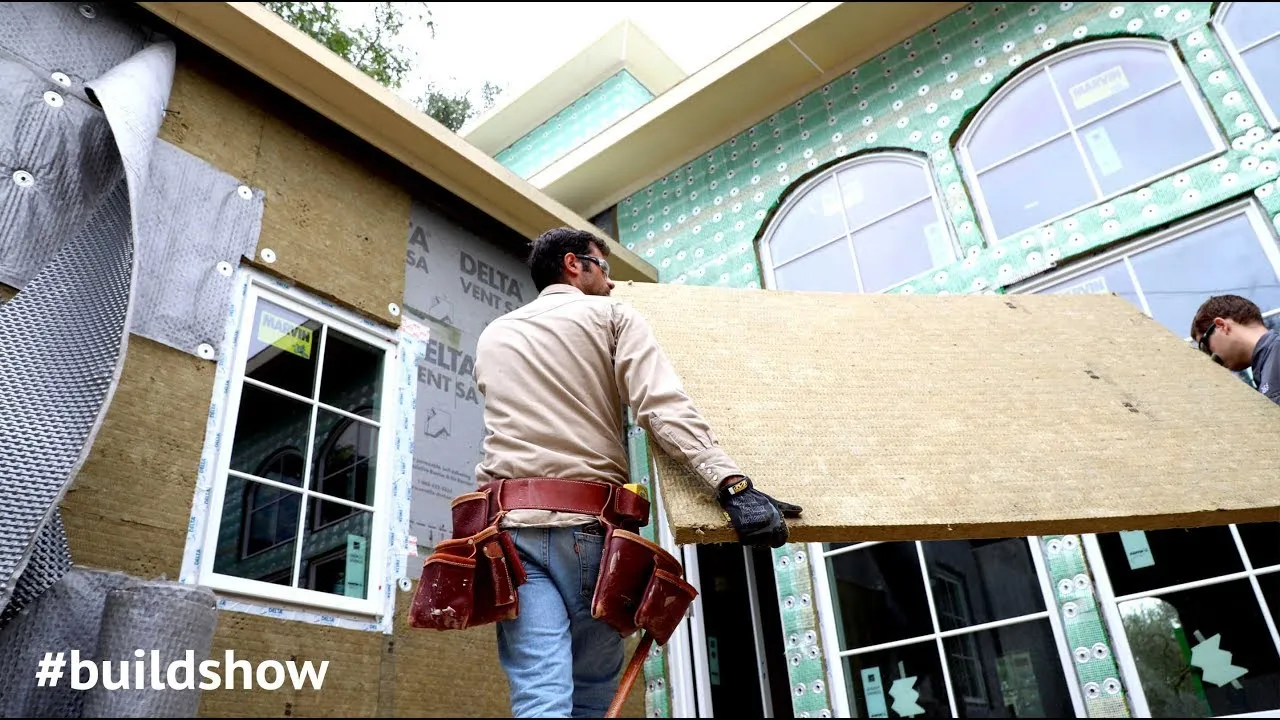
Coming from a job site, we’re rebuilding a new custom home with Vanguard Studios architects. We’ve been to this house before. This is my LVL framed house, but I’m doing something new in this house that I’ve not used before. This is exterior insulation from Roxul. This happens to be ComfortBoard 80, a stone wool insulation.
If you’re not familiar with stone wool, this is a type of insulation that’s made basically from rocks. It’s very different from some of the exterior foam-based insulations I’ve used in the past, and it has a lot of advantages. Before I get into this specifically, let me tell you about why this came about.
Not that long ago, there was a big fire in London. The cause of the fire on this tower building, where about 80 people died, was basically the exterior rigid foam catching fire and spreading around the entire house. I read a quote in The New York Times that it was as if the building had kerosene on the outside.
Now, this product we’re using here, the big reason that I think people should consider this, is because this is a fire-resistant material. It’s actually good up to 2,000 degrees. I brought a Bic lighter just to show you how incredible this product is.
On the fireproofing, let’s check this out. You can see this is pretty crazy. You wouldn’t do this if we had a sheet of XPS or Polyiso or EPS. We can put a direct flame on this for a long time and all we’re going to get is just a little scorch mark, but it’s not going to catch fire. Very impressive product.
So, we know this has some fire-retardant properties. What else do we like about it?
First, let’s talk about R-value. We’re using a two-inch-wide board here, and this product is R-4 per inch. So, I’ve got R-8 of rigid exterior insulation blanketing the entire outside of the house. I love exterior insulation because this covers over my studs, it reduces my thermal bridging, and that insulation on the outside brings a ton of value to the house compared to cavity insulation. So in most climate zones, this is now actually code to add exterior insulation.
How is this different from some of the other exterior insulations you’ve seen me use?
As I mentioned, this is stone wool or sometimes called mineral wool. This is about 40% recycled content, and it’s basically made from rocks. That’s why it’s not burning. There’s no blowing agents, there’s no CFCs in this, there’s nothing to off-gas from this. So there’s really an incredible both recycled and green story here compared to the traditional exterior rigid foams.
The big thing I like here, though, is that there’s no drift in the R-value. Polyiso or XPS foam at R-5 or maybe R-6 per inch are a slightly higher R-value per inch, but those in time are going to lower and have a lower R-value. This has no drift in R-value in time.
The other big advantage of this, because it’s made from stone, it expands and contracts very, very minimally. In fact, I read the reports on this, and this is expanding and contracting about 10 times less than other products. So, if you’re installing Polyiso, for instance, you have to definitely install two layers and overlap those seams because it’s going to shrink in time. This is going to stay totally rigid.
So, in this house, we’re on butting the seams up tight. I don’t have to go two layers thick; I can do everything I need in one layer. That’s a big deal. I also like that this material is not going to encourage mold growth, and bugs and insects do not like this. This is really going to keep those out of the house.
But the other big deal for me about this in particular is the fact that it’s vapor permeable. This means that if you’re in a cold climate, you want to be able to dry to the outside during the wintertime, and you’re going to be able to do so through this. A 2-inch-thick version like I’m installing in this house is approximately 30 perms. And of course, we’re installing this over Delta Vent SI, which is also a high perm product. So now, you could do the same assembly anywhere in the nation because you could dry through this in the wintertime. That’s a really big deal compared to most exterior installations, which are basically zero perm.
Okay, next, I’m always worried about water on the outside of my house, and this has some really unique properties. I love how this is basically a water repellent product. You might think that this was kind of like a fiberglass bat that would absorb water, but this one water runs off like water on a duck’s back. None of this is absorbing; it’s totally water repellent.
The last thing I want to mention is the sound absorption properties of this exterior insulation. I’ve got a highway not too far from this house, and with this on the outside of the house, it’s really cutting down that noise transmission through the house. This is very similar to their sound bats that they’re using on the inside of the house.
Very impressive product with a lot of benefits. I’d highly recommend it.
Now, in this house behind me, I do want to mention a couple of details. We sheathed this house with AdvanTech sheathing, and then we covered that. Our WRB is Delta’s Vent SI, a peel-and-stick hyper house wrap. On top of that, we’ve got this two-inch-thick Roxul, and then, as you can see, we’ve put it on with a cap fastener.
Up here in this gable we’re working on, you see the cap fasteners are spaced very loosely. We have this in four by eight sheets; you can get this in a number of different configurations. Now, this is going to be heavier than some other installations. For instance, a 4×8 sheet of 2 inches thick weighs over 50 pounds. But I like that I’ve got very little shrinkage, so I can butt those seams up.
But I also want to maintain an air gap on this house, and so you’re going to see behind me two different air gap materials. So, this one here is Dorken’s Delta Dry Stucco and Stone, and this is our stone ledge on the house. So we’ve got stone veneer going on top of this gray material. The green dimple mat you see behind me, that’s Boral’s Drain and Dry Lath. That uses Delta’s technology with a synthetic lath on the outside. We’re actually going to be stuccoing over that face of the house. But the entire outside of the house is getting two inches thick of Roxil’s stone wool insulation.
The last thing I want to mention is that this was incredibly easy to install. It cuts very easily with basically a bread knife. We’re using a knife that has an extended blade. It cuts right through this material, and again, because we can install it in one layer with very little shrinkage, my entire house is totally blanketed in two inches of this Roxil, which is going to give me a continuous R-8 that’s not going to drift.
To summarize, there are four things that I really like about this. It’s fire-resistant, non-combustible, sound-absorbent, and water-repellent. This is really a big deal. I like this Roxul a lot. You ought to consider this for your next project.