
Foreword by Ian Thompson, Editor
In this episode Matt Risinger will be explaining why Structural Insulated Panels (SIPS) are a great alternative to a stick ‘timber’ framed house.
I’m a big fan of Structural Insulated Panels (SIPS) over traditional stick-framed construction. They save time and provide excellent bracing qualities for external walls. Additionally, they offer optimal surfaces for fixing and are renowned for their outstanding insulation properties, considered among the best in the industry. However, there is a caveat: your builder must ensure precise foundations for the SIPS. Any unnecessary undulation can complicate panel installation, as the panels are designed for a precise fit. So, be prepared for some adjustments if your builder or foundation team has had a bad day.
It’s important to note that not all SIP manufacturers are the same. Some utilize Oriented Strand Board (OSB) panels with glues that emit high levels of formaldehyde, while others use friendlier variants with very low emissions. Additionally, SIPS can be constructed using plywood or even metal surfaces.
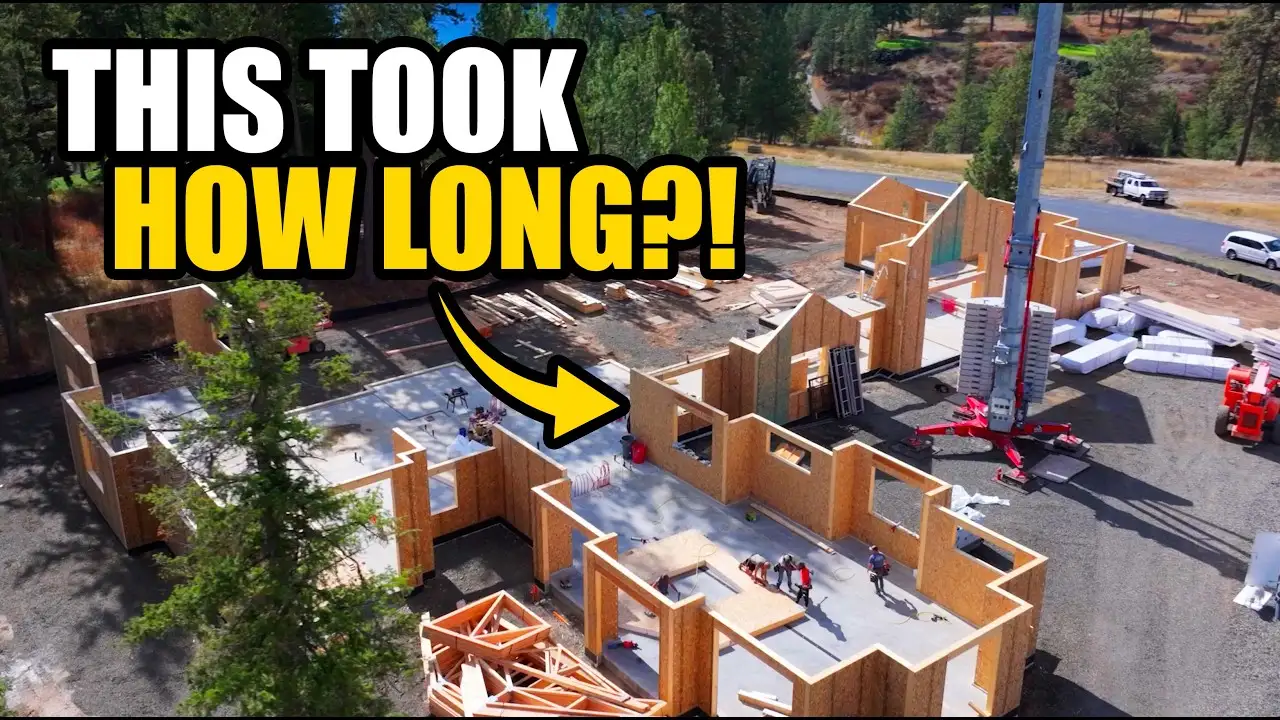
You might come across the notion that stick-built timber frame houses are cheaper than SIPS. However, it’s crucial to consider insulation costs, installation, and wall lining materials. Personally, I’m not convinced that stick-built structures are more cost-effective, especially for well-designed homes. Recently, I witnessed the construction of a two-story house where all the SIP panels (walls and roof) were installed in a single day. The build was well-organized, and the foundations were level!
The primary advantage of stick timber builds over SIPS is the ease of installing plumbing and electrical items during the framing process, and it’s generally easier to carry out wall variations during the build, but that in my book should be avoided at all costs!
Matt talk’s about integrating standard timber framing (not sticks) and SIP’s together to make a strong and effective structural envelope. I would also like to thank Matt [Risinger] and his team from The Build Show for contributing his educational videos to The Build Review. Over to Matt:
SIPS & Timber Framing – A Perfect Match
Video Transcript:
We’re talking today about both the aesthetic and the performance benefits of building a house with timber frame and SIPs panels.
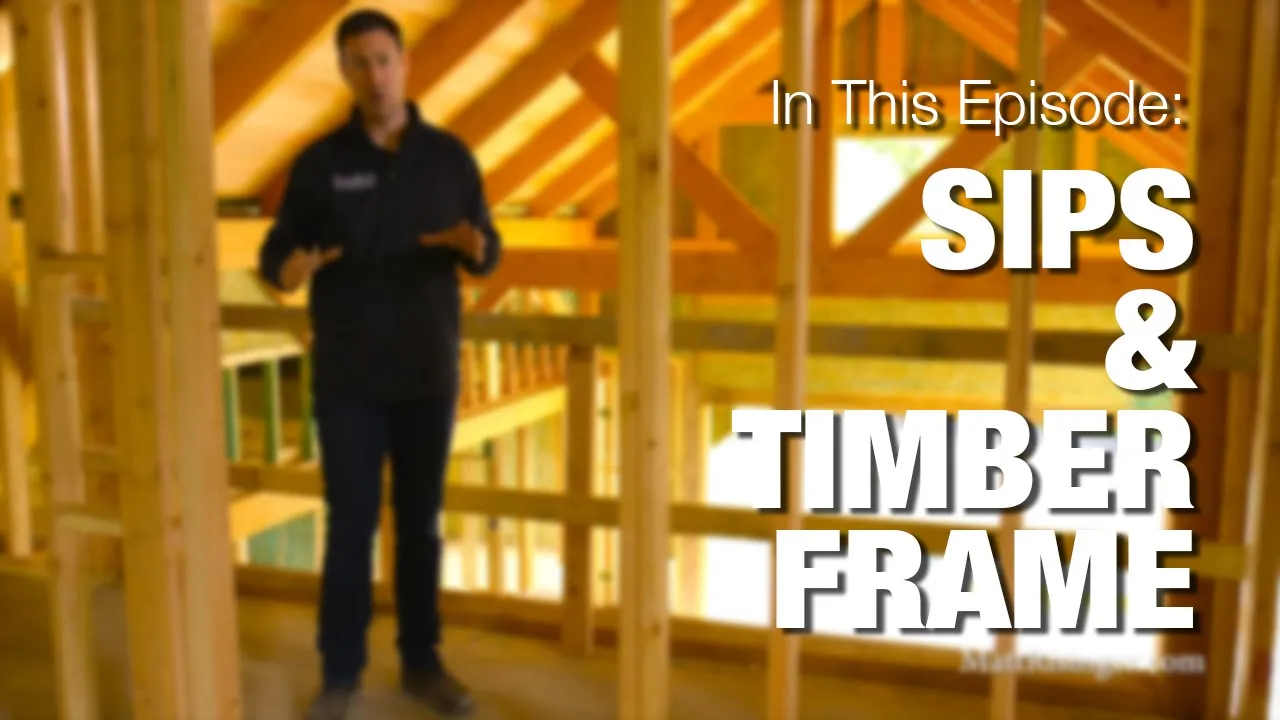
We’re back at our SIPs house, and I want to talk to you today about integrating timber frame with SIPs and why there’s such a good fit for each other. As you can see behind me, the great room is framed all in timber frame. These are Douglas fir architectural timbers from the Pacific Northwest, and a local company, Texas Timber Frame, put everything together. This is really an impressive great room. Look at the mortise and tenon coming into the pegs. I’ve got a Doug 4 2×6 T&G ceiling. It really is going to make a beautiful room once we get this all whitewashed.
But what I like about marrying the two is that now this timber frame is actually carrying the structural load for that great room. My SIPs panels on the roof are only doing insulation duty. Now my ten-inch thick SIPs panels made from EPS foam have a continuous R-38. I don’t need a structural ridge. I don’t need additional roof support. The timber frame is handling that. The SIPs panels are strictly doing insulation on the roof. And now, at this point, I’m totally done. I don’t have to worry about how we might insulate above that timber frame. It’s really a perfect marriage of these two concepts.
Now, the rest of the house has SIPs panels that are both structural and insulative for the roof system. So, for instance, this bedroom or in here, if you look at this attic space above, we’ve got a structural beam running across. These are double LVLs that are carrying that roof load, and I also have some structural support inside my SIPs panels. So I’ve got a slightly reduced R-value in this roof compared to above my great room, but it’s still a very, very well-insulated and, of course, very airtight roof system. Also, we’re not going to need additional insulation. So now when I put my ducts up in that attic above me, it’s part of the air-conditioned space of this house. That attic may be one or two degrees hotter than this bedroom where I am now, but it’s basically the same as where we are. Very, very impressive system.
On the outside of this house, we’re going to be using Cosella-Dörken’s Delta-VENT SA on the walls and Delta-Foxx on the roof. And now I’ve got a house that’s both air and watertight and super-insulated for many, many generations to come.
For more information on both timber frame or SIPs, visit my blog at mattrisinger.com. And if you want to follow the progress of this house, we’re always going to do a hashtag #RisingerSIPs when we post on Instagram or Twitter.
We’ll see you next time on the Build Show
Related framing posts:
3 Benefits of SIPs Framing vs Traditional Studs
External Youtube post: How Structural Insulated Panels Work