Table of Contents
- Sodium-Ion Batteries could be the environmental battery solution that we’ve been looking for
- Why Salt-Powered Batteries Matter for Home Energy Storage
- Key Advantages for Home Applications
- Specific Differences ofSodium-ion battery vs lithium-ion
- Industry Movement Towards Sodium-Ion Technology
- What This Means for Future Home Energy Systems
- Practical Implications for Homeowners
- The Broader Energy Transition
- Looking Ahead: Salt – Powered Homes
- Related
Foreword by Ian Thompson, Editor
Sodium-Ion Batteries could be the environmental battery solution that we’ve been looking for
The world of battery technology is witnessing a significant shift that could revolutionise how we store energy in our homes. In a surprising turn of events, CATL, the world’s largest lithium battery manufacturer, is betting big on sodium-ion batteries – essentially batteries powered by salt – suggesting they could replace up to half the current lithium battery market.
This isn’t just talk; CATL is already producing sodium-ion batteries and plans to launch an improved second generation later this year. When the biggest name in lithium batteries starts looking beyond lithium towards common table salt, it’s worth paying attention.
My big bet is the cost of SIB’s should be much more affordable than Lithium, and all the other developing battery technologies we’ve mentioned over the years.
Why Salt-Powered Batteries Matter for Home Energy Storage
Sodium-ion batteries – powered by the same element found in common table salt – function similarly to lithium-ion ones but offer distinct advantages that make them particularly suitable for home energy storage. The most compelling benefit is the abundance of sodium – it’s literally available in seawater and salt deposits worldwide – making it significantly cheaper and more accessible than lithium.
The environmental contrast is stark: lithium extraction often involves water-intensive mining operations that can deplete local water supplies and cause chemical contamination of surrounding ecosystems. Lithium mines frequently disrupt natural habitats and generate significant carbon emissions. Salt, on the other hand, can be harvested through solar evaporation of seawater or extracted from abundant salt flats with significantly lower environmental impact. This makes sodium-ion technology a genuinely greener alternative for environmentally conscious homeowners.
Simply put, we’ll never run out of salt, and obtaining it doesn’t require the same destructive practices that lithium mining does.
For homeowners considering future energy storage solutions, sodium-ion technology represents a potentially more affordable option that doesn’t compromise on performance in the ways that matter most for residential use. While these batteries currently have lower energy density than their lithium counterparts (meaning they’re bulkier for the same amount of stored energy), this disadvantage is less critical for home installations where space constraints aren’t as strict as in electric vehicles.
Key Advantages for Home Applications
Sodium-ion batteries excel in areas particularly relevant to home energy storage:
- Temperature resilience: They perform exceptionally well in extreme conditions, including very cold environments where lithium batteries struggle. CATL claims its second-generation sodium batteries can function at temperatures as low as -40°C (-40°F), making them ideal for homes in colder climates.
- Enhanced safety: These batteries are less prone to thermal runaway (the uncontrolled overheating that can lead to fires), a crucial consideration for systems installed in homes.
- Comparable efficiency: They offer similar round-trip efficiency to lithium-ion batteries, meaning you get back nearly the same amount of energy you put in – essential for effective home energy management.
- Lower cost potential: As production scales up, sodium-ion batteries could eventually become significantly cheaper than lithium options, with BYD suggesting they could ultimately be up to 70% less expensive.
Specific Differences ofSodium-ion battery vs lithium-ion
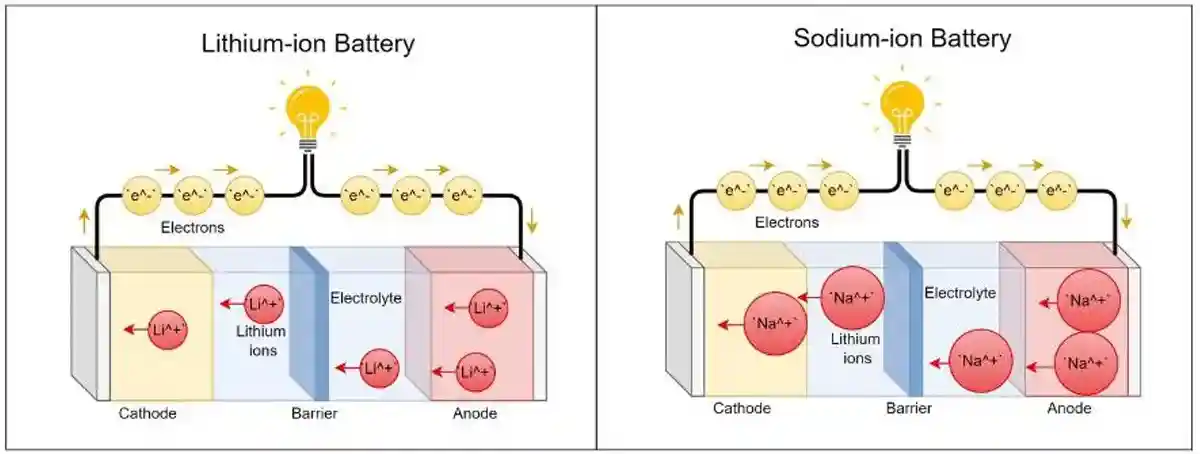
- Energy density is lower than that of lithium batteries
The current energy density of sodium-ion batteries is 120-150wh/kg, which is lower than the current lithium battery energy density of 150-180wh/kg, and there is a certain gap between the energy density of ternary lithium batteries of 200-250wh/kg. Due to the energy density gap with lithium batteries, sodium batteries can only be used in low-speed vehicles, A0-class vehicles or models with a range of less than 400 kilometers in the automotive field. - There is a gap in cycle life compared to lithium iron phosphate batteries.
Sodium ions are larger in size, difficult to deintercalate, and have poor cycle performance. The radius of sodium ions is larger than that of lithium ions, so sodium ions are relatively stable in the rigid structure and difficult to reversibly deintercalate.
Even if deintercalation can occur, the power of sodium ion intercalation and deintercalation is very slow and can easily cause irreversible phase changes in the structure of the electrode material, thereby reducing the cycle performance of the battery. At present, the cycle times of sodium-ion batteries are generally 2000-3000 times, and the cycle times of lithium iron phosphate batteries are generally 3000-6000 times. - Differences in production processes between sodium batteries and lithium batteries
The production process of sodium-ion batteries is similar to that of lithium-ion batteries, mainly including pole piece manufacturing (positive and negative electrode stirring and pulping-coating-rolling-die-cutting, etc.) and battery assembly (winding/lamination – Shell encapsulation-liquid injection-formation-volume separation and sorting, etc.). The production lines of the two are compatible and the production equipment can be shared.
Since sodium-ion batteries can use aluminum foil as the negative electrode current collector, the same aluminum tabs can be used for the positive and negative electrode sheets, and related processes such as tab welding can be simplified. Therefore, the existing battery assembly production line for lithium-ion batteries can be used to produce sodium-ion batteries with slight modifications and parameter adjustments. The replacement cost of developing sodium-ion batteries is very low.
Industry Movement Towards Sodium-Ion Technology
The push towards sodium-ion isn’t limited to CATL. BYD, the second largest battery manufacturer globally, is constructing a gigafactory expected to produce 30 gigawatt-hours of sodium-ion batteries annually by 2027.
They’re also launching the MC Cube SIB Energy Storage System for utility-scale applications, which could eventually be scaled down for home use.
Other companies making significant moves include:
- Zhejiang Hu Na Energy: Currently producing 4 GWh of sodium-ion battery cells with plans to expand to 20 GWh (though, as Matt notes, we should take this with a few grains of sodium)
- Natron Energy: Developing fast-charging sodium-ion batteries with an impressive lifespan of 50,000 cycles and building a gigafactory in North Carolina
- The Dincă Group: Creating innovative organic cathodes for sodium-ion batteries that could rival traditional cobalt-based cathodes at roughly one-third the cost
What This Means for Future Home Energy Systems
For homeowners looking ahead to future energy storage options, sodium-ion technology presents a promising alternative to current lithium systems. As the technology matures, we could see integrated home energy solutions that leverage sodium-ion batteries to store excess solar power or off-peak grid electricity more affordably and safely than current options.
The transition might not happen overnight. Lithium prices have recently dropped due to oversupply, temporarily weakening the financial case for sodium alternatives. This price drop – about 70% in the past three years – has created an interesting economic challenge for sodium-ion technology. Additionally, sodium-ion manufacturers need to scale up production to benefit from economies of scale and make their products cost-competitive.
However, unlike many other emerging battery technologies that remain years away from commercialisation, sodium-ion batteries are already being manufactured at scale by industry leaders. This puts them much closer to widespread adoption, including for home energy storage applications.
Practical Implications for Homeowners
What might this mean practically for your home in the coming years? Imagine a salt-powered battery system installed alongside your solar panels that:
- Costs significantly less than current lithium options
- Operates reliably even during freezing winter conditions
- Poses lower fire safety risks than conventional batteries
- Lasts through thousands more charge cycles than today’s home batteries
- Has a dramatically smaller environmental footprint without the toxic mining waste associated with lithium extraction
For the average homeowner, this could translate to more affordable entry points into energy independence, lower maintenance costs, and systems that function effectively regardless of climate challenges—all while knowing their energy storage solution isn’t causing environmental devastation somewhere else in the world.
The Broader Energy Transition
The emergence of viable sodium-ion technology comes at a critical time in the global energy transition. As more homes incorporate renewable energy sources and electric vehicles become commonplace, the demand for stationary energy storage will grow exponentially. Sodium-ion batteries could help meet this demand without putting additional pressure on limited lithium resources.
While current sodium-ion batteries might not match the energy density of premium lithium options, this matters less for stationary home storage than for mobile applications. The focus for home systems is on safety, longevity, efficiency, and cost – areas where sodium-ion technology shows particular promise.
Looking Ahead: Salt – Powered Homes
The road to widespread adoption of sodium-ion batteries for home energy storage still faces challenges. The technology needs further refinement to improve energy density, and manufacturing capacity must expand to drive costs down through economies of scale.
However, with major industry players like CATL and BYD committing substantial resources to sodium-ion development, the timeline for these improvements may be shorter than expected. As Matt points out, unlike many battery technologies that remain stuck in research phases, salt-based batteries are already in production and improving rapidly. This might be one of the few times, as Matt quips, that a “salty” market outlook is actually a good thing.
For homeowners planning for future energy needs, sodium-ion technology represents a practical, sustainable alternative that could soon transform how we store and use energy in our homes. The combination of abundant raw materials (there’s an entire ocean full of it!), improving performance characteristics, and significant industry backing suggests that these salt-powered batteries could indeed be the future of home energy storage – a future that’s more accessible, affordable, and sustainable than what lithium alone can offer.
Related
Renewable Energy Storage: Why Solid State Batteries are Finally Here
How Old EV Batteries are Perfect for Energy Storage
Are Silicon-Graphene Batteries the Next Mainstream Renewable Energy Storage Solution?