
Foreword by Ian Thompson, Editor
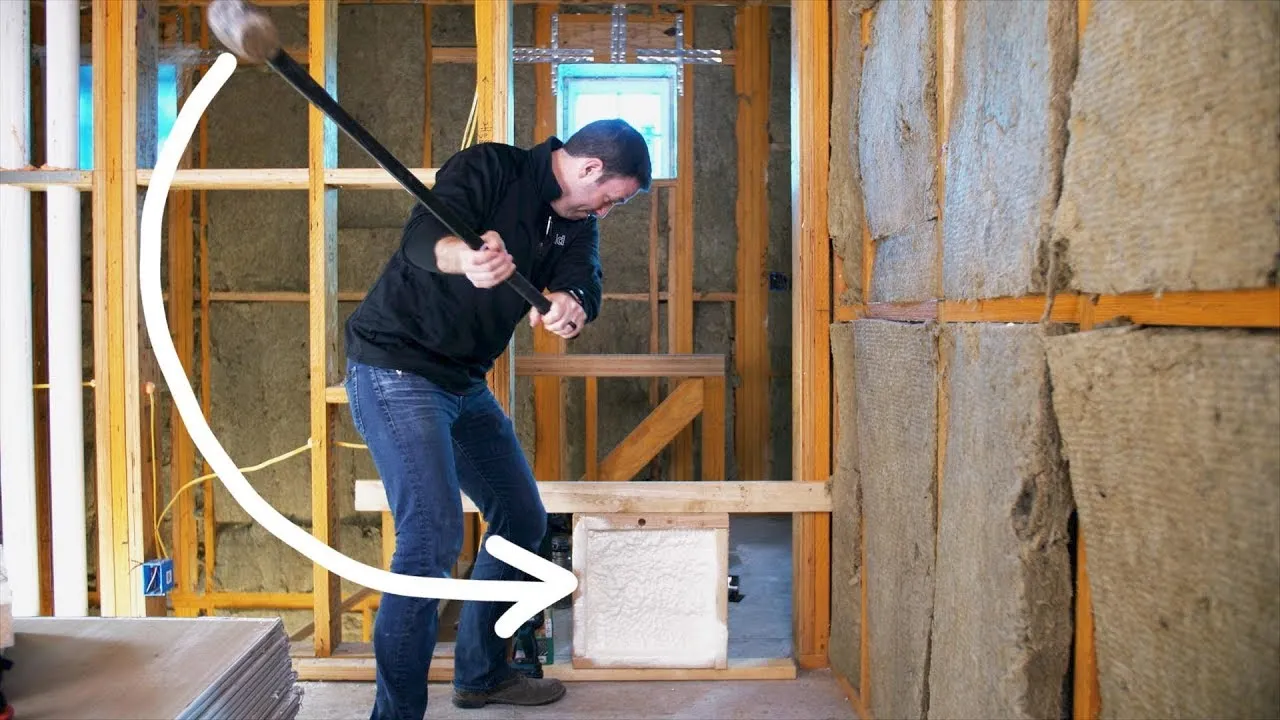
Matt’s rather ‘unscientific’ closed cell foam strength test visually illustrates that strength is added to the wall cavity after insulation application, but how much?
What’s interesting to note here is how effectively the closed-cell foam adheres to the timber frame, giving it additional shear strength. This is not a characteristic found in many insulation types, as they are mostly self-supporting building elements. In fact, most designers overlook the strength of insulation when conducting bracing calculations.
However, closed-cell foam isn’t environmentally friendly. It can be quite harmful to the installer if they are not using the appropriate breathing apparatus, and it’s likely to off-gas for some time. That being said, there are some definite sealing and thermal advantages to consider over many other insulation types.
Matt’s video is a quick and easy way to understand the strength benefits of using closed-cell spray foam.
Closed Cell Foam Strength Test: Does it add structural benefits?
Video Transcript:
On the Build Show today, I’ve got a visual test to show you how much strength closed-cell foam is actually going to add to your house. Alright guys, here’s the background. I’m coming to you from my LVL framed house. If you’ve seen any videos on this house, we built this house with traditional framing, but instead of a standard two by six, we substituted these. This is an LVL stud. On the outside of this, we sheathed the house with half-inch Advantech sheathing, a really good sheathing that’s going to add a lot of strength, and we actually nailed and glued it on. The idea is we built this standard wood-framed house to withstand hurricane forces. But on today’s video, what we’re going to do is talk about how much strength this adds to the house.
Right here, this is closed-cell foam. This is a rigid foam, or often referred to as a 2-pound foam. Now, we sprayed 2 inches in the outside walls, and then if you saw my video, I think last week it was, we published Flash and Bat. We’ve covered the bays of this closed-cell foam with Rockwool. But what I want to talk about today is the strength this adds. Now, the engineers tell me that this closed-cell foam is going to add between 75 and 200 percent additional shear strength to the house. Remember from high school science class, shear strength, that’s the force of the wind acting on the house, trying to push the house over, and the framing is resisting those forces. And this closed-cell foam is supposedly adding to that strength.
So, I’ve dreamt up a way that I think I could visually test that and show that. Let’s go upstairs and let’s have a look. Alright guys, we’ve got a test to see what kind of strength closed-cell spray foam adds to a wall cavity. Here’s what I did. I made three of these mock-ups. This is an 18 by 18-inch square made of a two-by-four and then just some Advantech sheathing on the backside, half-inch sheathing. All three of these are made identically, and the front sheathing was attached with just a couple of trim nails. We wanted it to be secure and on, but not actually nailed on like a shear wall would.
And here’s how we’re going to test this to see how much strength the closed-cell foam is going to add. First of all, we’ve got a control right here. This one, all three of these built the same, like I said. This is our control. We’re going to whack a sledgehammer at this and see how easily that comes off. And then we’re going to do a picture-framed version. So, this is closed-cell foam. We picture frame the opening, which I understand adds a great amount of strength. I’m curious to see, we’ll find out when that 20-pound sledge hits it. And then the way I’ve built this house is, we’ve done two inches of closed-cell in the entire opening, and I’m curious to see what kind of strength difference the total fill versus the picture frame does.
So, we’ve got a GoPro set up out here. Let’s see what happens. One, two, three…
Well, it worked! Alright, let’s set up the next one to see what happens. Take two, picture frame. Alright, one, two, three…
Oh, it came off, but it was definitely harder. Interesting. Alright, now take three. Whoa! Okay, so this is now closed-cell foam full swing. You ready? Oh, screw in there. I think it moved a little bit. We’re going to make sure this thing’s solid. So, let’s put another screw in. Look at that hit on that. Alright, one, two…
Oh, it moved on the second hit. Though I’ll see if I can get it to come out.
Alright, so there you go. I’m not sure how scientific this test is. This is like we use a measured force here. But interestingly enough, the picture frame seemed to help. It obviously still went in the first swing. The total fill, two-inch closed-cell, I think the 200 percent which the engineers tell me it adds strength-wise, that seems pretty accurate. I mean, the first whack, you could see that closed-cell dented, but I actually dislodged the screws a little bit. I’d have put a third screw in to make sure it wouldn’t move, and the second hit, it came off. The third hit, it dramatically failed. But I would say that it definitely added strength to that cavity. And remember that Advantech sheathing on the outside, that Advantech sheathing was just on with a couple of trim nails. So, hardly any kind of strength of those nails at all. It was the foam that was doing all the work.
Very interesting test. I think in the end, this boils down to if you’re building a house and you want that extreme strength, you want to actually add some shear to your house, you’re building in a hurricane-prone zone, or you’re building just a house that you want to withstand the worst that mother nature is going to throw at it, closed-cell foam is a good choice. And I really like this Flash and Bat we did on this house.
Related insulation posts:
Closed-Cell Spray Foam Insulation: Is it the Right Choice for Your Build?
Youtube: Open vs Closed Cell Spray Foam Insulation | What’s the difference?