Foreword by Ian Thompson, Editor
How To Achieve a Perfect Paint Finish is easy when you know how.
Today Matt’s discussing how to obtain perfect paint finishes for new builds and renovations. I’m going to be honest with you: I hate painting. Even the process of repairing a wall and painting after making a modification seems gruelling to me. It’s time-consuming, monotonous, and frankly, it feels akin to watching paint dry.
The thing about painting is that almost anyone can do it, but that doesn’t necessarily mean they should. I’ve seen results from even professional painters that have left me astounded, thinking that it must have been more difficult to produce a result so poor that it must have required more effort than doing it well in the first place.
I’m already feeling listless even writing about painting, but let’s face it – there aren’t many building or renovation projects that don’t require painting. So, we might as well learn how to do it well. That’s where our ever-present expert, Matt Risinger, comes in, who will be hosting this painting tips video.
How To Achieve Perfect Paint Finishes in Building Projects
Follow the 4 P’s to achieve a Perfect Paint Finish – Video Transcript
All right guys, on the Build Show today, we’re talking paint. You know, when you see this phase of construction when it’s almost done, there’s just such that excitement in the homeowner’s eyes and voice about the job. They can see that we’re almost done. We’re actually coming to you from my house today, and I can tell you that my wife and I have that same excitement about the house.
But there’s something interesting about paint in particular. For instance, my wife, she could care less about what kind of HVAC system I have or how well insulated my house is or any of those things from a building science perspective that I really care about. What she cares about is these kinds of views and making sure the paint job looks really good. She can, in her untrained eye, spot when things aren’t good. Isn’t that true for most people? They can spot a paint job that’s not very good.
So, on the Build Show today, I’m going to give you several keys to a really excellent paint job on your project. Today’s Build Show is sponsored by Sashko. Let’s get going.
All right, we’re talking paint today, guys. The first ‘P’ that I think everyone thinks of, let’s get this one out of the way, that’s paint, right? The actual product that we’re going to put on the walls to make the walls beautiful. Now, there’s a lot of options out there, and I’ve had really good success with these. But I do want to tell you, overall, you get what you pay for on paint. You don’t want your painter, who’s doing a project for a fixed cost, to decide which paint is being used.
You actually want to take a little time and certainly spend some time talking with them and researching what is a good paint and what paint you want to use for your project. For instance, I’ve been using these for about a decade now, and I’ve had really good success. Benjamin Moore is a terrific brand, and this paint is known as an upper-end paint in terms of dollars. It’s because I’ve had really good performance with it. All of my walls and ceilings in my house, anything that’s got this level 5 smooth drywall, is all going to get this Aura paint.
It’s really nice paint. I’ve had really good success with that. One of the things I really like about it is it doesn’t have a lot of that nasty paint smell that you get sometimes with the lesser cost paints. But it also lays down really nice for us and gets a really even coat. I find it easy to touch up as well during the process of paint and construction.
Continue Reading
Next, let’s switch gears and talk about millwork paint, and that’s where this comes in. This Ben Moore Advance is a really interesting product in that it’s a waterborne paint, an alkyd paint. But it really lays down nicely like the oil-based paints that I loved for a long, long time in my career. Oil base has this reputation for laying down and kind of losing those brush or spray marks. Now, you notice on this house, we’re doing a lot of spraying. Pretty much all my millwork is getting sprayed and not brushed. That’s a bit of a regional thing, but I love that gorgeous finish coat when you actually take the time and effort, and money frankly, to spray it.
Ben Moore Advance is a great choice. We’re not going to yellow like we might with an oil-based paint. In the past, if you painted a pocket door and you let that pocket door go back into a dark pocket where light wasn’t going to hit it, you’d pull that pocket door out over time and you’d realize, “Oh, this paint is yellowing.” That was pretty typical with oil-based paint. This alkyd paint has kind of solved some of those issues and has allowed us to get that really laid down smooth finish. It’s really easy to clean up and lacks smell. This is the room that’s been used as a paint room. I’m not smelling anything in here, and it’s not going to yellow on us over time.
So, those are two great choices, but in the end, there are other great paints out there. Do your research and your homework, and remember, it’s worth spending a little bit more for some really high-quality paint for your project.
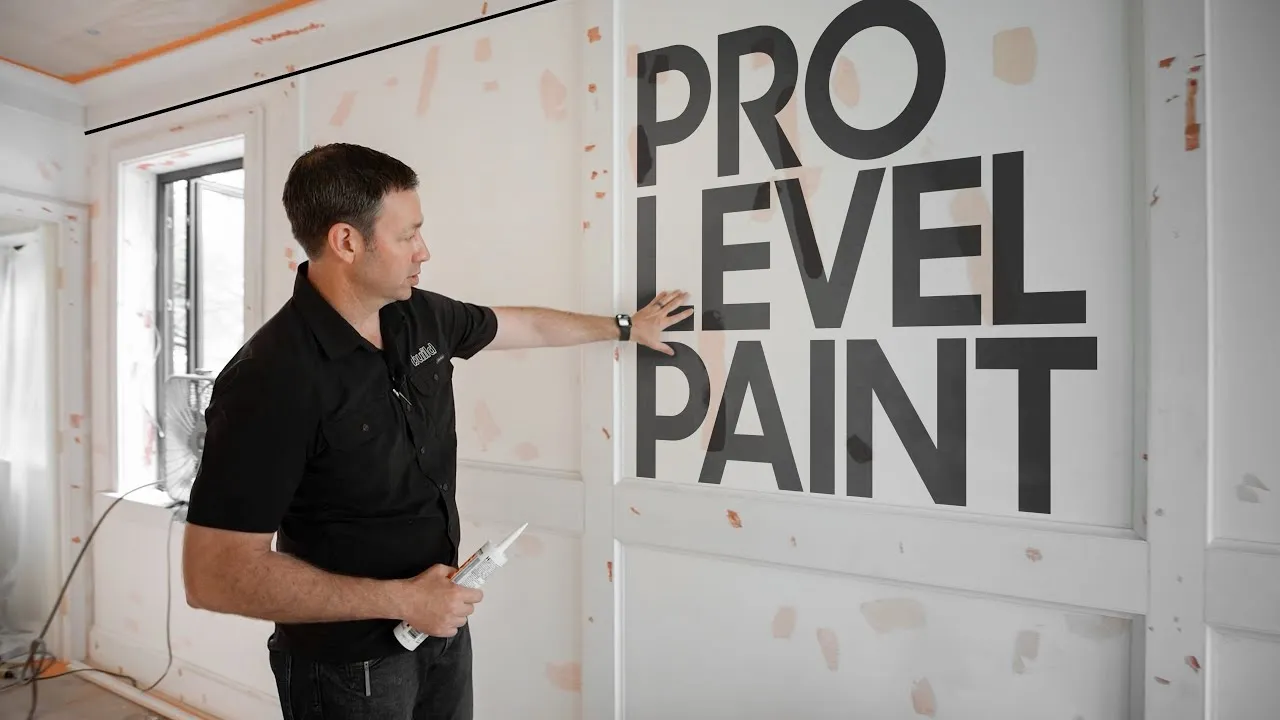
The next ‘P’, prep. This is critical to a really good paint job. So, let’s talk about the materials that we’re going to use to prep with. When you look at this wall right here, you’re seeing a lot of prep work, meaning this kind of pinkish stuff we’ll get to in a second. But I do want to mention that anytime you’re doing finished carpentry, there’s always going to be somewhat of a gap between that carpentry and the paint. That’s when you need a product like this. You need a painter’s caulking.
Now, quick plug for these guys, not all painters caulk is created equal. About 15 years ago, when I started my custom home business, an old painter got me turned on to this. At the time, it was hard to find. You couldn’t find it at the big box stores. You only found it at a local hardware store, and I went and got what he asked me for for the paint job. I came back to him and said, “Gosh, that was really expensive. This was like, you know, six dollars a tube. When previously, when I was working for a production builder, we were using a dollar fifty a tube.” And he said, “You know what, son, you get what you pay for.”
This is one that’s really worked for me. Fast forward now, 15 years later, I understand the science of why these are so much different in cost, even though this and another product might say the same things, but they’re vastly different on both cost and performance. For instance, Big Stretch by Sashko. One of the big differences is the cheap caulking that you see on there and this one. There’s basically just a few components in there, and I’m boiling this down. But basically, there’s water in there, it’s latex-based, water-based. There’s going to be some latex material that’s kind of similar to Elmer’s glue, basically. And then there’s going to be, believe it or not, some other products in there as well, things like clay.
When you buy the cheap tubes, more than half the tube is clay, just regular old clay mined from the earth, and a little bit of latex and a lot of water. On the other hand, when you buy this tube, we’ve got a lot more of that expensive ingredient, and that’s why this costs so much. I’ve been using this for gosh, 15 years now and had really good success with that. Using a product like this means that when the house moves and changes and shrinks, this is going to shrink and move and change with it rather than showing the crack, which I spent a lot of time on callbacks on at that one year warranty period when I worked for that production builder.
So, in the end, spending a few dollars more per tube, a huge difference, and it’s going to save you on the back end on warranty. Now, one thing I do want to mention though is you don’t want to use a micro bead of this. You want enough of a bead laid down that this product can do its job and move with you and actually stretch. If you’re using just the tiny micro amount of this on a joint, you’re going to have a hard time giving that product the ability to stretch if there’s a tiny amount. So, we want to use a proper amount of this and apply it properly.
All right, so on the prep side of things, one of the things that’s critical is for your painter to take the time to deal with all those little imperfections before any paint goes down. Now, typically builders talk about using Bondo, but there’s actually kind of three products that we use and have used a lot over the years.
First off, wood filler. Almost all the nail holes from a pneumatic gun, all those tiny little pinholes, those are all wood filler. Wood filler is great for that because it doesn’t shrink and crack. Now, if you have bigger imperfections, like if you’re filling a screw hole, or if you’ve got a chip or a crack, we’re going to use Bondo. Bondo is a little harder to use only in that it’s a two-part product, meaning I need a Part A, and I’ve got to put a hardener in there, and then we’re going to sand it down. But it works really well for bigger things.
Now, for smaller things, here’s a secret that Geo gave me that I don’t think a lot of painters know about, and that’s another product from Bondo called Glazing and Spot Putty. Almost all these smaller cracks that you’re seeing and these minor imperfections that Geo’s filled, he’s used this. Now, this is a single component, single part, a little more viscous, a little more fluid than Bondo. That’s going to help get it in these minor things. See that scratch right there that was on the wood? He was able to fill that, and then he’s sanding and doing a real nice job of sanding and prep. You can see I’ve got some of that kind of pink dust on my hands. That’s from sanding on this. We’re going to, of course, get that off before we paint.
Okay, so finishing up on prep, as we talked about earlier, use those good products and really spend the time to prep the wall. Look at the wall. You’re going to see a good painter use a cordless light a lot. In fact, I have a couple of extras that he’s been borrowing on my job because we really want to take a look at that wall in what they call “critical light,” which is that raking light. So, when you see the painter walking around with a light like this and really looking at the wall, you know that that prep job is going to be good. And in a room like this, seeing all the pink like this makes me really happy.
All right, the next thing we want to talk about is the painter themselves. We’re looking for a painter that has good experience. But I can tell you, not all painters are alike, and it’s really important to find a painter that’s going to do the type of work that you’re doing. So, for instance, this house, a lot of traditional woodwork in this house. We’d want to go and take a look at a previous job that a painter, if you’ve not used them before, has done to see if they’re able to do that.
There’s a huge difference between a new construction painter and a repainter, you know, someone who’s going in and painting houses after they’ve already been painted. We talked earlier about all the prep work. That’s prep work that often is not done on repaint jobs but on new construction is vital to absolutely get that fantastic looking paint job, that paint job that’s not perfect but really, really precision, really, really tight, really, really crisp, as I like to call it. So, you’re going to want to look for a painter that’s got that.
Then, hand in hand with a good painter is obviously the price of the project. I can tell you, over the years, when I’ve presented budgets to clients, most of the time, they don’t know how much foundations or concrete or steel or framing would cost. But they seem to comment often, and they feel like they know how much a paint job should cost. I can tell you, without fail, over the years, when I don’t budget enough for paint, the job at the end suffers.
Now, I’m in a different market. I’m in a marketplace that doesn’t have second or third-generation painters. If you’re in Chicago or you’re in some established older town that’s had really good painting companies that have been around for 30, 40 plus years, they might be able to hard bid your projects and really tell you how much it’s going to cost to do that ahead of time. But in my marketplace, almost all the painters are first-generation business owners where they were great tradesmen. They were a great painter, or maybe they worked for another painter, and they rose to the top, and then they start their own paint company.
But they don’t really get the business side of painting. This is no knock on any painters if you’re watching this and you’ve worked for me in the past. You’re a great tradesman if you’ve worked on my jobs, but you maybe are not always the best businessman. Here’s how I overcome that. I’m looking to make sure that number one, my tradesmen, if they’re going to bid the project, are not going to either hit a home run and get a Hawaiian vacation out of the project or, even worse, they’re going to be behind and not be able to really pay his guys or pay his paint bills on time to make sure that that job’s really good at the end.
Ultimately, as a builder, I want my tradesmen to be around on multiple jobs to make a good living but not to kill it on a particular project or even worse, get creamed on a project because they’re trying to do something to make a client happy, but the expectations weren’t there. That’s hurt a lot of painters. I can think, in my 25 years of this, a lot of good painters that have gone out of business because of that scenario.
So, here’s what I do. At the beginning of the year or, let’s say, the beginning of the job, I confer with that painter on what his labour rates are going to be, or her labour rates. Then, I pay for all the paint and all the supplies separately. In fact, they can use my account at the Benjamin Moore store, for instance. Then, I know what paint I’m getting, and they’re not worried about paying that bill. Then, on typically when it comes to painters, I’m paying them more regularly than some other trades. Oftentimes, once a month we’re paying all our suppliers, but very often, painters are getting paid on a weekly basis. If they get their invoice to me on a Wednesday, I’m paying them the following Friday so they don’t have to wait a long time to get paid.
Sometimes, that’s a really good way to get an excellent paint job. You don’t want a painter to rush, but you also don’t want to walk in and see them on Facebook in the middle of the day as well. So, that’s a delicate balance: finding that really good laborer who’s a good craftsman who can really make it happen, but also making sure that they have the time to do it right and they’re getting paid to do it right.
Guys, hopefully, you learned something about the process of getting that excellent paint job. When it’s all done, you can absolutely see the results. As I said earlier in the video, not many people understand behind the scenes of a good framing job, or a really good air sealing job, or good insulation, or any of those kind of building science details. But anybody can spot a really good paint job versus a not-so-good paint job.
One of my favorite compliments I’ve gotten from people in the past as they’ve walked my finished houses is that they were really crisp. I love that. A crisp paint job, not perfect, right? We can see some flaws if we really look hard. We’re not inspecting our paint job like this, right? We’re going to look back from a distance, and if we spot something, we’re going to fix it. But we want a really crisp paint job where the guys took the time, they did it right, they used good products like we talked about earlier.
Including big thanks to my friends at Sashko for sponsoring today’s video. I’ll put a link for them in the description so you can learn about all their other products as well. And if you’re not currently a subscriber, guys, hit that subscribe button below. We’ve got new content here every Tuesday and every Friday. Follow me on Twitter and Instagram. Otherwise, we’ll see you next time on the Build Show.
Related
Ultimate Guide to Floors, Doors, Trim, and Paint Post Drywall – The Real Rebuild Episode 6