Foreword by Ian Thompson, Editor
Insulating old houses presents unique challenges and opportunities for homeowners and contractors alike. As we strive for energy efficiency and comfort in our living spaces, the question of how to properly insulate vintage homes becomes increasingly relevant. In this video Matt Risinger explores a 1950s remodel and addition project in a charming Austin neighborhood, tackling the complexities of insulating old houses while preserving their character and structural integrity.
Before we dive in, it’s worth noting that there are often excellent opportunities to purchase and renovate older houses instead of buying new construction. The advantages can be significant, primarily due to desirable locations and potentially lower purchase prices. Many older homes are situated in established neighbourhoods with mature trees, proximity to city centers, and unique architectural character – features that new developments may lack. Quite often these older homes reside in areas that have more of a community feel and are closer to established transport networks.
By investing in renovation and proper insulation, homeowners can create a modern, energy-efficient living space while capitalizing on the charm and prime location of an older property, but do so with your eyes fully open. Get a really good building inspection carried out before purchase because many of these older homes have a few surprises that often catch even seasoned professionals out.
Matt’s journey takes him through a characterful mid-century home, where he’ll examine various aspects of insulation strategy for older buildings. From the original wood siding to the pier and beam foundation, every element of this house tells a story – and presents its own insulation considerations.
Matt will discuss how to approach insulating old houses in a way that respects the building’s history while bringing it up to modern energy standards. Throughout this exploration, we’ll cover several key areas of focus when insulating old houses:
We’ll also touch on the importance of proper ventilation, the challenges of working around existing HVAC systems, and how to address potential moisture issues common in older structures. By the end of this video, you’ll have a comprehensive understanding of the strategies and considerations involved in insulating old houses effectively.
Renovation Tips: Insulating Old Houses
Video Transcript:
This is coming to you from a beautiful downtown Austin neighborhood where my friend Emily, the builder at Emerald and Laurel Design Build, is doing this project here. This is a 1950s remodel and addition house. And she’s got a couple of interesting building science questions that she asked me to weigh in on and we talked about together.
I thought I’d give you a quick tour of the house. But before we go inside, have a look at that roof that’s on there. That’s a standard three tab shingle roof. I don’t know quite on the age. I’m guessing that’s maybe 10 years -ish old.
But as we walk up to the house, the first thing you’re going to immediately notice, beautiful wood siding. This is that original 1950s siding. It’s had a lot of wear and tear on it, as you can see. Pretty cracked and faded. I’m not sure what this is. It might be longleaf from the 50s, a really, especially rot resistant type of pine, but hard to say for sure.
But other than the peeling paint, it’s in great condition. I don’t see any rot out here at all. The other thing you’re going to immediately notice is this is a pier and beam house. The house is up a little bit. She’s putting some new piers in.
There’s some addition going here. There’s a two -story section going on in the back. But one thing that we’re going to not talk about this on this video, but in a future video, is this right here. Here’s the back of the wood siding.
And when they pulled the sheet rock off, they said, uh -oh. Look, we can see the back of the siding. And in fact, the tar paper is damaged in quite a few places and you’re seeing the siding. So stay tuned for a future episode on how to deal with that.
But what I wanted to show you in here was we talked about what’s the insulation strategy for this house. You know, we got to bring this up to code. We got to bring this up to modern insulation standards. And how do we do that in a way that’s not going to harm the house?
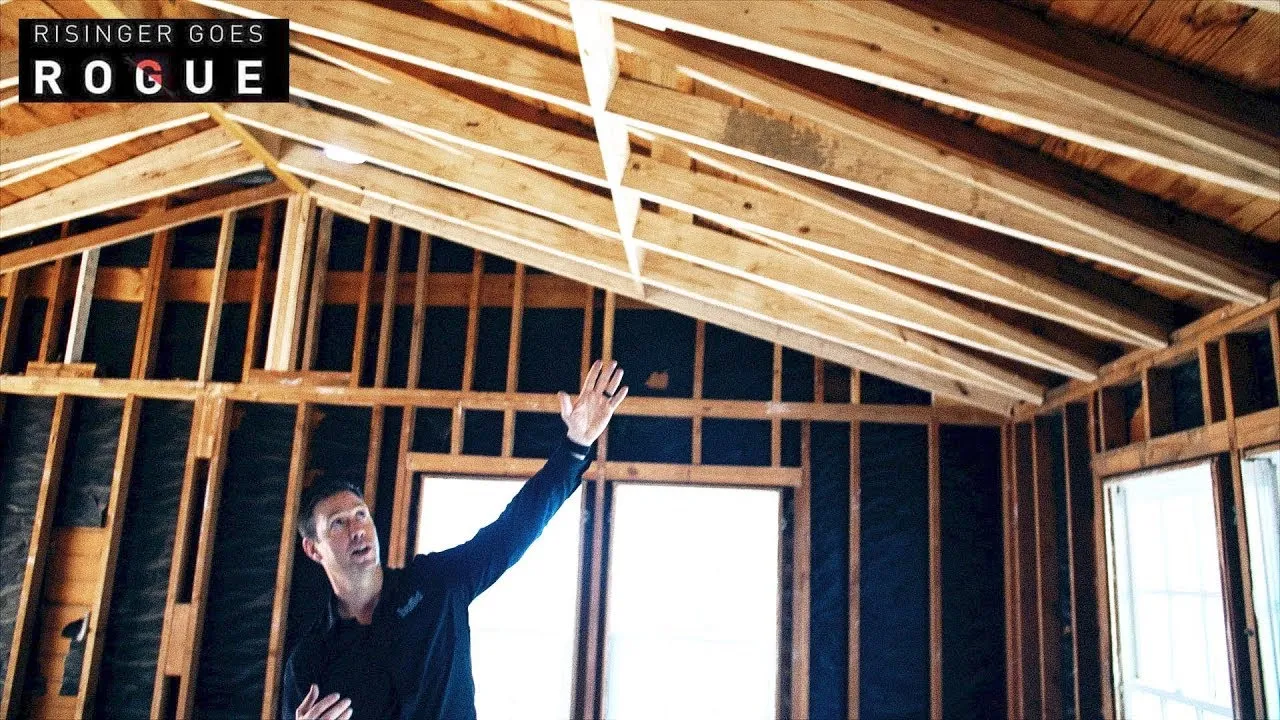
So as we look at this original house, we’ve got solid pine studs. We’ve got solid decking on the roof here. This is probably a, I don’t know, one by eight ship lap. So that’s probably a full three -quarter inch thick roof decking, a fantastic roof deck.
And interestingly enough, you can see some places where there’s been some water. If you look over this way, clearly there’s been some water intrusion here, probably some leaks over the years. You got some staining on those. Now, if you look back this way, look at that board right there, a lot of water staining there.
There must have been a leak there. But what’s interesting is this has always been a vented attic space. So water that got in was able to easily dry on that, especially because that’s a solid roof sheeting.
That, you know, that old 50s ship lap was able to soak it in. And this was a flat ceiling formerly like the rest of the house is now. And so this area had traditional insulation on the flat. And now it’s going to be a vaulted space.
Now how do we want to treat that? We don’t want to necessarily use bat insulation up in that attic space because it’s going to have a hard time fitting in between some of this funky framing, especially when we’ve got old and new.
So for this ceiling space, spray foam would be a really good choice. But remember my video I posted on Friday talking about how spray foam, if we do have a leak, is going to hold that water potentially and could cause a problem. So we’re recommending spray foam for this vaulted ceiling area.
But we’re also going to recommend that the client removes the shingles and puts a new roof down so that we can make sure we’ve got a really good underlayment underneath there that’s really watertight. We’re going to use an ice and water shield. And then we’re going to put a new roof on there that we can really guarantee is not going to leak on us and give us some really good protection for this spray foam that’s in here.
Now we really, because we’re in the south, I’m coming to you from Texas. So this is a hot human climate. We could use an open cell or we could use a closed cell in this climate. My preference would be to use a closed cell. Here’s the reason. We don’t know what the humidity in the house is going to be.
Insulating Old Houses: Continue Reading
And there’s been some studies from the guys at Building Science Corporation. Look at the link in the description, something called ping pong water, which basically means that over time we could, if we had elevated humidity levels, have some accumulated humidity or really moisture condensation in the sheathing towards the roof line.
There’s a couple of ways to deal with that, but check out that article for more information here. But I think that the solution in this house is going to be used closed cell. Now over here, look at this. What we’ve got here, flat roof right here on this other part of the house.
And look what’s up there. See that yellow line? That indicates we have a gas furnace up there. That’s probably a 80% efficient gas furnace. And Emily tells me it’s relatively new. So we’re going to save the money by not putting a new furnace in.
And here’s the original bee vent for that furnace. See that? So we can’t have that in that spray foamed area. We need to move that into this other space. And so that space is not going to be a condition attic. We’re going to have standard, blown insulation here.
And then we’ll hang the sheet rock in this wall here where we’ve got this gable so the spray foam crew can spray the backside of that and make sure those knee walls are thoroughly insulated. We don’t want to typically use bats there because those bats can fall off.
Now stay tuned for my episode coming up on how we’re going to deal with these walls and this issue of existing siding and keeping that siding.
But the clients really want to use rock wool and all the walls. So we’re going to put rock wool insulation and all these walls here. And the last thing we need to talk about for insulation is the crawl space. You know this house here in Austin, Texas, we don’t have the best soils here.
And so a crawl space foundation is actually a great foundation because we can come in over time and level this foundation. But it’s interesting to see how this is built. 1950s house, we’ve got a two by six floor joist. So pretty small floor joist, 16 inch on centers, which is nice. And then look at this.
This is a horizontal lap sheathing. It’s a ship lap basically just like if you can see that ship lap profile, just like the decking on the roof, except here it’s floor decking. And then right on top of that is our hardwood floors.
The problem is we’ve got elevated humidity that’s going to happen down here in this crawl space. And I would love to suggest that they go with a conditioned crawl space, but it’s just not in the budget for a project like this. So what’s the next best thing we can do?
I’m going to recommend that we come in with two inches of closed cell foam and spray underneath here right underneath to this decking with closed cell foam. That’s going to prevent any moisture from migrating from this crawl space, which could have some moisture accumulating in it from coming up here and getting into this wood, which is going to get into our hardwoods and make them swell and move on us.
Now ideally the spray foam crew would actually coat these joists as well. So these joists would be totally encapsulated. It doesn’t always happen. And in fact, I haven’t always done that as well. I haven’t seen a ton of problems with that. But really your best practice would be to spray under the floor with that closed cell and then go all the way so that these are totally encapsulated as well.
So these would be kept warm or cool like the house is and they wouldn’t absorb any moisture. Guys, hopefully this quick insulation walkthrough was helpful for you. Stay tuned for this future video. We’re going to be talking about how we’re installing some Delta products so that this siding can actually stay on the house and not have to come off.
But we’ll experience the same conditions post remodel, post energy efficiency, post air sealing, post insulation as what it’s experienced now. And that way hopefully this client and this builder will get another 70 years or so out of this beautiful siding. See you soon.
We’ll see you next time on the Build Show
Related insulation posts:
Insulating an old house: What to do!
Insulate Smarter: InSoFast’s Revolutionary Waterproof Continuous Insulation Panels