
Foreword by Ian Thompson, Editor
In today’s video post, Ricky McLean addresses a common question in modern sustainable mass timber construction: What’s the optimal grid option for mass timber projects: post and beam or post and plate?
Ricky delves into the comparison between the two connection systems, offering a comprehensive insight that’s valuable for architects, engineers, and developers alike.
Some key takeaways you’ll discover:
- Post and beam construction allows for larger column spacings, making it versatile for various project types including multi-family, office, and mixed-use buildings.
- Post and plate systems can minimize overall structural depth, potentially reducing floor-to-floor heights and overall building height. This could lead to savings in facade and finishing costs.
- However, post and plate systems typically require tighter column spacing, often limited by panel widths of 8 to 12 feet in the weak axis.
- The design process for post and plate systems is more complex, involving interaction equations for strength and stiffness in both directions.
- Post and beam remains the most common framing system for mass timber structures in North America.
Ricky also touches on real-world applications, referencing the Brock Commons Student Housing project as a notable example of post and plate construction.
Whether you’re considering mass timber for your next project or simply staying abreast of industry trends, this video offers valuable insights into the structural considerations that shape our built environment. Let’s tune in and expand our understanding of these innovative construction methods.
Post and Beam vs. Post and Plate: Which is Best for Mass Timber?
Video Transcript:
So, what’s the best grid option for my mass timber project?
Post and beam or post and plate? Actually, I get asked that question a lot. That’s today’s topic. Let’s go!
Welcome back to another Two-Minute Tuesday. I’m Ricky McLean. Post and beam versus post and plate. That’s today’s question. We’re going to try to dissect this, understand what are the pros and cons of each, and what project typologies would these grid systems work best in in different mass timber projects. Alright, let’s start out by defining what we mean by post and beam versus post and plate.
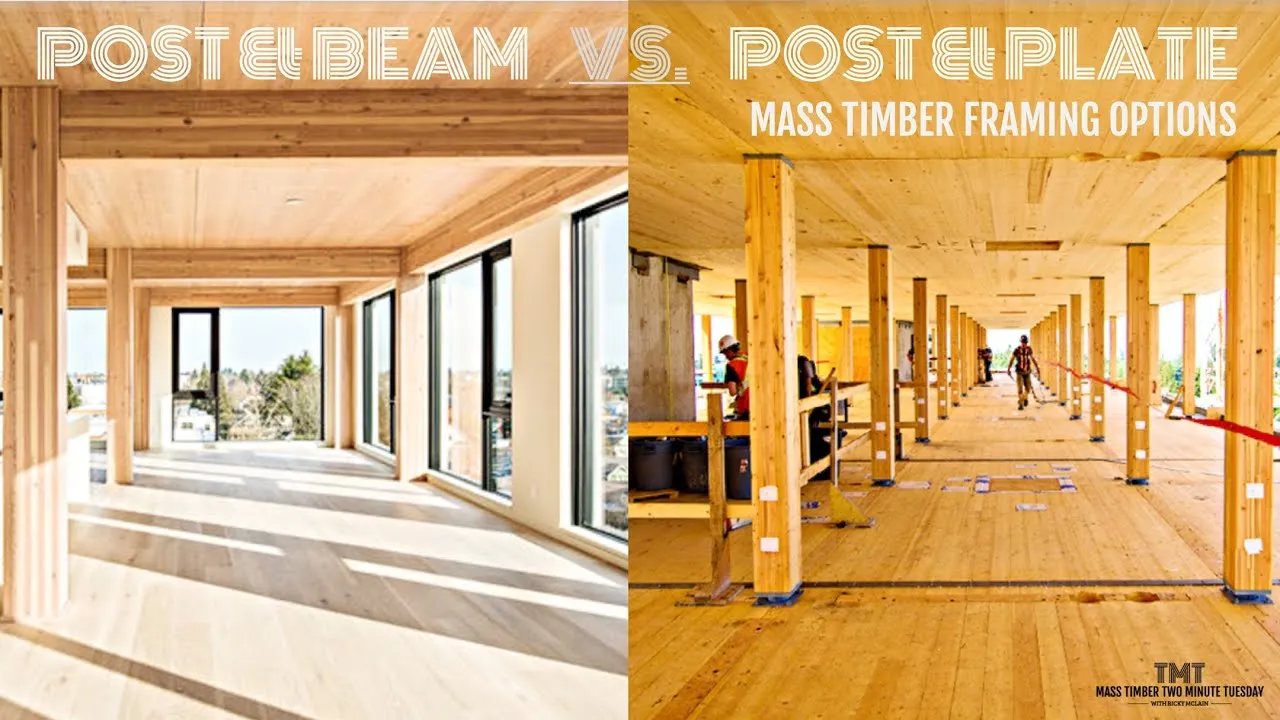
We’re talking about a post and beam style of construction where our structural framework consists of beams in one or both directions, columns supporting those beams, and obviously a mass timber floor panel on top of that. Now, in a post and beam style construction, this mass timber floor panel is only spanning in one direction, it’s spanning in its primary strength axis.
Now, in a post and plate style of construction, our mass timber floor panels are spanning in two directions, spanning in both the major and minor axes of the mass timber floor panel. So, there are no beams in a post and plate style of construction, there are only columns. Columns are supporting those mass timber floor panels at point locations.
Alright, so let’s dive right into dissecting these two different structural framing systems, what some of the pros and cons of each are, and what project typologies they might work best in. Starting out with a post and beam style of construction, now a couple of the positives of using something like this is that we are able to achieve larger column spacings. Our grid dimensions are generally larger in a post and beam style of construction than what they would be in a post and plate style of construction. We’ll explain why in just a minute.
Now, some of the potential drawbacks with using a post and beam style of construction with mass timber is that, of course, we do need to accommodate the overall beam depth in looking at how deep is the actual structure, and that, of course, has an impact on the head height. So, when we’re considering floor-to-floor heights, we do need to think of that beam depth.
So, what project typologies work best for the post and beam style of construction? Well, I will say that for mass timber structures, post and beam is by far the most common type of framing system. Mass timber is very efficient in that regard. And in some cases, we’re running just beams in one direction with panels perpendicular. In other cases, depending on the grid dimensions, we might be running beams in both directions. So, it can work well in a variety of occupancies and project scales. We’ve seen it be used very frequently in multi-family buildings, in office buildings, in higher ed, in commercial and retail mixed-use structures. So, we can really vary the grid to meet the project needs in terms of open floor plates or more compartmentalized, and therefore use mass timber in a post and beam style of construction in many different project typologies.
Alright, and then when it comes to a post and plate style of construction, really what we’re looking at doing is minimizing that overall structure depth because, again, we no longer have beams, we’re simply the flat plate, the mass timber floor panel supported by columns. So, we’re really minimizing the overall structure depth. One of the benefits there, obviously, is that we can have more head height if we’re using the same floor-to-floor height, or we can cut down our floor-to-floor height, still have the same head height, and reduce the overall building height, which, of course, can save us on things like exterior wall finishes, interior wall finishes, enclosure, facade, all of those things that have a ripple-down effect when we’re reducing the overall building height.
Now, when it comes to post and plate style of construction, the first and biggest downside is that it results in column spacings which are much tighter, much closer together than they would be in a post and beam style of construction. Really, the most pertinent and large-scale project in North America using mass timber post and plate style of construction is the Brock Common Student Housing project in British Columbia. The column grid spacing was about 9 feet in one direction and 13 feet in the other direction. One of the main reasons for that is that, at this point, we are really limited in your weak axis dimension as far as how far apart those columns are by the width of the panel. And for most North American and PRG320 certified panel manufacturers, that is going to be in the range of 8 to 11 or 12 feet. So, that’s really going to limit your weak axis column spacing.
Now, there are some potential products on the market that would look to create fixity at the weak edges of two panels coming together. However, those haven’t been widely adopted yet here in the US. So, most projects that are evaluating a post and plate style of construction are limiting column spacings in the weak axis of the panels to the actual panel width. Also, when we’re looking at this post and plate style of construction, the design process is a bit atypical. We’re needing to look at interaction equations of strength in both directions, stiffness in both directions. And as of yet, there isn’t a widely adopted process for doing those structural evaluations. And also, we need to consider higher concentrations of shear forces, both bearing and punching shear, at those point-supported locations on the CLT panels because, again, we’re not distributing those support locations across an entire length of a beam. All of the supports, the reactions of that CLT panel, are isolated or concentrated right at the columns.
So, what are some examples of buildings where this post and plate style of mass timber construction can work well? Well, exactly like the Brock Commons project, student housing, potentially hotels, projects where there is quite a bit of repetitive compartmentalization, smaller rooms where you can hide those columns within walls. Also, projects that have a very sensitive floor-to-floor height or overall building height and want to reduce the structure depth, post and plate can provide some benefits in that regard.